4.4.2.2 - Nuclear Equations
Nuclear equations are a compact way to show what changes when an unstable nucleus emits radiation. In this lesson, the important skill is not memorising particular decay examples. It is balancing the mass numbers and atomic numbers when a single alpha or beta particle is emitted, and knowing that gamma emission changes neither.
Reading nuclear symbols
A nuclear equation uses nuclear symbols rather than ordinary word equations. The two small numbers to the left of a symbol carry the balancing information:
mass number
   |
   v
  A X
  Z
  ^
  |
atomic number
The mass number, A, is the total number of protons and neutrons in the nucleus. The atomic number, Z, is the number of protons in the nucleus. For a nucleus, a higher atomic number means a greater positive nuclear charge because there are more protons.
For example, means a carbon nucleus with mass number 14 and atomic number 6. The symbol C tells you the element is carbon; the two numbers tell you what must balance in a nuclear equation.
Nuclear Equation
A nuclear equation represents radioactive decay by showing the original nucleus, the changed nucleus and the emitted radiation using nuclear symbols.
For this lesson, the key emitted particles are:
| Name | Nuclear-equation symbol | Meaning for balancing |
|---|---|---|
| alpha particle | mass number 4, atomic number 2 | |
| beta particle | mass number 0, atomic number -1 | |
| gamma ray | gamma or γ | no change to mass number or atomic number |
The beta particle is written with atomic number -1 because it is a negatively charged electron. That -1 is part of the balancing, not a count of protons inside the electron.
The balancing rule
Nuclear equations are balanced in two rows at the same time. The total of the top numbers must be the same on both sides. The total of the bottom numbers must also be the same on both sides.
[DIAGRAM: asset_name: Nuclear Equation Balancing - diagram 1; asset_slug: 044_4_4_2_2_nuclear_equations_diagram1; file: diagram_assets/044_4_4_2_2_nuclear_equations_diagram1.png; recommended_method: deterministic_drawn; description: Exact equation-layout diagram showing a generic nuclear equation with top-row mass numbers and bottom-row atomic numbers highlighted separately. It shows that A = B + particle mass number and Z = C + particle atomic number, with alpha and beta particle examples in side boxes. Deterministic drawing is used because number positions, symbols and balancing relationships are assessed details.]
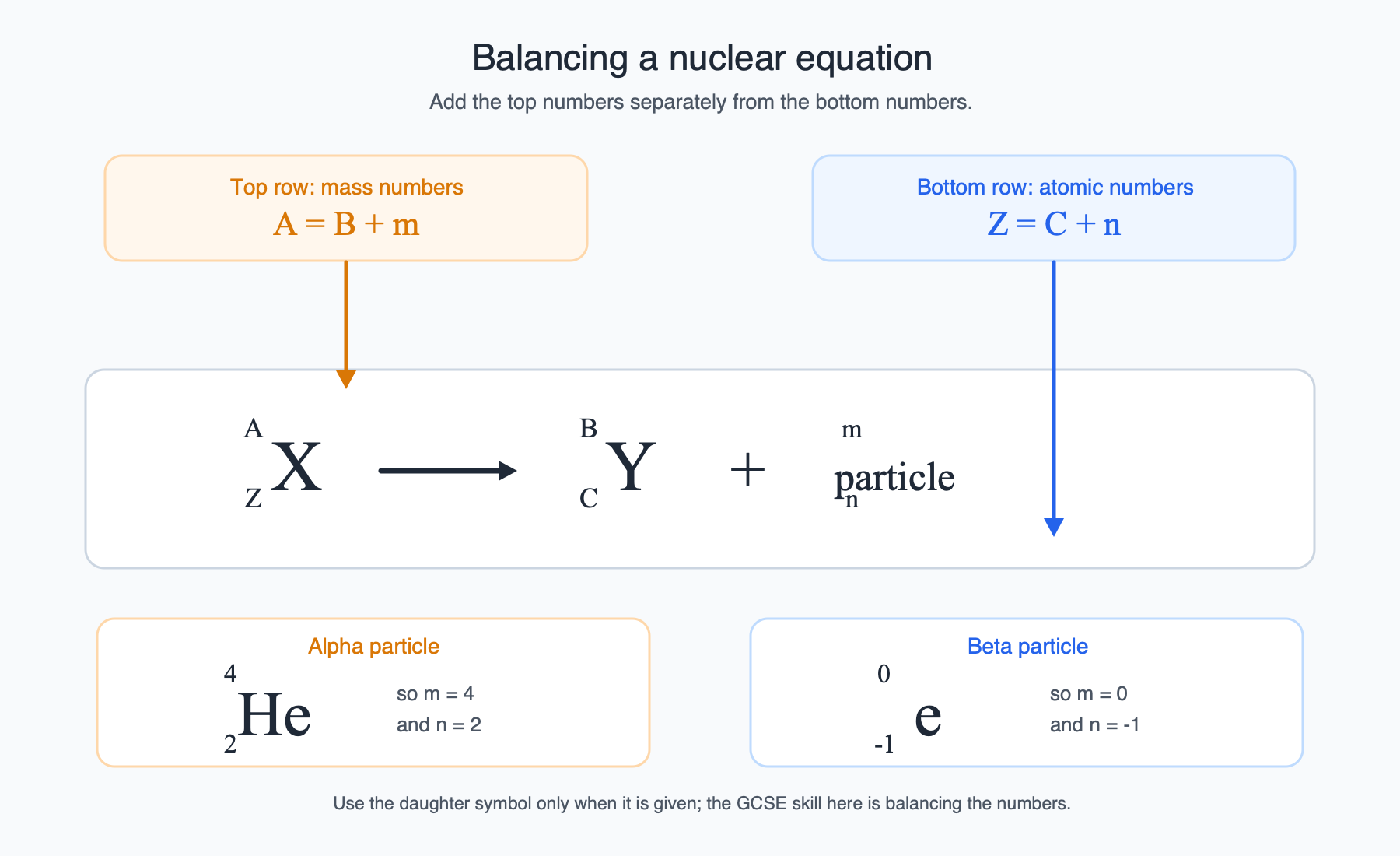
Here is the method:
- Add the mass numbers on the left-hand side.
- Add the mass numbers on the right-hand side.
- Make those totals equal.
- Repeat the same process for the atomic numbers.
You do not need to identify the daughter element from the periodic table in this specification point. If a question expects a daughter nucleus symbol such as Y, N or Po, it must give the name or symbol you need. Your job is to balance the numbers.
Worked example: determine the missing numbers in this beta-decay equation.
Balance the mass numbers:
15 = ? + 0
? = 15
Balance the atomic numbers:
7 = ? + (-1)
? = 8
So the balanced equation is:
Alpha decay
An alpha particle is the same as a helium nucleus: it contains two protons and two neutrons. In a nuclear equation, it is represented as:
When a nucleus emits one alpha particle, it loses two protons and two neutrons. Therefore:
| Quantity | Change in alpha decay |
|---|---|
| mass number | decreases by 4 |
| atomic number | decreases by 2 |
| nuclear charge | decreases because there are two fewer protons |
The general pattern is:
The letters X and Y stand for the parent nucleus and the daughter nucleus. At GCSE, the balancing skill is to subtract 4 from the mass number and 2 from the atomic number when an alpha particle is emitted.
Worked example: a nucleus emits one alpha particle. Determine the mass number and atomic number of the daughter nucleus.
Continue this lesson.
You’re previewing NovaLearn without an account. Create a free account to read the rest.
Create free account