4.5.6.1.5b - Uniform Acceleration and Terminal Velocity
Some motion graphs tell you more than just "speeding up" or "slowing down". In this lesson, you will use velocity-time graphs to find distance, apply the uniform-acceleration equation, and explain why a falling object can eventually move at a constant terminal velocity. The Higher Tier parts are clearly labelled; terminal-velocity graph interpretation is physics-only.
Area under velocity-time graphs
In a velocity-time graph, the vertical axis is velocity in m/s and the horizontal axis is time in s. The area under the line gives the distance travelled, or displacement if direction is being treated carefully.
This is a Higher Tier skill.
For a graph above the time axis:
area under a velocity-time graph = distance travelled
The units explain why this works:
(m/s) x s = m
For a straight-line section, split the area into simple shapes. A rectangle represents motion at a constant velocity. A triangle represents the extra distance travelled while velocity increases or decreases uniformly.
[DIAGRAM: asset_name: Uniform acceleration area graph - diagram 1; asset_slug: 071_4_5_6_1_5b_uniform_acceleration_and_terminal_velocity_diagram1; file: diagram_assets/071_4_5_6_1_5b_uniform_acceleration_and_terminal_velocity_diagram1.png; recommended_method: deterministic_drawn; description: Exact assessed velocity-time graph for uniform acceleration from 4 m/s at 0 s to 20 m/s at 8 s. Shade the full area under the line and label it as distance travelled. Show the rectangle area 4 x 8 = 32 m, triangle area 1/2 x 8 x 16 = 64 m, and total distance 96 m. Use deterministic SVG-to-PNG drawing because axes, values, scale, line, shaded area and calculations are exact motion-graph information.]
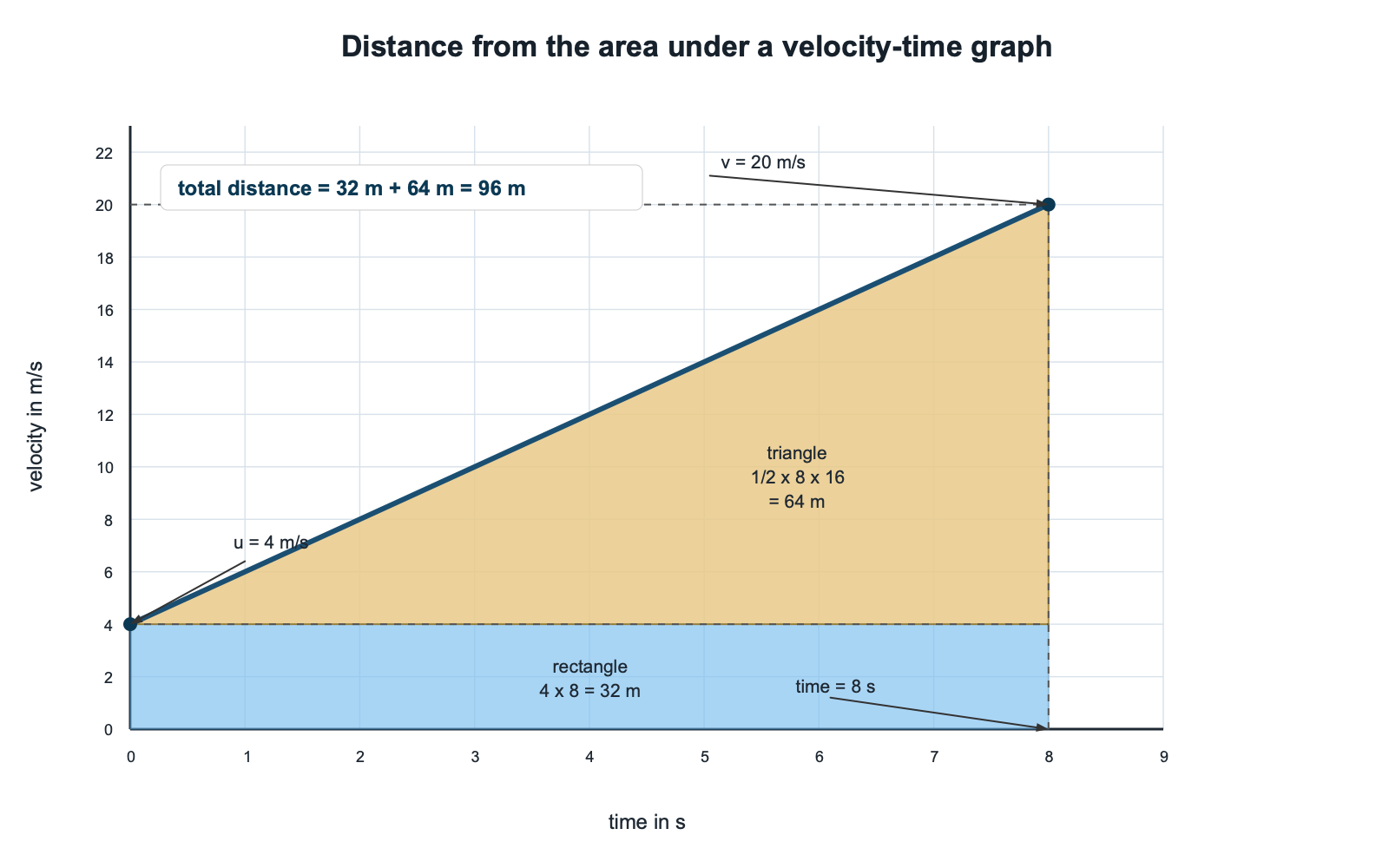
For the graph in the diagram:
rectangle area = 4 x 8 = 32 m
triangle area = 1/2 x 8 x (20 - 4) = 64 m
total distance = 32 + 64 = 96 m
You can also treat the shaded area as a trapezium:
distance = 1/2 x (initial velocity + final velocity) x time
distance = 1/2 x (4 + 20) x 8
distance = 96 m
If a graph has a curved line, exact formulae may not fit. When appropriate, Higher Tier questions can ask you to count squares under the graph to estimate the area.
Uniform acceleration equation
Uniform acceleration means constant acceleration. The velocity changes by equal amounts in equal time intervals.
Higher Tier students should apply this equation for uniform acceleration:
Uniform Acceleration
This equation is given on the Physics equation sheet, so students should apply it rather than recall it.
The symbols and units are:
| Symbol | Quantity | Unit |
|---|---|---|
v | final velocity | metres per second, m/s |
u | initial velocity | metres per second, m/s |
a | acceleration | metres per second squared, m/s^2 |
s | distance | metres, m |
Use this equation when acceleration is constant and the question connects initial velocity, final velocity, acceleration and distance. It is especially useful when time is not given.
Worked example: a cyclist accelerates uniformly from 3.0 m/s to 15.0 m/s over a distance of 24 m. Calculate the acceleration.
v^2 - u^2 = 2as
15.0^2 - 3.0^2 = 2 x a x 24
225 - 9 = 48a
216 = 48a
a = 216 / 48
a = 4.5 m/s^2
Check the answer against the situation: the velocity is increasing, so the acceleration is positive.
Free fall near Earth
An object is in free fall when it is falling under gravity only. In real air, drag often matters, so a falling object is only approximately in free fall if air resistance is negligible.
Near the Earth's surface, any freely falling object has an acceleration of about:
9.8 m/s^2 downwards
This value is about the same for different masses if the objects are freely falling. A heavy ball and a light ball have the same free-fall acceleration when air resistance is ignored.
At Higher Tier, this acceleration can be used in the uniform-acceleration equation. For example, if an object is dropped from rest and falls freely for 5.0 m:
v^2 - u^2 = 2as
v^2 - 0^2 = 2 x 9.8 x 5.0
v^2 = 98
v = 9.9 m/s
The final velocity is downward because the object is falling.
Falling through a fluid
A fluid is a liquid or a gas. Air is a fluid, so a skydiver, a paper cone or a model parachute falling through air experiences a resistive force from the air.
When an object first starts falling, its velocity is small. The downward force of gravity is larger than the upward drag force, so there is a downward resultant force and the object accelerates.
Continue this lesson.
You’re previewing NovaLearn without an account. Create a free account to read the rest.
Create free account