4.3.1.1b - Required Practical 5 - Measuring Density
Density is found from two measurements: mass and volume. In this required practical you determine the density of a regular solid, an irregular solid and a liquid, choosing apparatus that measures each quantity accurately. The key skill is matching the volume method to the sample: dimensions for regular shapes, displacement for irregular shapes, and direct volume reading for liquids.
What must be measured
Density is the mass per unit volume of a material or object. In this practical, you measure mass and volume, then calculate density.
Density
rho is density, m is mass and V is volume. The standard SI unit for density is kg/m^3, using mass in kg and volume in m^3. In school practical work you may first measure mass in grams and volume in cubic centimetres, giving density in g/cm^3; convert to SI units if required.
Useful conversions are:
1 cm^3 = 1 mL1 g = 0.001 kg1 cm^3 = 0.000001 m^31 g/cm^3 = 1000 kg/m^3
For every sample, the method has the same logic: measure the mass, determine the volume, calculate density = mass / volume, and record the answer with a sensible number of significant figures.
Regular solid method
A regular solid has a shape whose volume can be calculated from measured dimensions. For a cuboid, measure its length, width and height, then multiply them.
[DIAGRAM: asset_name: Required Practical 5 Measuring Density - diagram 1; asset_slug: 030_4_3_1_1b_required_practical_5_measuring_density_diagram1; file: diagram_assets/030_4_3_1_1b_required_practical_5_measuring_density_diagram1.png; recommended_method: image_gen; description: Exact assessed apparatus layout for measuring density of a regular cuboid. Shows a digital balance measuring mass, a cuboid with length, width and height arrows, and a ruler/Vernier callipers as appropriate dimension-measuring apparatus. It teaches that volume comes from measured dimensions and density is then calculated from mass divided by volume. Labels and measurement arrows must be visually checked after generation.]
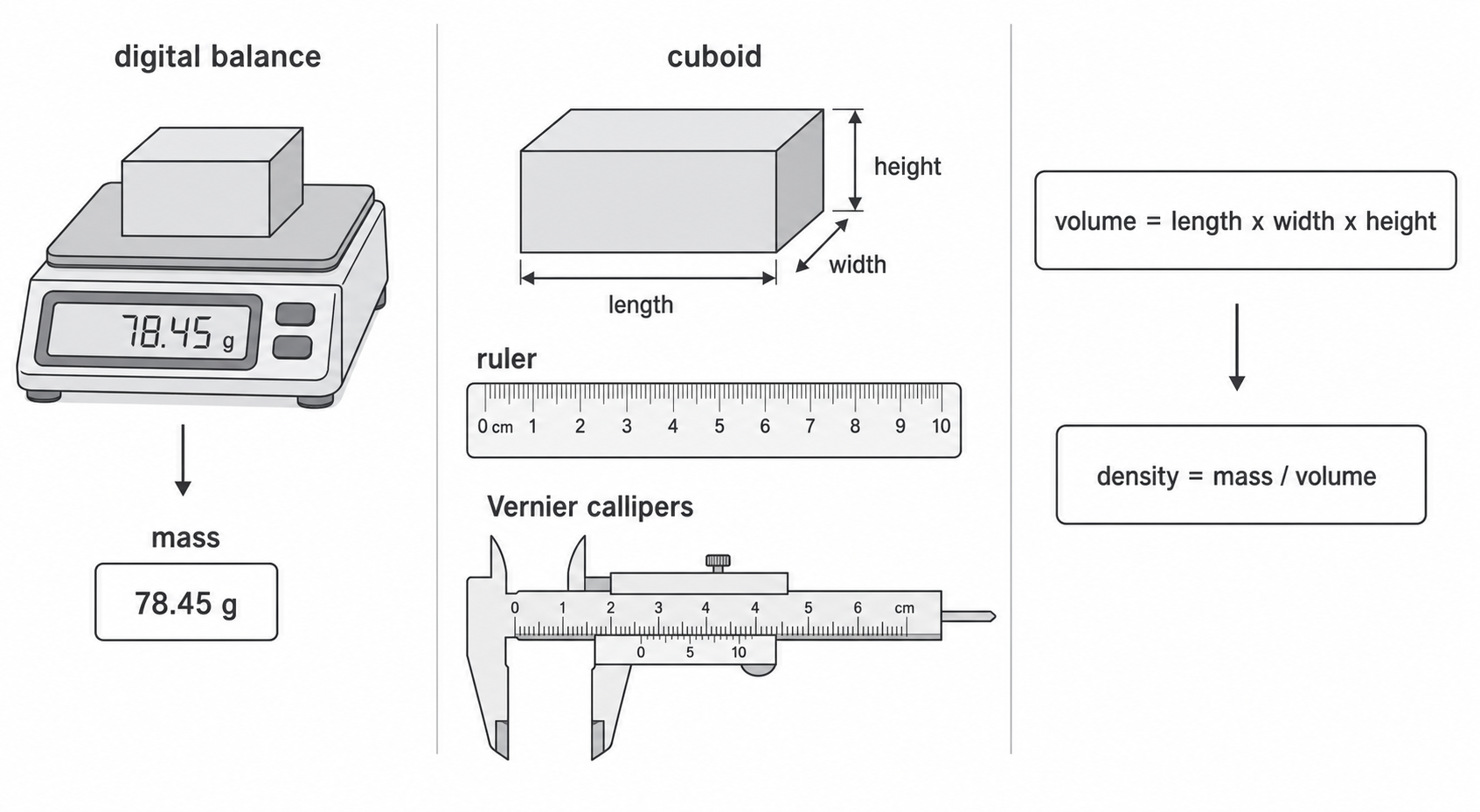
Method for a regular cuboid:
- Place the dry object on a balance and record its mass.
- Measure the length, width and height using a suitable instrument, such as a ruler or Vernier callipers.
- Repeat each dimension measurement at different positions if the object is not perfectly uniform.
- Calculate the volume using
V = length × width × height. - Calculate the density using
rho = m / V. - Repeat for other regular objects if the investigation compares materials.
Use the most appropriate measuring instrument. A ruler is suitable for larger objects where millimetre precision is enough. Vernier callipers or a micrometer can measure smaller dimensions more precisely, but the instrument must be used correctly and read to its resolution.
Worked example: a metal cuboid has mass 216 g, length 6.0 cm, width 3.0 cm and height 2.0 cm.
To convert to kg/m^3:
Irregular solid displacement
An irregular solid does not have dimensions that can be multiplied easily to find volume. Instead, use a displacement technique: the object pushes water out of the space it occupies, so the volume of displaced water is equal to the volume of the object.
[DIAGRAM: asset_name: Required Practical 5 Measuring Density - diagram 2; asset_slug: 030_4_3_1_1b_required_practical_5_measuring_density_diagram2; file: diagram_assets/030_4_3_1_1b_required_practical_5_measuring_density_diagram2.png; recommended_method: image_gen; description: Exact assessed apparatus layout for an irregular solid using a displacement can. Shows the can filled to the spout, an irregular object fully submerged, displaced water flowing into a labelled measuring cylinder, and a digital balance measuring the object's mass. It teaches that collected water volume equals object volume. Apparatus sequence and labels must be visually checked after generation.]
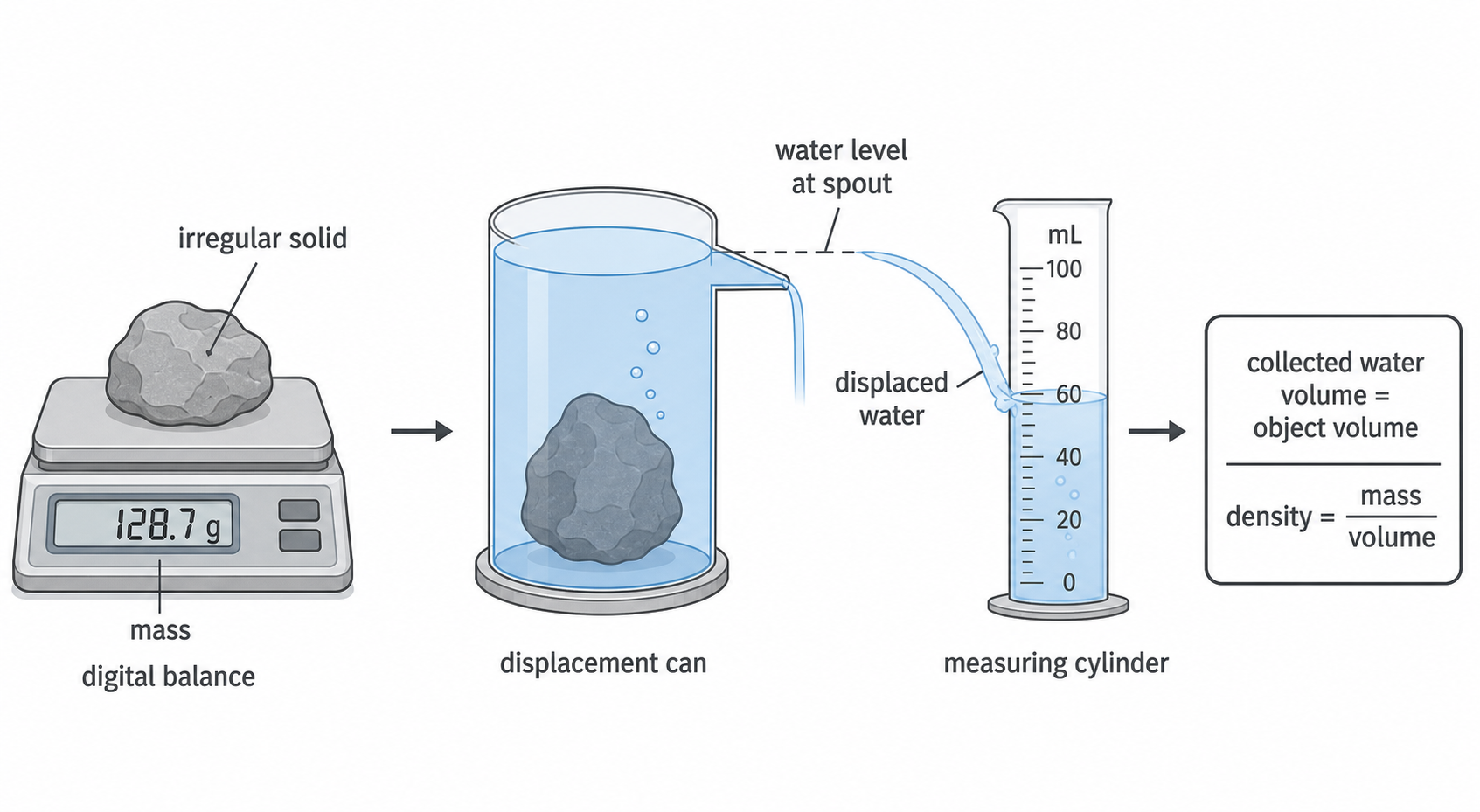
Method for an irregular solid:
- Measure and record the mass of the dry irregular object.
- Fill the displacement can with water until water leaves the spout.
- Wait until the water stops dripping, then place an empty measuring cylinder under the spout.
- Carefully lower the object into the water so it is completely submerged.
- Collect all the displaced water in the measuring cylinder.
- Read the volume of water at eye level. This is the volume of the object.
- Calculate the density using
rho = m / V. - Refill the displacement can to the spout before repeating with another object.
Choose a measuring cylinder with a suitable range and resolution. A very large measuring cylinder may give a less precise reading for a small displaced volume. If the object floats, it must be kept fully submerged, but the method must still allow only the object's volume to be counted.
Continue this lesson.
You’re previewing NovaLearn without an account. Create a free account to read the rest.
Create free account