4.5.7.3 - Changes in Momentum
In this Higher Tier, physics-only lesson, you will use the idea that a force can change momentum. You will apply the equation , link it to , and explain how safety features reduce forces by increasing the time taken for a change in momentum.
Force changes momentum
Momentum is mass multiplied by velocity:
Momentum
If a force acts on an object that is moving, or able to move, the object's velocity can change. If its mass stays the same, a change in velocity means a change in momentum.
For a constant mass:
In words:
change in momentum = mass x change in velocity
The change in velocity is:
where:
| Symbol | Meaning |
|---|---|
| initial velocity | |
| final velocity | |
| change in velocity |
A force can increase momentum, decrease momentum, or reverse the direction of momentum. In a straight-line question, the sign of the answer can show direction.
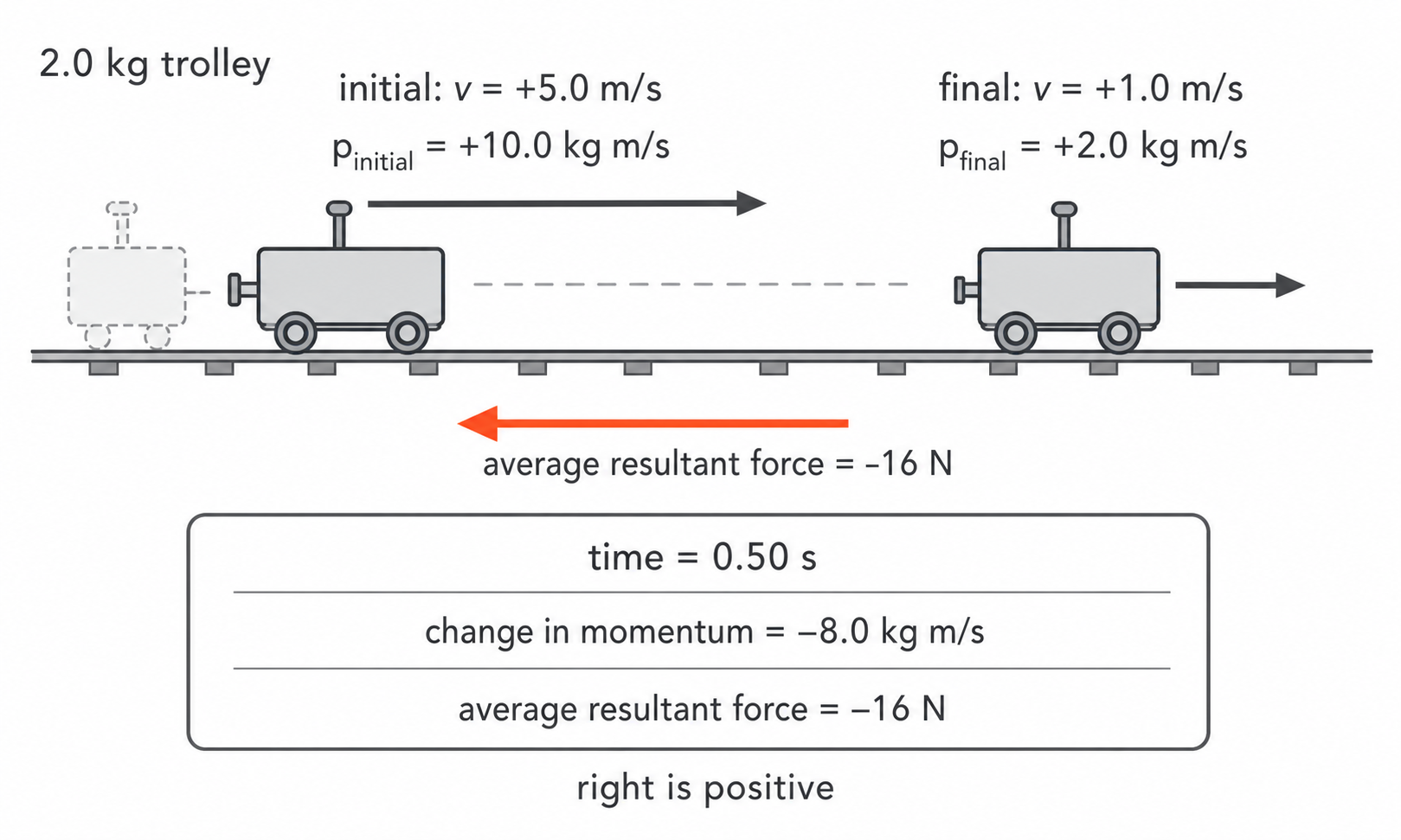
Worked example: A 2.0 kg trolley slows from +5.0 m/s to +1.0 m/s.
The momentum has changed by 8.0 kg m/s backwards, because the force reduced the trolley's forward momentum.
[DIAGRAM: asset_name: momentum_change_from_velocity_change - diagram 1; asset_slug: 082_4_5_7_3_changes_in_momentum_diagram1; file: diagram_assets/082_4_5_7_3_changes_in_momentum_diagram1.png; recommended_method: image_gen; description: Image-generated schematic showing a 2.0 kg trolley slowing from +5.0 m/s to +1.0 m/s over 0.50 s. It labels initial momentum +10.0 kg m/s, final momentum +2.0 kg m/s, change in momentum -8.0 kg m/s, and average resultant force -16 N.]
Rate of change equation
Newton's Second Law is:
For motion in a straight line, acceleration is the change in velocity divided by the time taken:
Substituting this into gives:
Force and change in momentum
In this equation:
| Quantity | Symbol | Unit |
|---|---|---|
| average resultant force | newtons, N | |
| mass | kilograms, kg | |
| change in velocity | metres per second, m/s | |
| time taken | seconds, s |
Since is the change in momentum:
So force equals the rate of change of momentum.
The equation is given on the Physics Equation sheet. The exam skill is selecting it, substituting values correctly, and explaining what changes when one variable changes.
For a fixed change in momentum, increasing the time taken decreases the average force.
Calculating force
Use the same calculation routine each time:
- Find the change in velocity, .
- Find the change in momentum, .
- Divide by the time taken.
- Include the unit
N.
Worked example: A 2.0 kg trolley slows from +5.0 m/s to +1.0 m/s in 0.50 s. Calculate the average resultant force.
Change in velocity:
Use the equation:
Substitute:
Answer:
The force is 16 N in the negative direction. If the positive direction was forwards, the force is backwards.
If a question asks for the size of the force, give the positive magnitude: 16 N.
Force, time and safety
Safety features are designed for situations where a moving person or object must be brought to rest. The change in momentum may be fixed by the person's mass and speed. The safety feature cannot make the momentum vanish without changing; it can make the change happen over a longer time.
From:
if is the same and is larger, is smaller.
[DIAGRAM: asset_name: same_momentum_change_different_times - diagram 2; asset_slug: 082_4_5_7_3_changes_in_momentum_diagram2; file: diagram_assets/082_4_5_7_3_changes_in_momentum_diagram2.png; recommended_method: image_gen; description: Image-generated force-time comparison for a 60 kg person slowing from 8.0 m/s to rest. Both rectangles have the same area, 480 kg m/s. A hard stop takes 0.10 s and has average force 4800 N. A cushioned stop takes 0.50 s and has average force 960 N. The visual shows that increasing time lowers average force for the same change in momentum.]
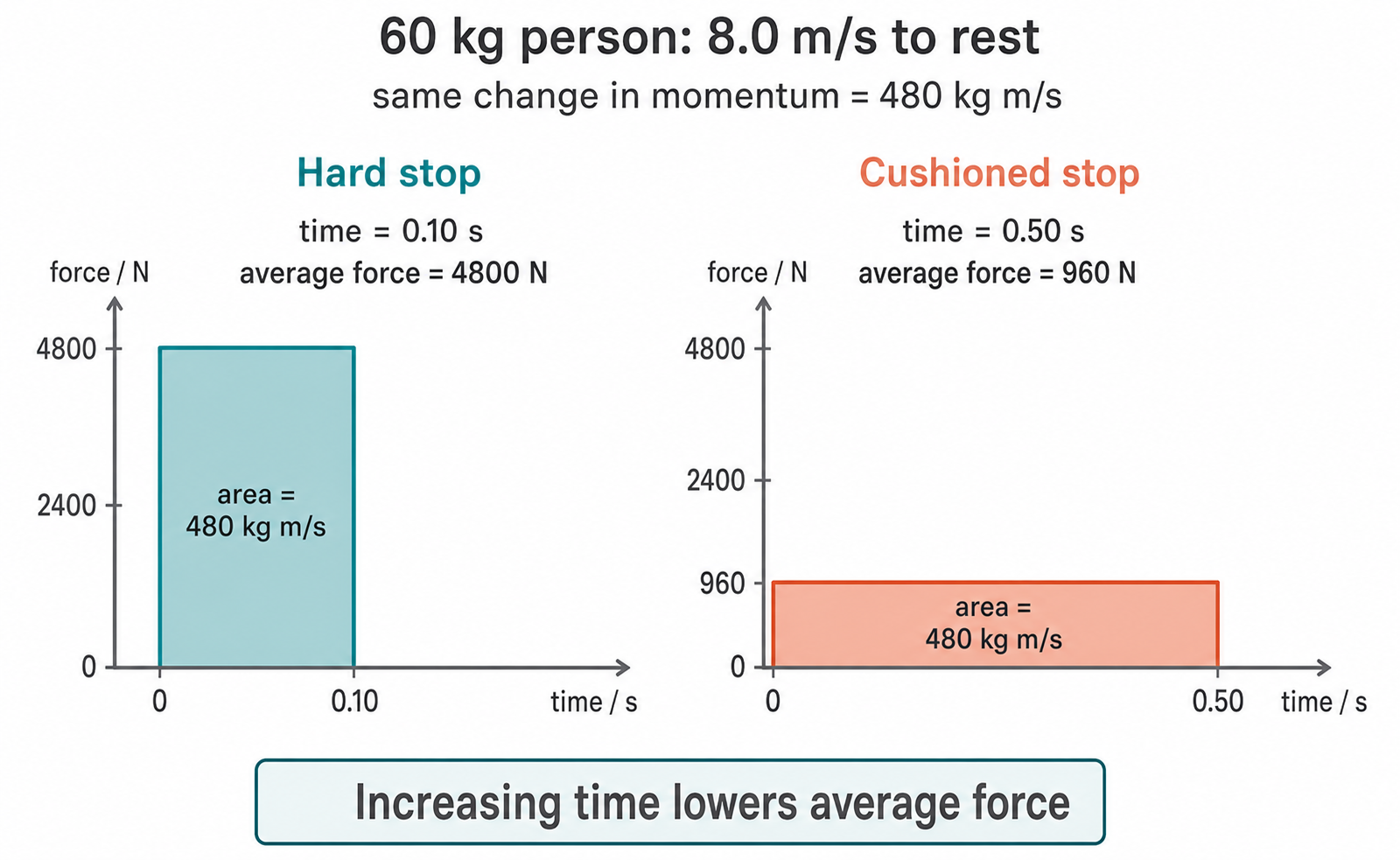
The shaded rectangles represent:
This is not a new equation to memorise for this lesson. It is just rearranged.
Worked example: A 60 kg person moving at 8.0 m/s is brought to rest.
Change in momentum:
The size of the change in momentum is 480 kg m/s.
If the stop takes 0.10 s:
If a safety feature increases the stopping time to 0.50 s:
Continue this lesson.
You’re previewing NovaLearn without an account. Create a free account to read the rest.
Create free account