4.3.2.2 - Temperature Changes and Specific Heat Capacity
When energy is transferred to a material and its temperature increases, the size of the temperature rise is not random. It depends on how much energy is transferred, how much material is heated, and what the material is. Specific heat capacity is the property that lets you calculate these temperature changes using the equation given on the Physics equation sheet.
What controls temperature rise
Heating transfers energy to a system. If the temperature of the system increases, the temperature rise depends on three things:
- the energy input to the system
- the mass of the substance heated
- the type of material
For the same mass and material, a larger energy input gives a larger temperature rise. For the same energy input and material, a larger mass gives a smaller temperature rise because the transferred energy is shared across more matter. For the same energy input and mass, different materials can have different temperature rises.
[DIAGRAM: asset_name: Temperature Rise Factors - diagram 1; asset_slug: 033_4_3_2_2_temperature_changes_and_specific_heat_capacity_diagram1; file: diagram_assets/033_4_3_2_2_temperature_changes_and_specific_heat_capacity_diagram1.png; recommended_method: image_gen; description: Qualitative comparison visual with three labelled panels: more energy input gives a larger temperature rise for the same mass and material; a larger mass gives a smaller temperature rise for the same energy input and material; and a high specific heat capacity material has a smaller temperature rise than a low specific heat capacity material for the same energy input and mass. This is not an assessed calculation diagram; nearby prose gives the exact assessed wording.]
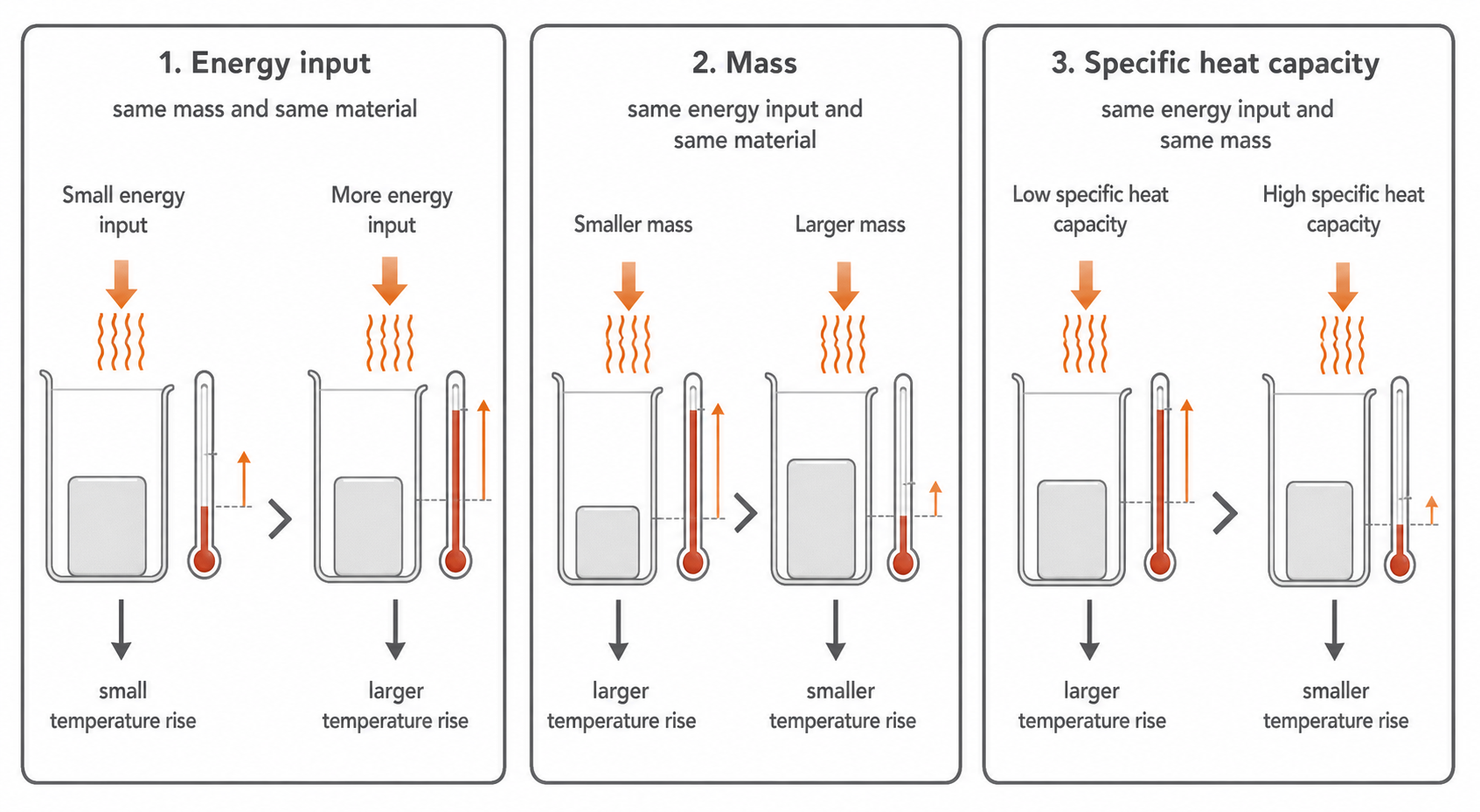
The important pattern is that temperature rise is larger when more energy is transferred, but smaller when the same energy is spread through more mass or through a material that needs more energy for each degree of warming.
What specific heat capacity means
Specific heat capacity describes how much energy a material needs for its temperature to rise. It is a property of the material, so different substances have different specific heat capacities.
Specific Heat Capacity
The specific heat capacity of a substance is the amount of energy required to raise the temperature of 1 kg of the substance by 1 °C.
The unit is joules per kilogram per degree Celsius, written as J/kg °C. For example, if a material has a specific heat capacity of 900 J/kg °C, then 900 J is needed to raise the temperature of 1 kg of that material by 1 °C.
A material with a high specific heat capacity needs a large energy transfer for each kilogram to warm by 1 °C. That means, for the same mass and same energy input, a high-specific-heat-capacity material has a smaller temperature rise than a low-specific-heat-capacity material.
This is the opposite of a common misconception: a higher specific heat capacity does not mean the material warms more quickly. It means the material needs more energy for the same temperature rise.
Continue this lesson.
You’re previewing NovaLearn without an account. Create a free account to read the rest.
Create free account