4.8.2a - Red-shift and an Expanding Universe
Red-shift is one of the key observations behind the modern model of an expanding universe. In this physics-only lesson, you will learn what red-shift means, why light from a receding galaxy has a longer wavelength, and how the pattern of red-shift with distance provides evidence that space itself is expanding.
Observing red-shift
Astronomers can split light from a galaxy into a spectrum. The spectrum contains lines at particular wavelengths because atoms absorb or emit light at known wavelengths. These lines can be compared with the same lines measured in a laboratory on Earth.
If the lines from a distant galaxy appear at longer wavelengths than the laboratory lines, the light has been red-shifted. The word red is used because red light is at the longer-wavelength end of the visible spectrum. Red-shift does not mean the whole galaxy looks red to the eye; it means the measured wavelengths have increased.
Red-shift
Red-shift is the observed increase in the wavelength of light from most distant galaxies.
[DIAGRAM: asset_name: red_shift_spectral_lines - diagram 1; asset_slug: 116_4_8_2a_red_shift_and_an_expanding_universe_diagram1; file: diagram_assets/116_4_8_2a_red_shift_and_an_expanding_universe_diagram1.png; recommended_method: image_gen; description: Exact assessed spectrum comparison showing a laboratory reference spectrum and two galaxy spectra. The same absorption lines are shifted to the right, towards longer wavelength/red, by a small amount for a nearer distant galaxy and by a larger amount for a more distant galaxy. Include a left-to-right arrow labelled longer wavelength / towards red. Image generation prompt should preserve the assessed shift direction, relative shift sizes and labels.]
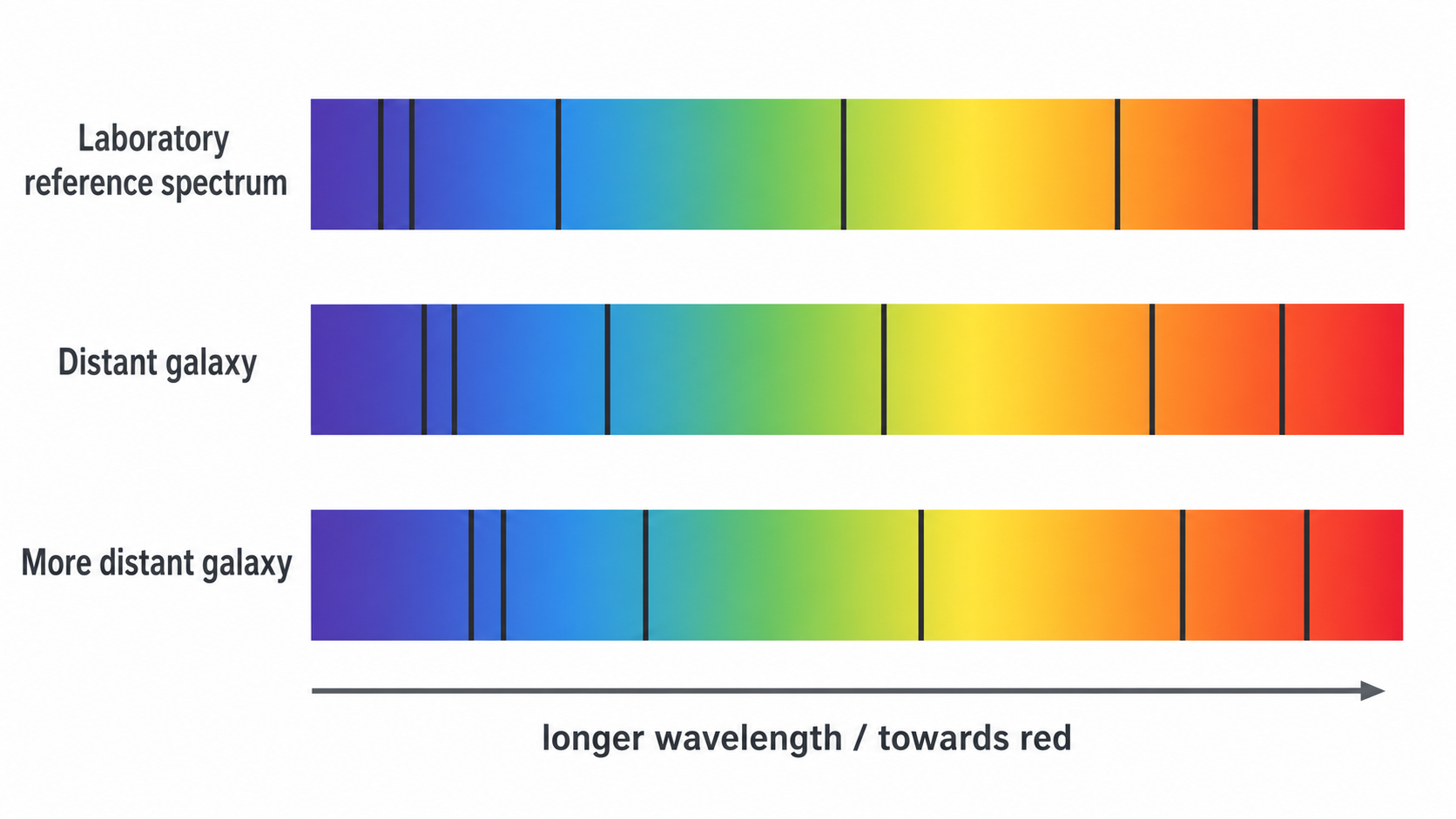
The important observation is not just that one galaxy is red-shifted. AQA states that there is an observed increase in the wavelength of light from most distant galaxies.
Why receding light shifts
A galaxy that is receding is moving away from us. For light from a receding distant galaxy, the wave crests arrive more spread out than when the light was emitted. More spread out wave crests mean a longer wavelength.
Receding
A receding galaxy is a galaxy that is moving away from the observer.
For distant galaxies, it is more accurate to think of space expanding while the light is travelling through it. As the space between the galaxy and us expands, the light is stretched. The received wavelength is therefore longer than the emitted wavelength, so the light is red-shifted.
At GCSE level, the explanation should be qualitative. You do not need a red-shift equation. You do need the chain:
galaxy receding -> light wavelength increases -> spectrum shifts towards red
Distance and speed
The size of the red-shift is not the same for every distant galaxy. The further away the galaxy is, the faster it is moving away, and the bigger the observed increase in wavelength.
[DIAGRAM: asset_name: distance_speed_red_shift_graph - diagram 2; asset_slug: 116_4_8_2a_red_shift_and_an_expanding_universe_diagram2; file: diagram_assets/116_4_8_2a_red_shift_and_an_expanding_universe_diagram2.png; recommended_method: deterministic_drawn; description: Exact qualitative graph with x-axis labelled distance to galaxy and y-axis labelled recession speed / size of red-shift. Show a rising straight trend with points labelled nearer galaxy, more distant galaxy and very distant galaxy. Add a note that further away means faster receding and a bigger wavelength increase. Deterministic drawing is required because the assessed relationship and axis directions must be exact.]
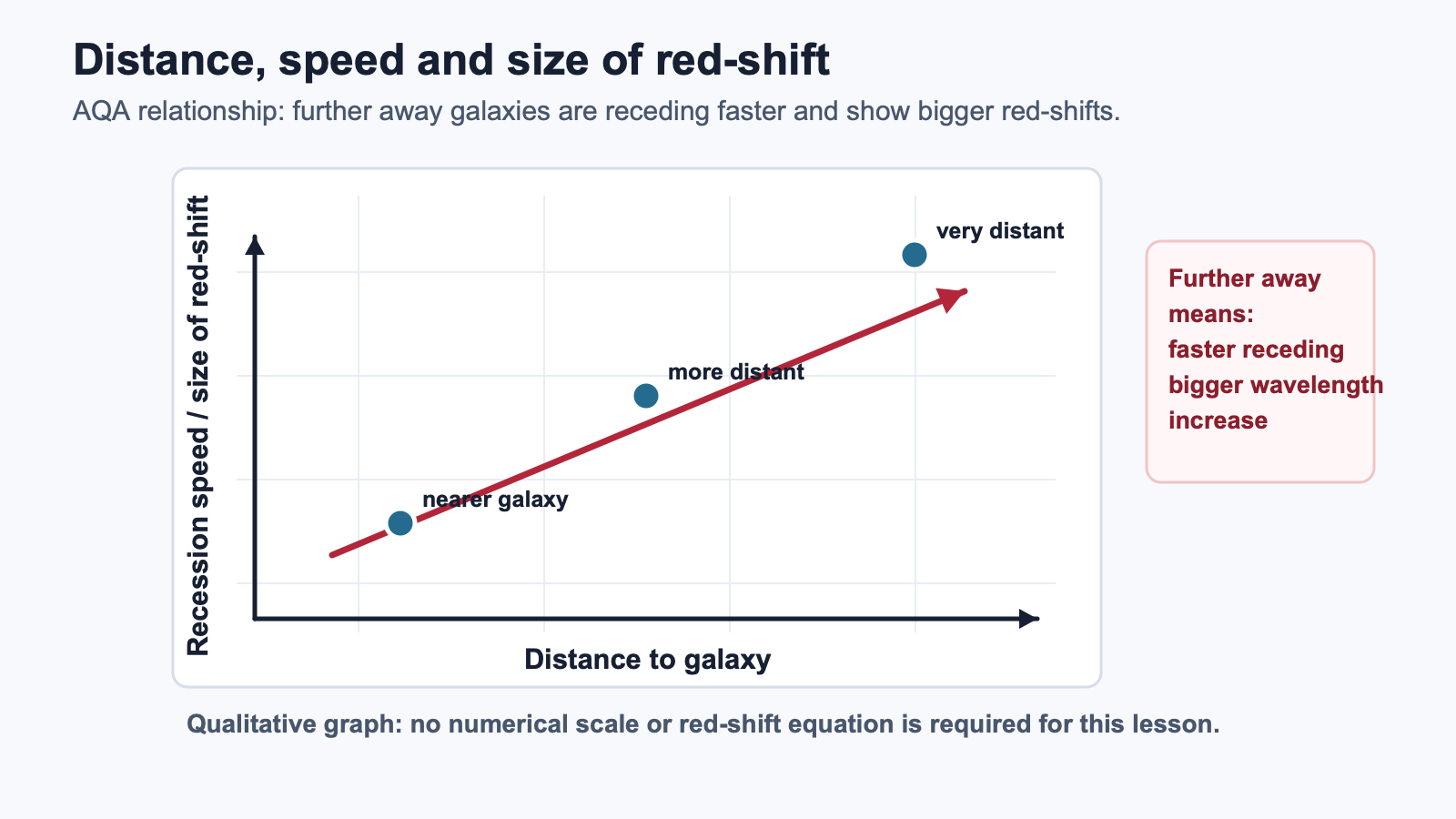
This is a pattern in observations, not a calculation topic in this lesson. A bigger red-shift means a bigger increase in observed wavelength. In the AQA statement, that bigger wavelength increase goes with a faster recessional speed.
So if two distant galaxies are compared:
- the galaxy with the bigger red-shift is moving away faster
- the galaxy moving away faster is further away
- the further galaxy has the bigger observed increase in wavelength
Continue this lesson.
You’re previewing NovaLearn without an account. Create a free account to read the rest.
Create free account