4.4.1.2 - Mass Number, Atomic Number and Isotopes
Atomic notation is a compact way to identify an atom or ion and count the particles in it. In this lesson, the key count is the number of protons, because that fixes which element the particle is. You will then use mass number and charge to work out neutrons and electrons, and to recognise isotopes.
Atomic number and neutral atoms
In a neutral atom, the number of electrons is equal to the number of protons in the nucleus. Protons have positive charge and electrons have negative charge, so equal numbers cancel out. That is why an atom has no overall electrical charge.
Atomic number
The atomic number of an atom is the number of protons in its nucleus.
All atoms of a particular element have the same number of protons. If an atom has 6 protons, it is carbon. If it has 11 protons, it is sodium. Changing the number of protons changes the element.
For a neutral atom:
| Particle count | Rule |
|---|---|
| protons | equal to the atomic number |
| electrons | equal to the number of protons |
| overall charge | zero |
Mass number and neutrons
The nucleus contains protons and neutrons. At GCSE, the mass number counts these two particles in the nucleus.
Mass number
The mass number of an atom is the total number of protons and neutrons in its nucleus.
If you know the mass number and atomic number, you can find the number of neutrons:
number of neutrons = mass number - atomic number
Worked example: a sodium atom has mass number 23 and atomic number 11.
number of neutrons = 23 - 11 = 12
So this sodium atom has 11 protons and 12 neutrons. In a neutral sodium atom, it also has 11 electrons.
Reading conventional notation
Atoms and ions can be represented by placing numbers around the chemical symbol. The mass number is written at the upper left of the symbol. The atomic number is written at the lower left. If the particle is an ion, its charge is written at the upper right.
[DIAGRAM: asset_name: Conventional atomic notation for atoms, isotopes and positive ions - diagram 1; asset_slug: 040_4_4_1_2_mass_number_atomic_number_and_isotopes_diagram1; file: diagram_assets/040_4_4_1_2_mass_number_atomic_number_and_isotopes_diagram1.png; recommended_method: image_gen; description: Exact assessed notation visual showing the AQA-style sodium example with mass number 23 at the upper left of Na and atomic number 11 at the lower left, plus an optional right-side positive ion charge and a carbon-12/carbon-14 isotope comparison. It teaches that upper-left mass number equals protons plus neutrons, lower-left atomic number equals protons, symbol gives identity, and charge shows electron imbalance if present. Nearby prose repeats all information for accessibility.]
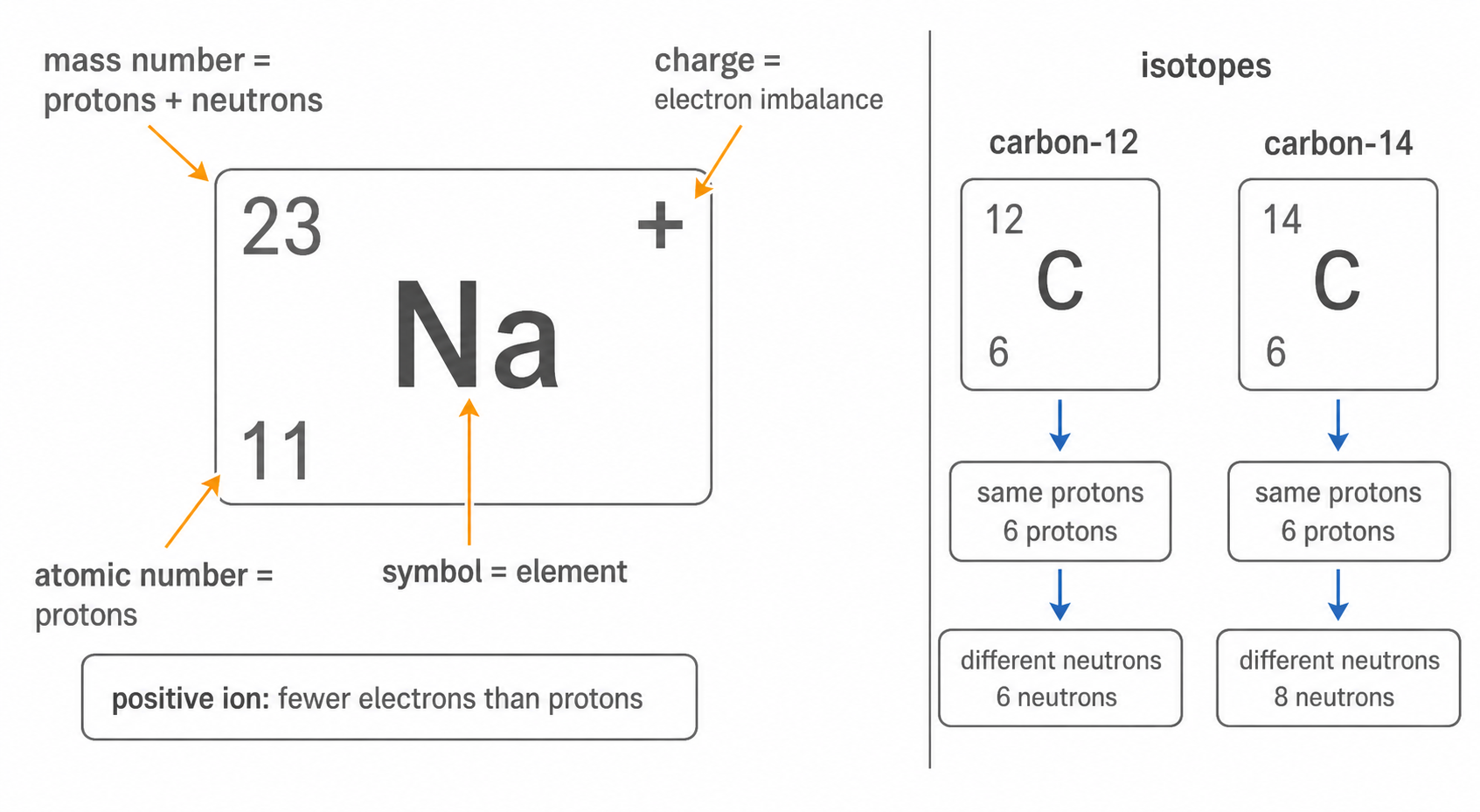
For example, means:
| Information | Meaning |
|---|---|
Na | the element is sodium |
lower-left 11 | atomic number, so 11 protons |
upper-left 23 | mass number, so 23 protons plus neutrons |
| no charge shown | neutral atom, so 11 electrons |
The number of neutrons is 23 - 11 = 12.
For a positive ion such as , the nucleus is still the same: 11 protons and 12 neutrons. The + charge means the particle has lost one electron, so it has 10 electrons.
Continue this lesson.
You’re previewing NovaLearn without an account. Create a free account to read the rest.
Create free account