4.5.6.1.5a - Acceleration and Velocity-Time Graphs
Acceleration describes how quickly velocity changes. In this lesson, the main skill is to connect the equation for acceleration to the gradient of a velocity-time graph. If the line on the graph is steep, the velocity is changing quickly; if the line is horizontal, the velocity is not changing.
Acceleration is change in velocity per second
Acceleration is the rate of change of velocity. It tells you how much an object's velocity changes every second.
Acceleration
Acceleration is the change in velocity per unit time.
The AQA GCSE Physics equation is:
Acceleration
For AQA GCSE Physics exams in 2026 and 2027, this equation is supplied on the Physics Equations Sheet. You still need to recognise when it applies and use it accurately.
The symbols and units are:
| Symbol | Quantity | Unit |
|---|---|---|
a | acceleration | metres per second squared, m/s^2 |
Δv | change in velocity | metres per second, m/s |
t | time taken | seconds, s |
The change in velocity is found from:
change in velocity = final velocity - initial velocity
For example, a cyclist increases velocity from 3 m/s to 11 m/s in 4 s.
change in velocity = 11 - 3 = 8 m/s
a = Δv / t
a = 8 / 4
a = 2 m/s^2
This means the cyclist's velocity increases by 2 m/s every second.
Deceleration and everyday estimates
An object that slows down is decelerating. In a straight-line situation where forward is treated as positive, a slowing object has a negative acceleration because its final velocity is smaller than its initial velocity.
For example, a car slows from 20 m/s to 8 m/s in 6 s.
change in velocity = 8 - 20 = -12 m/s
a = -12 / 6
a = -2 m/s^2
The negative sign shows the velocity is decreasing. If a question asks for the magnitude of the deceleration, give the positive size: 2 m/s^2.
Students should also be able to estimate everyday accelerations. Estimates do not need to be exact; they need to have a sensible order of magnitude.
| Situation | Rough calculation | Typical magnitude |
|---|---|---|
| Cyclist setting off | 0 to 6 m/s in 4 s | about 1.5 m/s^2 |
| Family car reaching motorway speed | 0 to 27 m/s in 10 s | about 3 m/s^2 |
| Object falling freely near Earth, before air resistance matters | speed changes by about 10 m/s each second | about 10 m/s^2 |
You can judge an estimate by asking: "How many metres per second does the velocity change each second?" A car acceleration of 300 m/s^2 would be unrealistic for normal driving because that would change the velocity by hundreds of metres per second every second.
Gradient of a velocity-time graph
A velocity-time graph shows velocity on the vertical axis and time on the horizontal axis. The acceleration is calculated from the gradient of the graph.
[DIAGRAM: asset_name: Velocity-time graph gradient calculation - diagram 1; asset_slug: 070_4_5_6_1_5a_acceleration_and_velocity_time_graphs_diagram1; file: diagram_assets/070_4_5_6_1_5a_acceleration_and_velocity_time_graphs_diagram1.png; recommended_method: deterministic_drawn; description: Exact assessed velocity-time graph with time in seconds on the x-axis and velocity in m/s on the y-axis. The plotted straight line runs from (0 s, 4 m/s) to (12 s, 28 m/s), with a gradient triangle showing time taken = 12 s and change in velocity = 24 m/s. A calculation box shows a = Δv / t = 24 / 12 = 2.0 m/s^2. Deterministic SVG-to-PNG rendering is used because axes, plotted coordinates, gradient triangle and labels carry assessed graph meaning.]
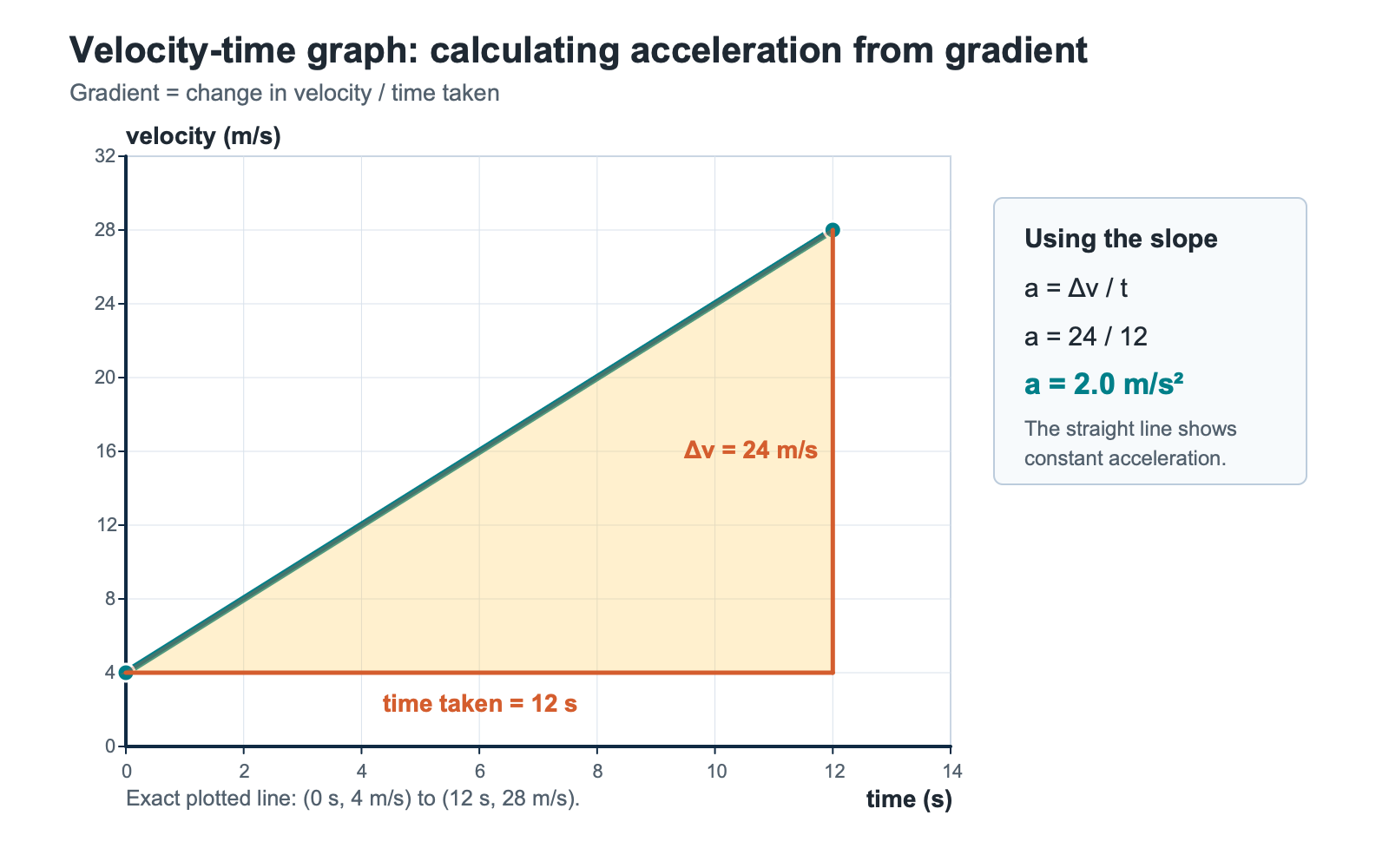
The graph in the diagram has:
change in velocity = 28 - 4 = 24 m/s
time taken = 12 s
acceleration = 24 / 12 = 2.0 m/s^2
The line is straight, so the acceleration is constant. A straight velocity-time line means the velocity changes by the same amount every second.
Work carefully with the two axes:
- Pick two clear points on the straight line.
- Find the change in velocity from the vertical axis.
- Find the time taken from the horizontal axis.
- Divide
change in velocitybytime taken.
Continue this lesson.
You’re previewing NovaLearn without an account. Create a free account to read the rest.
Create free account