4.6.2.2b - Required Practical 10 - Infrared Radiation and Surfaces
This required practical investigates how the amount of infrared radiation absorbed or radiated by a surface depends on the nature of that surface. The key skill is making a fair comparison: change only the surface, then measure radiation or temperature in a controlled way. The most common school method uses a Leslie cube to compare infrared radiation emitted by different surfaces at the same temperature.
Aim and surface language
Infrared radiation is part of the electromagnetic spectrum. It can transfer energy from a hotter object to a cooler object without needing particles between them, so it can travel through air and through a vacuum.
In this practical, the surface can affect two linked processes:
- emission: giving out infrared radiation
- absorption: taking in infrared radiation and increasing the object's thermal energy store
Surface nature
The nature of a surface means properties such as whether it is dull or shiny, dark or light, rough or smooth, painted or metallic.
A dull dark surface usually emits more infrared radiation than a shiny metallic surface at the same temperature. A dull dark surface is also usually a better absorber of infrared radiation. A shiny metallic surface is usually a poor absorber because it reflects more infrared radiation away.
This lesson uses those ideas only as practical conclusions. The full black-body-radiation model is taught separately.
Leslie cube emission method
A Leslie cube is a hollow metal cube with different surfaces on its sides. For example, it may have a matt black side, shiny black side, white side and shiny metal side. When the cube is filled with very hot water, the different sides are at approximately the same temperature but emit different amounts of infrared radiation.
[DIAGRAM: asset_name: Required Practical 10 Infrared Radiation and Surfaces - diagram 1; asset_slug: 093_4_6_2_2b_required_practical_10_infrared_radiation_and_surfaces_diagram1; file: diagram_assets/093_4_6_2_2b_required_practical_10_infrared_radiation_and_surfaces_diagram1.png; recommended_method: image_gen; description: Exact assessed apparatus layout for the Leslie cube emission method. Shows a Leslie cube on a heatproof mat, lid, very hot water being added safely, labelled matt black, matt white, shiny black and shiny silver faces, an infrared detector connected to a meter at a fixed distance from one face, a ruler showing the detector distance, and safety labels for hot water and heatproof mat. Image generation must preserve the apparatus placement, detector distance, surface labels and safety features because they carry assessed meaning.]
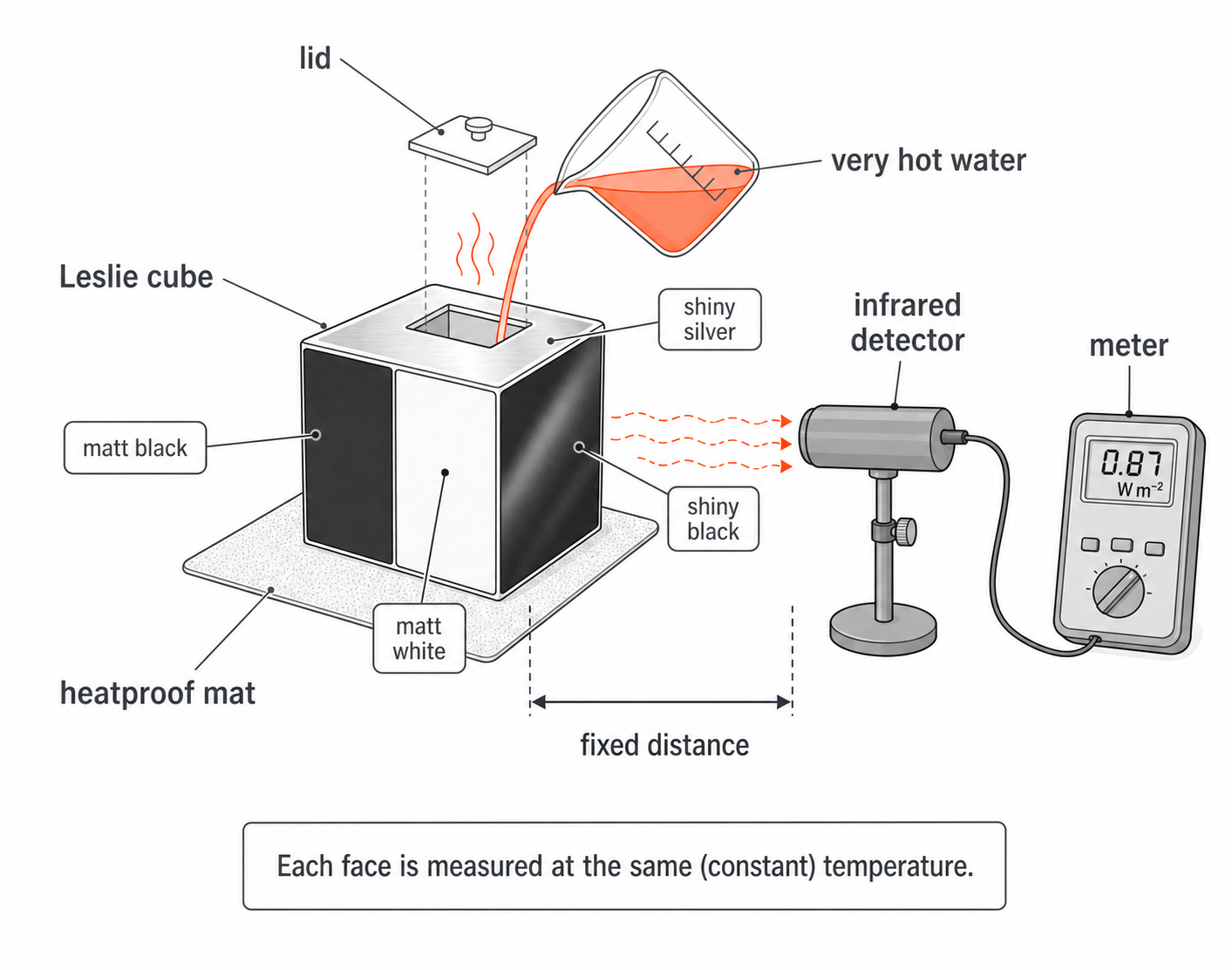
A suitable method is:
- Place the Leslie cube on a heatproof mat.
- Fill the cube with very hot water and replace the lid.
- Put the infrared detector a fixed distance from one surface, such as
5 cm. - Wait for the detector reading to become steady, then record the reading.
- Repeat for each surface of the cube.
- Keep the detector distance and angle the same for every surface.
- Repeat readings if time allows, then calculate a mean detector reading for each surface.
The detector reading is a measure of the infrared radiation reaching the detector. A higher reading means that surface is radiating more infrared to the detector in the same conditions.
Variables and fair test
For the Leslie cube emission method:
| Variable type | Variable in this method |
|---|---|
| Independent variable | Nature of the surface |
| Dependent variable | Infrared detector reading |
| Control variables | Detector distance, detector angle, same detector, same cube, same water temperature as far as possible, same room conditions |
The most important control variable is detector distance. Infrared radiation spreads out from the surface, so moving the detector closer or farther away can change the reading even if the surface has not changed. The detector should face the centre of each side and stay the same distance away each time.
The water temperature should also be as consistent as possible. The cube gradually cools, so readings should be taken in a planned order and repeated if possible. If the cube cools a lot during the practical, refill it safely or note that later readings may be lower because of cooling rather than because of surface type.
Repeat readings help identify anomalies. For example, if the matt black surface gives readings of 73, 74 and 52 detector units, the 52 reading should be checked because it may be due to the detector being misaligned or moved too far away.
Absorption and cooling variants
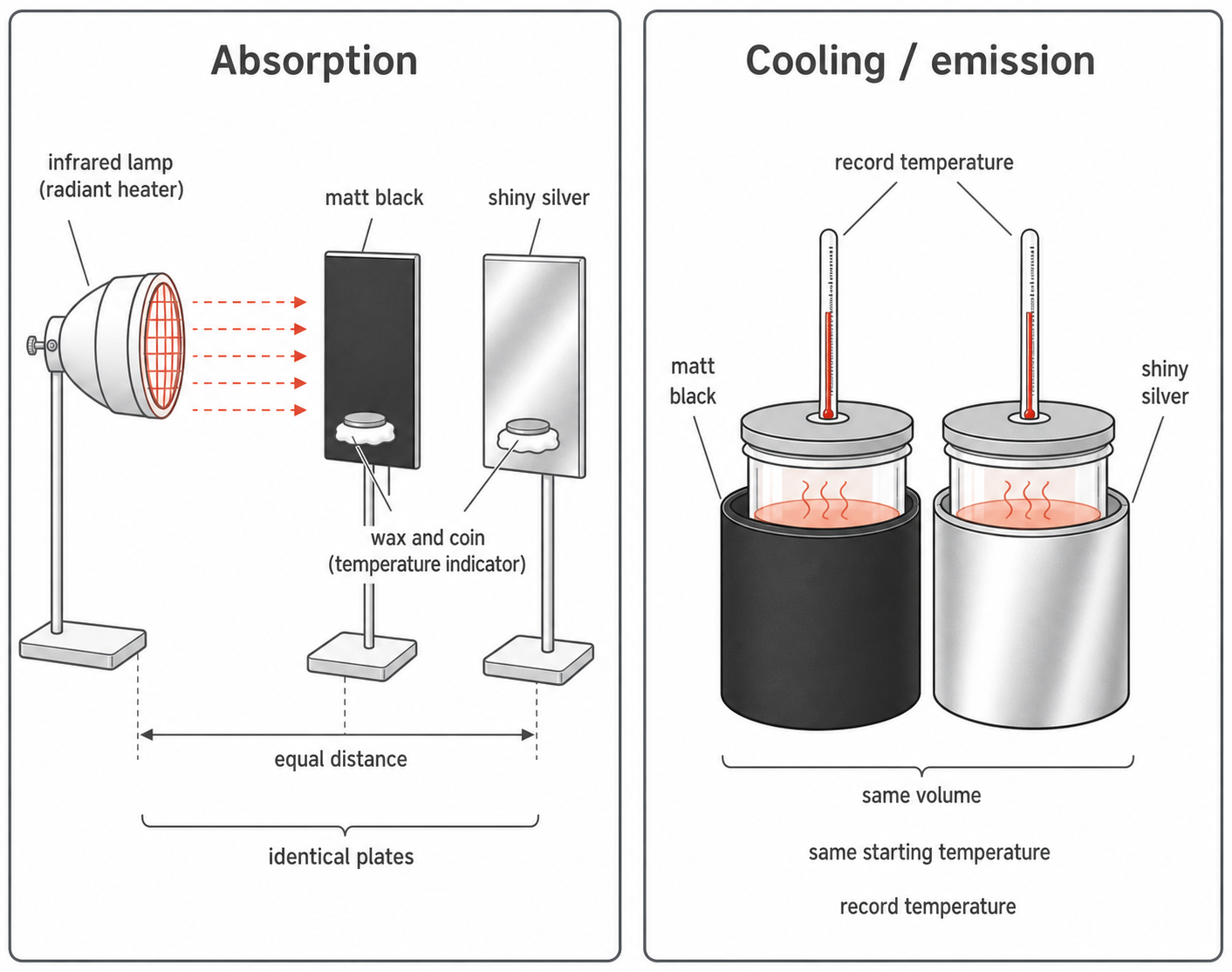
The official aim includes both absorption and radiation. The Leslie cube is the usual emission method, but other valid variants can test absorption or cooling if the variables are controlled carefully.
[DIAGRAM: asset_name: Required Practical 10 Infrared Radiation and Surfaces - diagram 2; asset_slug: 093_4_6_2_2b_required_practical_10_infrared_radiation_and_surfaces_diagram2; file: diagram_assets/093_4_6_2_2b_required_practical_10_infrared_radiation_and_surfaces_diagram2.png; recommended_method: image_gen; description: Exact assessed comparison of two alternative apparatus setups. Left panel shows absorption: an infrared lamp or radiant heater at equal distance from two identical metal plates, one matt black and one shiny silver, with temperature probes or wax-and-coin indicators. Right panel shows cooling/emission: identical hot-water cans or beakers wrapped with matt black and shiny silver surfaces, lids, thermometers, equal water volume and starting temperature. Image generation must preserve the apparatus equality, distances, temperatures and surface labels because they are assessed.]
Continue this lesson.
You’re previewing NovaLearn without an account. Create a free account to read the rest.
Create free account