4.3.3.1 - Particle Motion in Gases
Gas pressure can seem mysterious because the molecules are too small to see. The particle model gives a simple explanation: gas molecules move randomly, collide with surfaces, and those collisions create pressure. In this lesson, the key link is temperature, average kinetic energy, molecular motion, and pressure at constant volume.
Random Motion
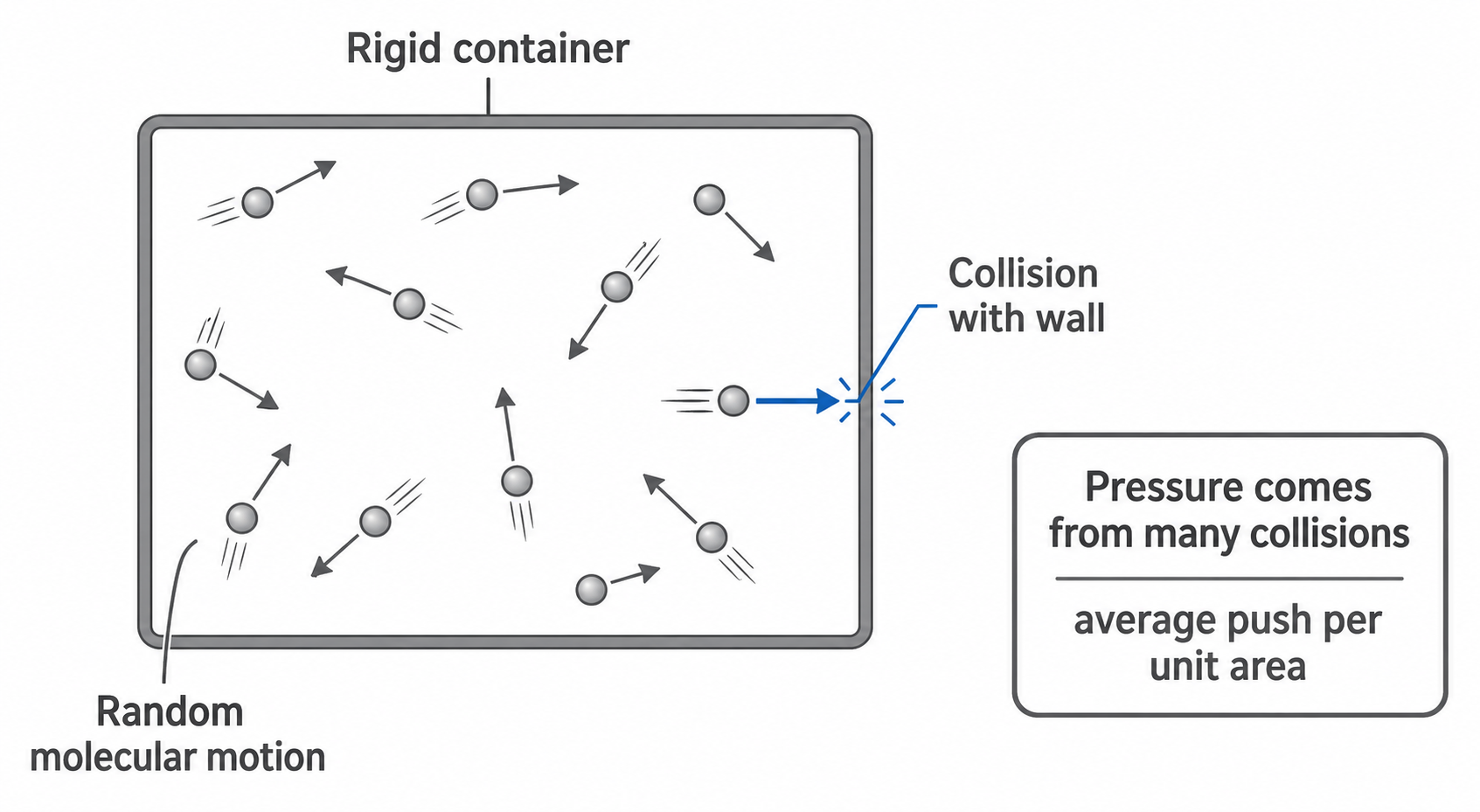
The molecules of a gas are in constant random motion. "Constant" means they keep moving; "random" means their directions are mixed up rather than all lined up in one direction.
Between collisions, a gas molecule travels through the empty space in the gas. When it collides with another molecule or with the wall of its container, its direction changes. At any instant, different molecules have different speeds and directions, so a gas is best described by the overall pattern of many molecules, not by tracking one molecule.
[DIAGRAM: asset_name: Gas pressure from random molecular motion - diagram 1; asset_slug: 036_4_3_3_1_particle_motion_in_gases_diagram1; file: diagram_assets/036_4_3_3_1_particle_motion_in_gases_diagram1.png; recommended_method: image_gen; description: Labelled conceptual schematic of gas molecules in random motion inside a rigid container, with one molecule colliding with a wall and a label that pressure is the average push per unit area from many collisions. The visual teaches the collision-pressure link; nearby prose gives the exact assessed wording.]
Temperature and Kinetic Energy
Kinetic energy is energy due to motion. For a gas, temperature is related to the average kinetic energy of its molecules.
Average kinetic energy of gas molecules
The average kinetic energy is the typical kinetic energy per molecule across a large number of gas molecules.
The word "average" matters. In a real gas, not every molecule has exactly the same kinetic energy. Some molecules are moving faster and some are moving slower, but the temperature tells us about the average for the whole gas.
When the temperature of a gas increases, the average kinetic energy of its molecules increases. Since the molecules have the same masses as before, a higher average kinetic energy means the molecules are moving faster on average. When the temperature decreases, the average kinetic energy decreases and the molecules move more slowly on average.
Pressure from Collisions
Gas pressure is caused by molecules colliding with surfaces. When a molecule hits a wall, the wall pushes the molecule so that its direction changes. The molecule also pushes on the wall during the collision.
One collision is tiny, but a gas contains a huge number of molecules. Many collisions every second create an average force on the wall. Pressure is the average push per unit area on the container walls.
This is why molecular motion is linked to pressure:
- Faster molecules reach the walls more often.
- Faster molecules hit the walls harder.
- More frequent and harder collisions mean a greater average push on the walls.
- A greater average push per unit area means a higher pressure.
Continue this lesson.
You’re previewing NovaLearn without an account. Create a free account to read the rest.
Create free account