4.5.5.1.1 - Pressure at a Surface
Pressure tells you how concentrated a force is over an area. In this Physics-only lesson, the force comes from a fluid, which means a liquid or a gas. You will learn how fluid pressure produces a force normal to a surface, then use p = F / A with the correct SI units.
Fluids and pressure
A fluid is any substance that can flow. For GCSE Physics, fluids include liquids and gases.
Fluid
A substance that can flow; either a liquid or a gas.
Fluid pressure is caused by the fluid pushing on surfaces. A liquid in a container pushes on the base and the walls. A gas in a sealed container pushes on every inside surface of the container.
The key exam idea is not just that the fluid pushes, but the direction of the force. Pressure in a fluid causes a force normal to any surface.
In physics, normal means at right angles to the surface. It does not mean "usual" or "ordinary".
[DIAGRAM: asset_name: Fluid pressure force normal to surfaces - diagram 1; asset_slug: 063_4_5_5_1_1_pressure_at_a_surface_diagram1; file: diagram_assets/063_4_5_5_1_1_pressure_at_a_surface_diagram1.png; recommended_method: image_gen; description: Exact assessed schematic showing a fluid next to three surfaces: a horizontal base, a vertical wall and a sloping surface. Show pressure-force arrows perpendicular to each surface, with a right-angle marker and labels "force normal to surface" and "normal = at right angles". Include a small note that a fluid can be a liquid or a gas. Deterministic drawing is required because force direction, right-angle meaning and labels are assessed.]
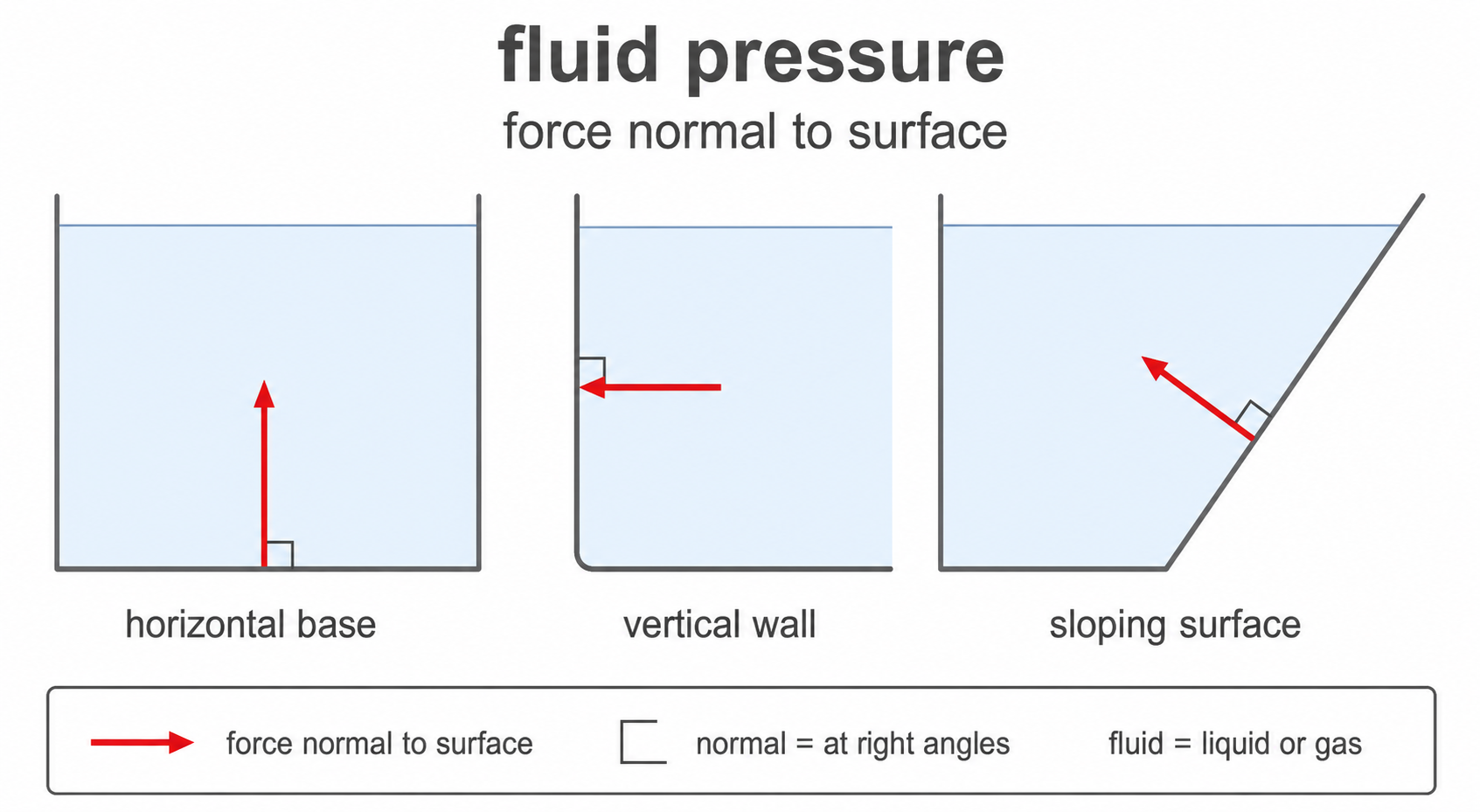
If the surface is horizontal, the normal force is vertical. If the surface is vertical, the normal force is horizontal. If the surface is tilted, the normal force is tilted too, because it still acts at right angles to that surface.
Equation and units
The pressure at the surface of a fluid is calculated using:
Pressure at a surface
In words:
pressure = force normal to a surface / area of that surface
The force must be the force acting at right angles to the surface. The area is the area over which that force is spread.
| Quantity | Symbol | Unit |
|---|---|---|
| pressure | p | pascal, Pa |
| force normal to the surface | F | newton, N |
| area of the surface | A | metre squared, m^2 |
A pascal is the same as one newton per metre squared:
1 Pa = 1 N/m^2
The AQA specification says students should recall and apply this equation. For 2026 and 2027 AQA GCSE Physics exams, the Physics Equations Sheet is provided, so you still need to recognise when to use the equation and apply it accurately.
Calculating pressure
For calculation questions, write the equation first, substitute the values, then give the answer with the unit.
Worked example: water in a container exerts a normal force of 36 N on a flat surface area of 0.018 m^2. Calculate the pressure at the surface.
The answer is in pascals because the force was in newtons and the area was in metres squared.
Continue this lesson.
You’re previewing NovaLearn without an account. Create a free account to read the rest.
Create free account