4.7.2.1a - Magnetic fields from currents and solenoids
An electric current can create a magnetic field. In this lesson you will learn the field pattern around a straight current-carrying wire, how current and distance affect field strength, why a solenoid makes a stronger magnetic effect, and how an iron core turns a solenoid into an electromagnet.
Current produces a magnetic field
When a current flows through a conducting wire, a magnetic field is produced around the wire. If the current is switched off, this magnetic field disappears.
Magnetic effect of a current
The magnetic effect of a current is the production of a magnetic field around a conductor when current flows through it.
One way to demonstrate this is to place a small compass near a straight wire connected to a power supply. When the current is switched on, the compass needle changes direction because it lines up with the magnetic field produced by the wire. If the current is reversed, the compass deflects the other way. If the current is switched off, the compass no longer shows the wire's magnetic field.
A solenoid can be investigated in a similar way. Place plotting compasses around and inside the coil, switch on the current for a short time, and record the directions in which the compass needles point. In a classroom demonstration, high-current coils may warm up, so the current should only be on for short intervals.
Field pattern around a straight wire
The magnetic field around a straight current-carrying wire forms concentric circles centred on the wire. The circles are not separate shells of field; they are a way to represent the field direction at different positions around the wire.
[DIAGRAM: asset_name: straight_wire_circular_field_pattern - diagram 1; asset_slug: 103_4_7_2_1a_magnetic_fields_from_currents_and_solenoids_diagram1; file: diagram_assets/103_4_7_2_1a_magnetic_fields_from_currents_and_solenoids_diagram1.png; recommended_method: image_gen; description: Exact image-generated diagram of the magnetic field around a straight current-carrying wire, shown from above. The left panel shows current out of the page using a dot symbol and anticlockwise circular field arrows. The right panel shows current into the page using a cross symbol and clockwise circular field arrows. Concentric field lines are closer near the wire to show a stronger field near the wire. This assessed field-pattern visual teaches the direction convention and field shape without adding motor-effect content.]
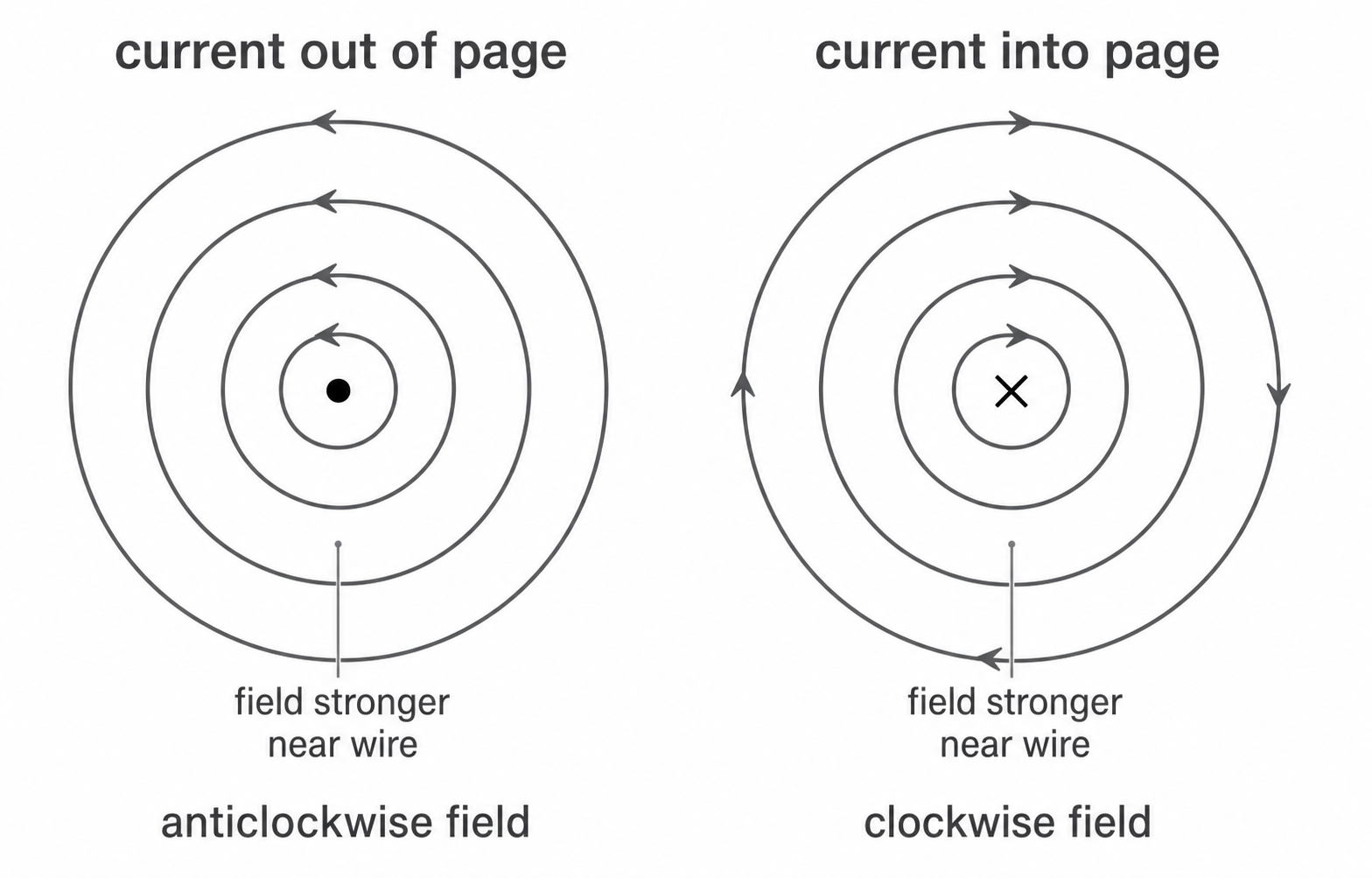
The direction of the field depends on the direction of the current. AQA questions usually use conventional current direction.
Use the right-hand thumb rule:
- Point your right thumb in the direction of the conventional current.
- Your curled fingers show the direction of the magnetic field around the wire.
In diagrams viewed from above, a dot means current coming out of the page towards you, and a cross means current going into the page away from you. With current out of the page, the field is anticlockwise. With current into the page, the field is clockwise.
Field strength, current and distance
The strength of the magnetic field around a current-carrying wire depends on two main factors in this lesson:
- increasing the current increases the strength of the magnetic field
- increasing the distance from the wire decreases the strength of the magnetic field
In a field-line diagram, a stronger region is shown by field lines that are closer together. This is why the circular lines near the wire are drawn closer together than the circular lines farther out.
Do not use a calculation formula for this GCSE subsection. The required idea is qualitative: more current gives a stronger field, and the field is weaker farther from the wire.
For a straight current-carrying wire, the magnetic field is strongest near the wire and becomes weaker farther away. Increasing the current makes the field stronger.
Continue this lesson.
You’re previewing NovaLearn without an account. Create a free account to read the rest.
Create free account