4.6.1.5b - Seismic Waves and Earth Structure
Seismic waves are waves produced by earthquakes. In this Higher tier Physics-only lesson, they are useful because they travel through parts of the Earth that cannot be seen or sampled directly. By comparing which seismic waves are detected, where they are detected, and how their speeds change, scientists can infer the structure and size of Earth's core.
Seismic Waves as Evidence
The inside of the Earth is hidden from direct observation. We cannot drill anywhere close to the core, so scientists need indirect evidence.
Seismic waves provide that evidence. An earthquake releases energy, and seismic waves spread out through the Earth. Seismometers at different places on the surface detect some of these waves. If the Earth had the same material all the way through, wave paths and arrival patterns would be much simpler. Instead, seismic waves are affected by different materials inside the Earth.
The key exploration idea is qualitative:
- waves can travel at different velocities in different materials
- waves can be absorbed or stopped by some materials
- waves can be reflected or change direction at boundaries between materials
For this lesson, the hidden structure is the Earth itself. The wave evidence helps reveal layers that cannot be observed directly.
Seismic Wave
A seismic wave is a wave produced by an earthquake that can travel through the Earth.
The AQA focus here is not an earthquake-location calculation. The focus is how the behaviour of P-waves and S-waves gives evidence about Earth's internal structure.
P-Waves and S-Waves
The two seismic wave types in this specification point are P-waves and S-waves.
P-waves are longitudinal seismic waves. In a longitudinal wave, the vibrations are parallel to the direction the wave travels. This means the material is compressed and stretched along the direction of travel.
S-waves are transverse seismic waves. In a transverse wave, the vibrations are perpendicular to the direction the wave travels.
| Feature | P-wave | S-wave |
|---|---|---|
| Wave type | longitudinal | transverse |
| Particle vibration | parallel to direction of travel | perpendicular to direction of travel |
| Travels through solids? | yes | yes |
| Travels through liquids? | yes, but at a different speed from solids | no |
| Typical arrival order | arrives before S-waves | arrives after P-waves |
[DIAGRAM: asset_name: P-waves and S-waves compared - diagram 1; asset_slug: 090_4_6_1_5b_seismic_waves_and_earth_structure_diagram1; file: diagram_assets/090_4_6_1_5b_seismic_waves_and_earth_structure_diagram1.png; recommended_method: image_gen; description: Assessed two-panel image-generated visual comparing P-waves and S-waves. Panel A shows a P-wave with direction of travel to the right, compression and rarefaction regions along the same line, and particle-motion arrows parallel to travel. Panel B shows an S-wave with direction of travel to the right and particle-motion arrows perpendicular to travel. Labels must state P-wave = longitudinal and S-wave = transverse; nearby prose gives the same information in text.]
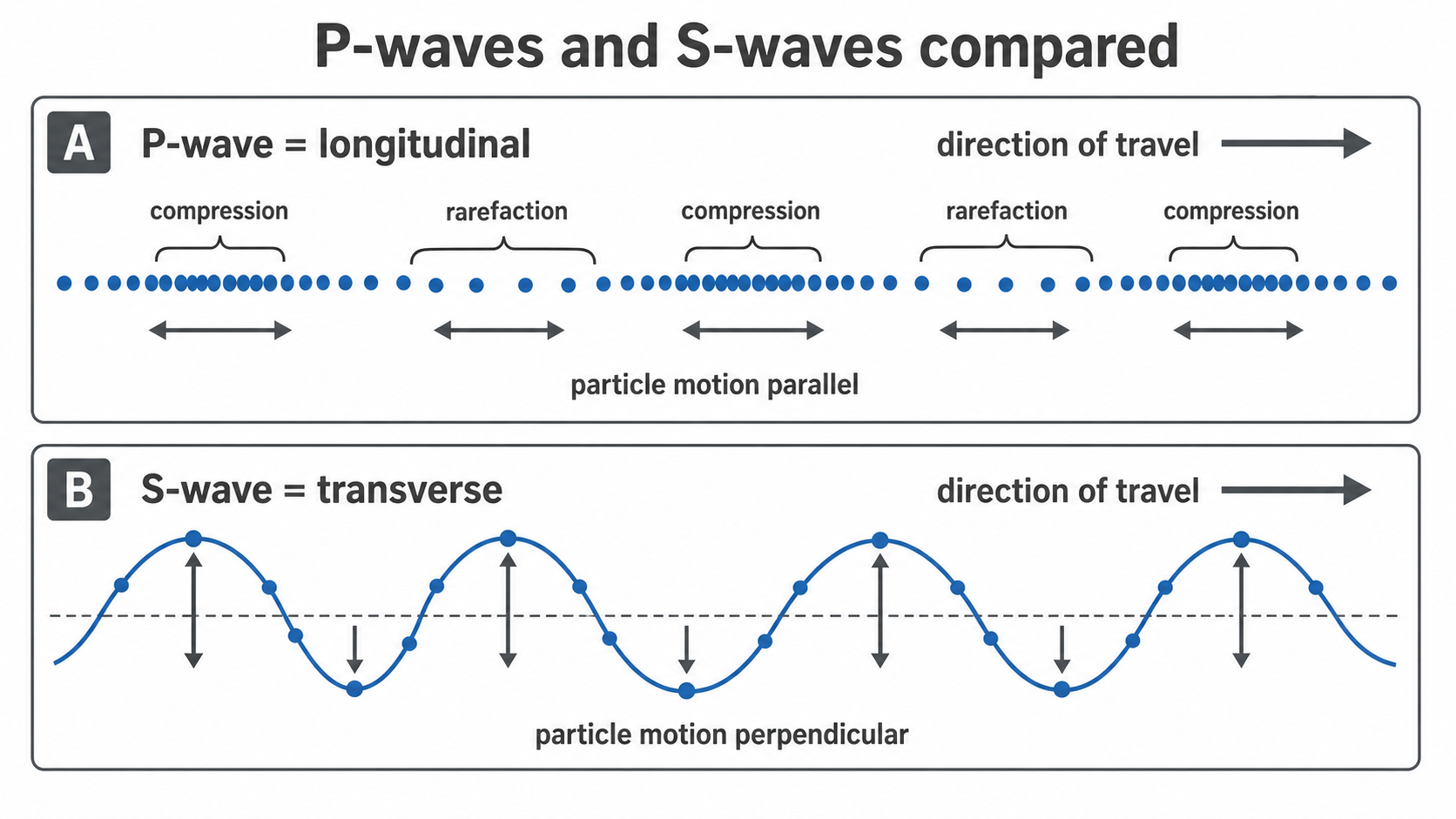
P-waves are often detected first because they travel faster through the Earth. S-waves are detected later where they can travel through solid material.
The most important material difference for this lesson is that S-waves cannot travel through a liquid. P-waves can travel through solids and liquids, but their speed changes when the material changes.
Waves Through Earth's Layers
As seismic waves move through the Earth, they meet boundaries between materials. At a boundary, a wave may be reflected, absorbed, or change speed. If the wave speed changes, the path of the wave can also change direction.
This is why P-waves and S-waves do not simply travel in straight, unchanged paths through the whole planet. Their paths and arrival patterns depend on the layers they pass through.
For P-waves:
- they can pass through solids and liquids
- they travel at different speeds in solids and liquids
- their path changes when their speed changes at a boundary
For S-waves:
- they can pass through solid parts of the Earth
- they cannot travel through liquid
- if a path would require an S-wave to pass through liquid, that S-wave is not detected beyond the liquid region
The mantle behaves as a solid for these seismic waves. The outer core is liquid, so it blocks S-waves. P-waves can still pass through the core, but their speed and path change.
Continue this lesson.
You’re previewing NovaLearn without an account. Create a free account to read the rest.
Create free account