4.7.2.1b - Electromagnetic Devices
A current in a wire does more than transfer electrical energy: it also produces a magnetic field around the wire. That magnetic effect can be strengthened by shaping the wire into a solenoid and by adding an iron core. In physics-only questions, you may also be given a diagram of a device such as a relay or electric bell and asked to explain how the electromagnet makes the device work.
Magnetic field from a current
When a current flows through a conducting wire, a magnetic field is produced around the wire. If the current is switched off, this magnetic field disappears.
The magnetic field is stronger:
- when the current is larger
- closer to the wire
One way to demonstrate the magnetic effect of a current is to place small plotting compasses around a wire connected in a circuit. When the switch is closed, the compass needles deflect because they experience the magnetic field produced by the current. Reversing the current reverses the direction of the magnetic field, so the compass deflection reverses too.
For a straight wire carrying a current, the magnetic field lines form concentric circles around the wire. The circles are closer together near the wire, showing that the field is strongest there.
[DIAGRAM: asset_name: straight_wire_field_demonstration - diagram 1; asset_slug: 104_4_7_2_1b_electromagnetic_devices_diagram1; file: diagram_assets/104_4_7_2_1b_electromagnetic_devices_diagram1.png; recommended_method: image_gen; description: Assessed image-generated field-pattern diagram showing a straight wire passing through a card, conventional current out of the page, concentric circular magnetic field lines with anticlockwise arrows, plotting compasses around the wire, and a note that the field is strongest close to the wire. Students should learn the shape and direction of the field around a straight current-carrying wire and how a compass can demonstrate the magnetic effect of current.]
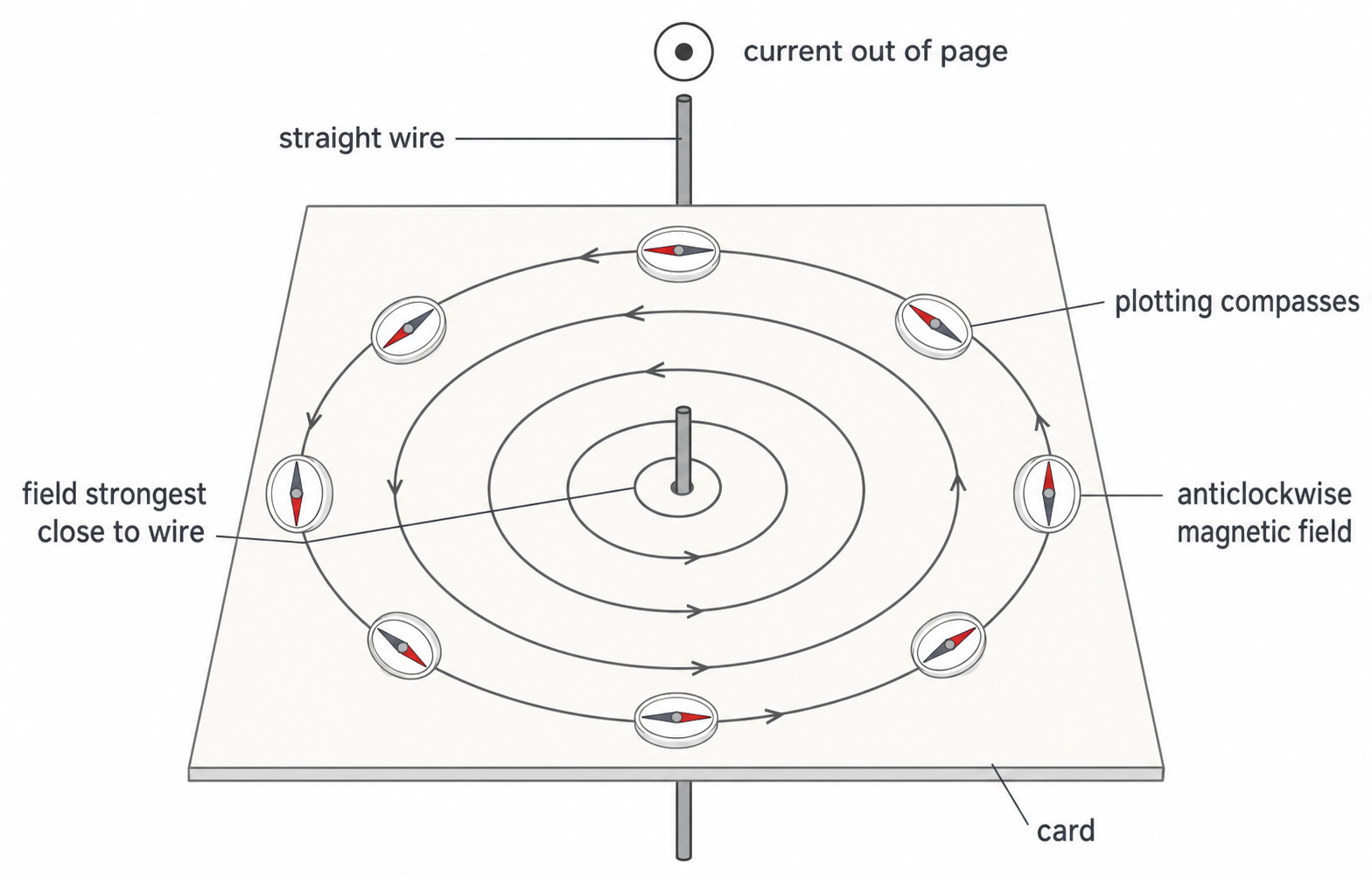
The direction of the field depends on the direction of the current. You can use the right-hand grip rule: point your right thumb in the direction of conventional current, and your curled fingers show the direction of the magnetic field. In the diagram, current comes out of the page, so the field is anticlockwise.
Solenoids and electromagnets
A solenoid is a coil of wire. When current flows through the coil, the magnetic fields around the individual turns combine.
This makes the magnetic effect stronger than for one straight length of wire. Inside the solenoid, the magnetic field is strong and uniform, which means it has the same strength and direction throughout most of the inside of the coil.
The magnetic field around a solenoid has a similar shape to the magnetic field around a bar magnet. One end acts like a north pole and the other end acts like a south pole.
[DIAGRAM: asset_name: solenoid_field_and_iron_core - diagram 2; asset_slug: 104_4_7_2_1b_electromagnetic_devices_diagram2; file: diagram_assets/104_4_7_2_1b_electromagnetic_devices_diagram2.png; recommended_method: image_gen; description: Assessed image-generated diagram of a solenoid with current in the coil, labelled S and N ends, straight parallel field arrows inside the coil from S to N, curved external field lines from N to S, and an iron core labelled as increasing field strength. Students should learn that the field inside a solenoid is strong and uniform, the outside field resembles a bar magnet, and adding an iron core makes an electromagnet.]
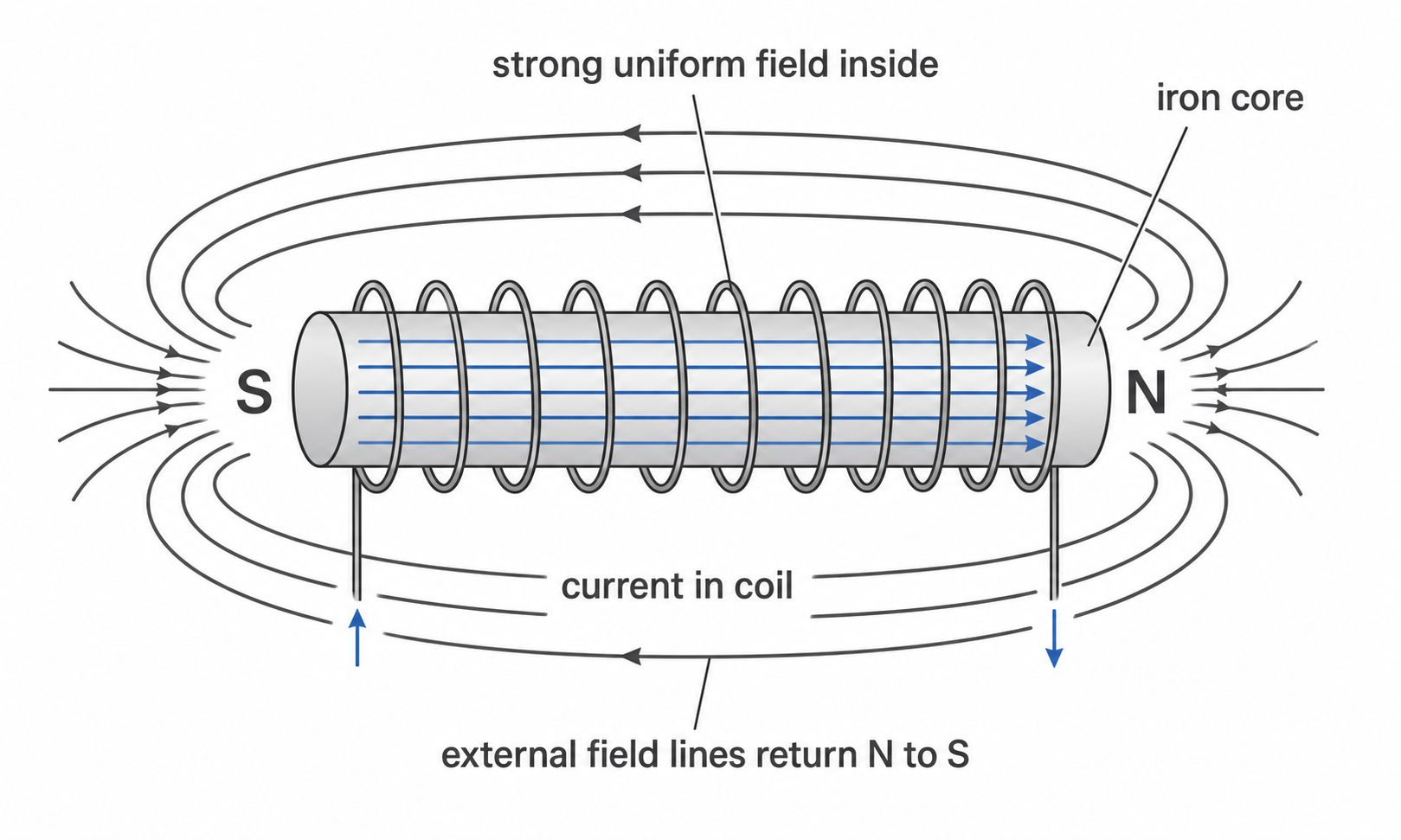
Adding an iron core increases the strength of the magnetic field. An electromagnet is a solenoid with an iron core.
The current flows in the coil, not through the iron core. The magnetic field produced by the current magnetises the iron core, so the core becomes a stronger temporary magnet while the current is flowing.
Electromagnet
An electromagnet is a solenoid with an iron core.
Solenoids and electromagnets are useful because their magnetic field can be switched on and off by switching the current on and off. Their strength can also be changed by changing the current or the number of turns in the coil.
Reading electromagnetic device diagrams
Physics-only questions can give you a diagram of an electromagnetic device and ask how it works. The best answers follow the cause-and-effect chain shown by the diagram.
Use this routine:
- Find the coil or solenoid.
- Find the iron core or iron armature.
- Follow the circuit to decide when current flows through the coil.
- State that the coil becomes an electromagnet when current flows.
- State which iron part is attracted and how it moves.
- Explain what that movement does to a switch, contact, hammer, bell, lamp, motor, or other load.
- If the current is broken, explain that the electromagnet switches off and a spring or elastic strip returns the moving part.
The word attracted matters. In these GCSE device diagrams, an electromagnet attracts a nearby iron part. Do not write that the iron is repelled unless the diagram explicitly gives a reason.
For an electromagnetic device, link the current in the coil to the magnetic field, then link the magnetic field to the movement of an iron part and the effect on the rest of the circuit.
Relay as an electromagnetic switch
A relay is an electromagnetic switch. It lets a small current in one circuit switch a separate circuit on or off.
Continue this lesson.
You’re previewing NovaLearn without an account. Create a free account to read the rest.
Create free account