4.4.1.1 - The Structure of an Atom
Atoms are much too small to see directly, but their structure explains many later ideas in atomic physics. In this lesson, the key picture is a tiny positive nucleus with negative electrons around it. The important exam details are the size scale, where the mass is, and how electrons can move between energy levels when electromagnetic radiation is absorbed or emitted.
Atom size and standard form
Atoms are very small. A typical atom has a radius of about:
1 x 10^-10 m
That is standard form. It means the same as:
0.0000000001 m
The power of ten tells you how many places the decimal point has moved. A negative power means the number is much smaller than 1, so 10^-10 m is a very small length.
The nucleus is much smaller again. The radius of a nucleus is less than 1/10 000 of the radius of an atom. If an atom has radius about 1 x 10^-10 m, then 1/10 000 of that is about 1 x 10^-14 m, so the nucleus radius is less than about 1 x 10^-14 m.
Basic structure of the atom
The basic structure of an atom is a positively charged nucleus surrounded by negatively charged electrons. The nucleus is made of protons and neutrons.
Nucleus
The nucleus is the tiny central part of an atom. It contains protons and neutrons and has an overall positive charge.
Electrons are outside the nucleus. They are negatively charged, and they are arranged at different distances from the nucleus. A common atom diagram has a nucleus in the centre with electrons shown around it, but the nucleus is normally drawn much larger than it would be on a true scale diagram. Otherwise, it would be too small to label.
[DIAGRAM: asset_name: structure-and-scale-of-an-atom - diagram 1; asset_slug: 039_4_4_1_1_the_structure_of_an_atom_diagram1; file: diagram_assets/039_4_4_1_1_the_structure_of_an_atom_diagram1.png; recommended_method: image_gen; description: Assessed schematic of an atom with a labelled positive nucleus containing protons and neutrons, negative electrons on energy levels, and a scale note that the atom radius is about 1 x 10^-10 m while the nucleus radius is less than 1/10 000 of the atom radius. The nucleus is deliberately enlarged for readability and marked not to scale.]
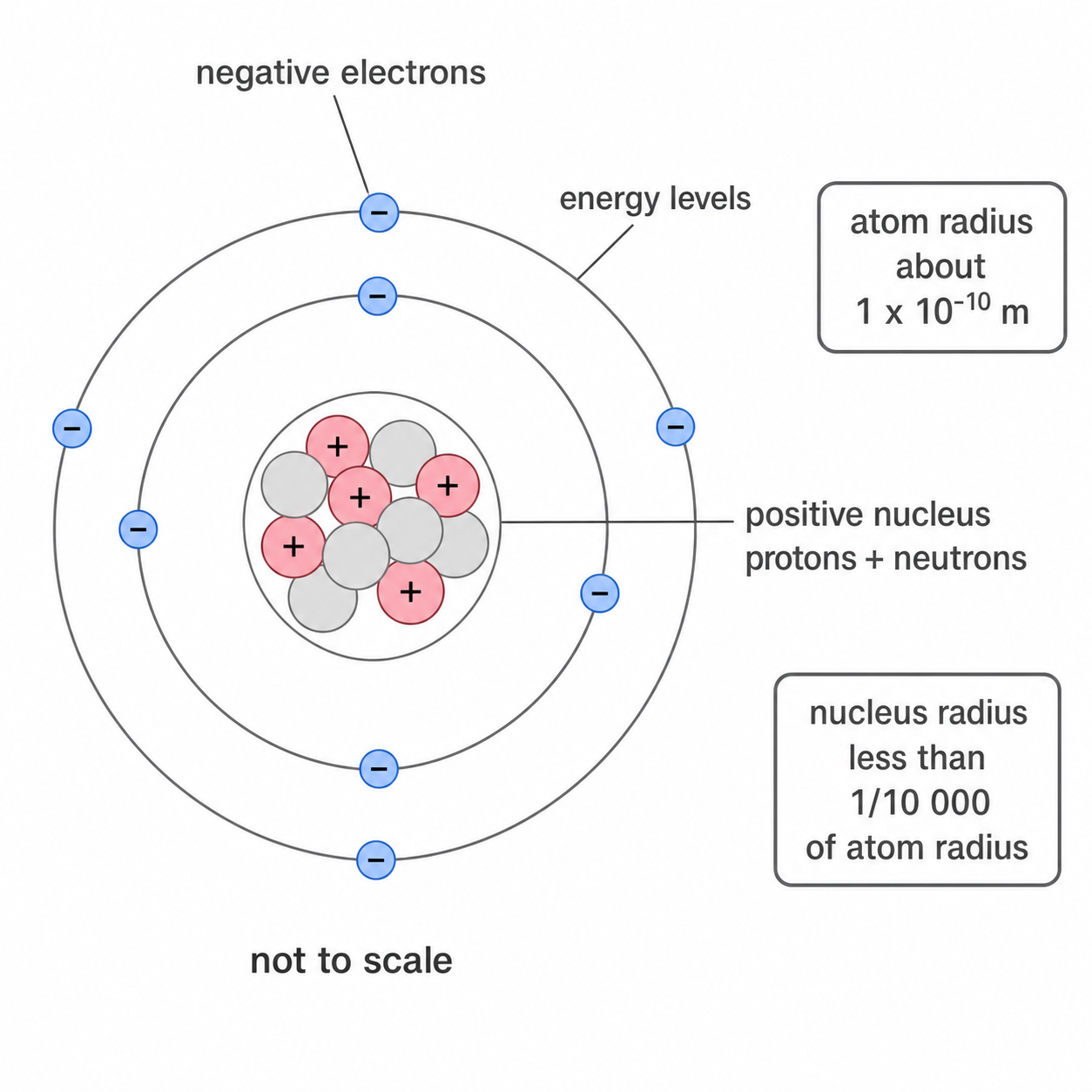
When you describe the structure, keep the charges attached to the correct parts: the nucleus is positive, and the electrons are negative.
Where the mass is
Most of the mass of an atom is concentrated in the nucleus. This is easy to miss because the nucleus is much smaller than the whole atom.
Think of two different ideas separately:
size: the nucleus is less than 1/10 000 of the atom radius
mass: most of the atom's mass is in the nucleus
So an atom is not like a solid ball with mass spread evenly through it. It has a very small central nucleus that contains nearly all the mass, with electrons arranged around it at much larger distances.
For this lesson, you do not need to calculate atomic number, mass number, or isotope information. The required idea is the concentration of mass in the tiny nucleus.
Continue this lesson.
You’re previewing NovaLearn without an account. Create a free account to read the rest.
Create free account