4.6.1.5a - Ultrasound and Echo Sounding
This Physics-only Higher Tier lesson is about using high-frequency sound waves to detect structures that cannot be seen directly. You will explain how ultrasound is reflected, absorbed and transmitted at boundaries, how echo time gives distance, and how the same pulse-echo idea is used in medical imaging, industrial testing and echo sounding.
What ultrasound is
Humans can normally hear sounds from about 20 Hz to 20 kHz. Ultrasound means sound with a frequency higher than the upper limit of human hearing.
Ultrasound
Ultrasound is sound with a frequency above 20 kHz, so it is too high-pitched for humans to hear.
Ultrasound is still a mechanical wave. It needs particles in a medium, such as a solid or a liquid, to transfer energy. In this specification point, ultrasound is useful because it can travel into materials or body tissues and some of the wave can return as an echo.
When a wave meets a boundary between two different media, three things can happen:
- some energy is reflected back
- some energy is transmitted into the next medium
- some energy is absorbed by the material
The amount reflected, transmitted or absorbed depends on the materials at the boundary and on the type of wave. Those differences can be used to detect hidden structures.
Boundary reflections
An ultrasound pulse is a short burst of ultrasound sent into a material. If the pulse meets a boundary between two different media, part of the pulse is reflected. The reflected pulse is called an echo.
Examples of useful boundaries include:
- a boundary between two body tissues
- a boundary between soft tissue and bone
- the far side of a metal plate
- a crack, air gap or flaw inside a solid material
The detector measures the time between sending the pulse and receiving the echo. If the wave speed in the material is known, that time can be used to determine the distance to the boundary.
[DIAGRAM: asset_name: ultrasound_boundary_echo_path - diagram 1; asset_slug: 089_4_6_1_5a_ultrasound_and_echo_sounding_diagram1; file: diagram_assets/089_4_6_1_5a_ultrasound_and_echo_sounding_diagram1.png; recommended_method: image_gen; description: Image-generated path diagram of an ultrasound transducer sending a pulse into medium A towards a hidden boundary with medium B. The diagram must show the outgoing pulse, a partial reflected echo returning to the transducer, a transmitted part continuing into medium B, and a small absorbed-energy label in the material. It should label the one-way distance to the boundary as d, the measured echo time as a round-trip time, and note that distance is found from half the total travel distance.]
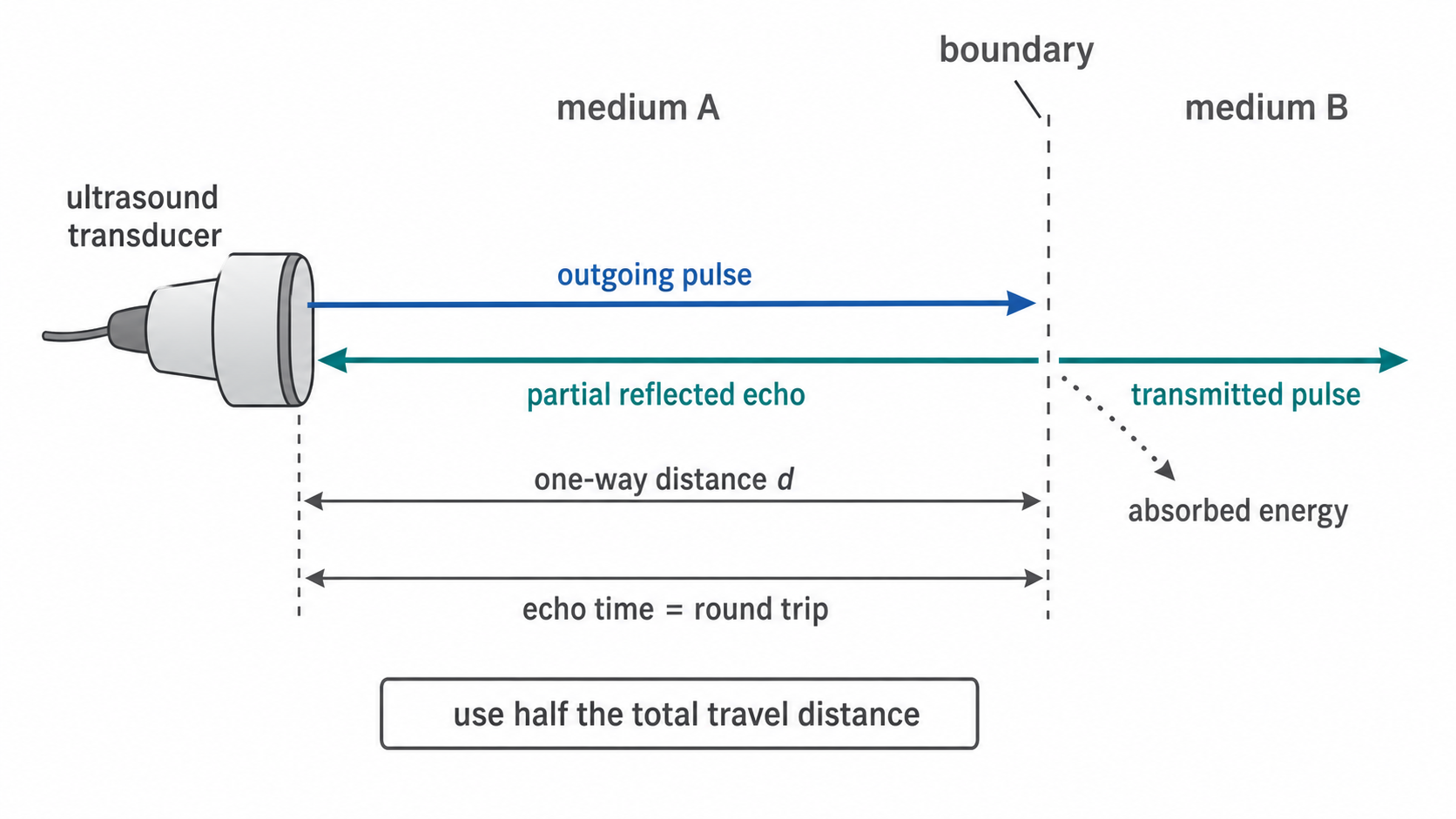
The important exam point is that the measured echo time is usually for the wave going out and coming back. The ultrasound has travelled twice the distance to the boundary.
If a question gives the wave speed and the echo return time:
Distance from echo time
This is not a new equation to memorise for this specification point. It is the wave speed relationship applied to a round trip.
Worked example: an ultrasound pulse travels through a solid at 5900 m/s. The echo from a hidden flaw returns after 0.000040 s. Calculate the distance from the probe to the flaw.
Total distance travelled by the pulse:
The pulse travelled to the flaw and back, so the distance to the flaw is:
The flaw is 0.118 m from the probe.
Medical and industrial imaging
In medical ultrasound imaging, a probe sends ultrasound pulses into the body and detects echoes from tissue boundaries. A computer uses the echo times to calculate the distances to the boundaries and build an image.
Different boundaries produce different echoes. A strong reflection may happen where there is a large change between the two media. Some wave energy is absorbed as the ultrasound travels, so echoes from deeper boundaries can be weaker.
The same idea is used in industrial imaging and non-destructive testing. A probe can send ultrasound into a metal component without cutting it open. Echoes can reveal hidden cracks, flaws or the thickness of the material.
The common idea is:
- send a high-frequency sound pulse into a solid or liquid
- detect echoes from boundaries inside it
- use echo time and wave speed to calculate positions
- use echo strength and timing to infer hidden structures
Continue this lesson.
You’re previewing NovaLearn without an account. Create a free account to read the rest.
Create free account