4.6.2.3b - Ultraviolet, X-ray and Gamma Hazards
Ultraviolet waves, X-rays and gamma rays are high-frequency parts of the electromagnetic spectrum. They can transfer energy to human tissue in ways that cause harm, but the risk is not the same for every exposure. In this lesson, you will compare the type of radiation, the size of the dose, and the consequence described by given data.
Type, dose and risk
The hazardous effect of radiation depends on two linked factors:
- the type of radiation
- the size of the dose received by the body
The type matters because different electromagnetic waves interact with body tissue in different ways. Ultraviolet mainly creates a skin hazard. X-rays and gamma rays are ionising radiation, so their hazard is linked to damage inside cells.
The dose matters because a larger exposure generally means a greater risk of harm. A small dose is not the same risk as a very large dose, even when the radiation type is the same.
Radiation Dose
Radiation dose is a measure of the risk of harm resulting from exposure of the body to radiation.
Radiation dose may be given in sieverts, symbol Sv, or millisieverts, symbol mSv.
1000 mSv = 1 Sv
To convert from mSv to Sv, divide by 1000. For example:
20 mSv = 20 / 1000 Sv
20 mSv = 0.020 Sv
AQA says students are not required to recall the unit of radiation dose. In an exam, focus on using the units, conversion and data that are given to you.
Ultraviolet hazards
Ultraviolet, or UV, has a shorter wavelength and higher frequency than visible violet light. You cannot see UV, so judging risk from brightness or warmth is unreliable. Warmth from sunlight is mainly linked to infrared radiation, not UV.
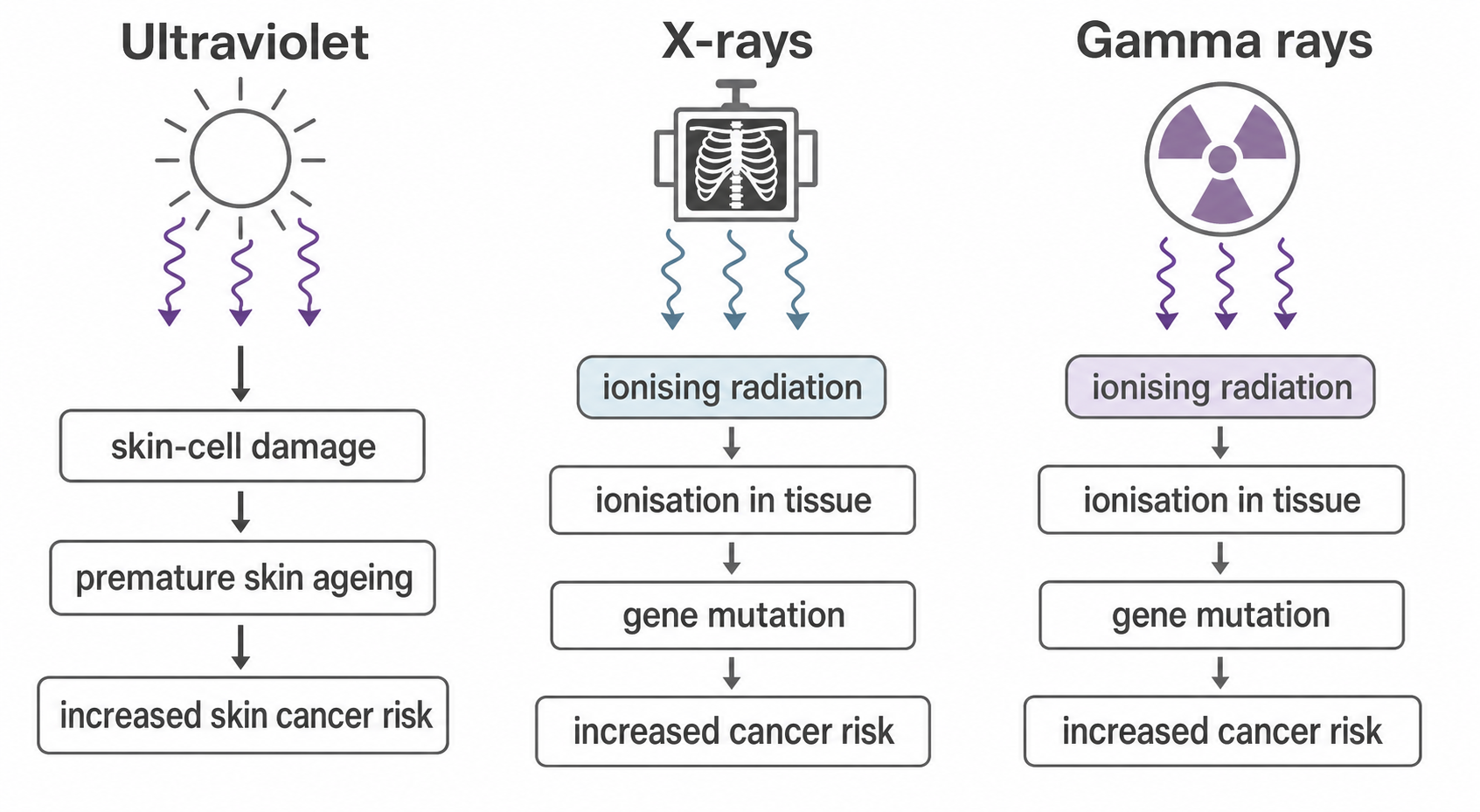
The main AQA hazard for ultraviolet waves is damage to skin. Too much exposure to UV can damage skin cells. Over time, this can make skin age prematurely and increase the risk of skin cancer.
Premature skin ageing means the skin shows ageing effects earlier than it otherwise would, such as loss of elasticity or wrinkles. Skin cancer risk increases because damaged cells may later divide in an uncontrolled way.
Important GCSE wording:
- ultraviolet waves can cause skin to age prematurely
- ultraviolet waves can increase the risk of skin cancer
- the risk depends on the dose or exposure, not just on the fact that UV is present
X-rays, gamma rays and ionisation
X-rays and gamma rays have even shorter wavelengths and higher frequencies than ultraviolet. In this part of the specification, their key hazard is that they are ionising radiation.
Ionising Radiation
Ionising radiation can remove electrons from atoms, forming ions. In living tissue, this can damage molecules inside cells.
If X-rays or gamma rays ionise atoms in body tissue, they can damage DNA. Genes are sections of DNA that carry instructions for cells. A change in a gene is called a mutation.
Most cell damage is repaired or the damaged cell dies, but not all damage is harmless. If a mutation affects the way a cell controls division, the cell may begin to divide uncontrollably. This can lead to cancer.
[DIAGRAM: asset_name: Ultraviolet, X-ray and Gamma Hazard Pathways - diagram 1; asset_slug: 095_4_6_2_3b_ultraviolet_x_ray_and_gamma_hazards_diagram1; file: diagram_assets/095_4_6_2_3b_ultraviolet_x_ray_and_gamma_hazards_diagram1.png; recommended_method: image_gen; description: Labelled comparison of the AQA hazard pathways. Three columns show ultraviolet causing skin-cell damage leading to premature skin ageing and increased skin cancer risk, while X-rays and gamma rays are labelled as ionising radiation causing ionisation in tissue, gene mutation and increased cancer risk. Image generation is used for the current regenerated PNG.]
Do not write that all electromagnetic waves are equally hazardous. The type of radiation changes the possible effect, and the dose changes the size of the risk.
Continue this lesson.
You’re previewing NovaLearn without an account. Create a free account to read the rest.
Create free account