4.4.4.2 - Nuclear Fusion
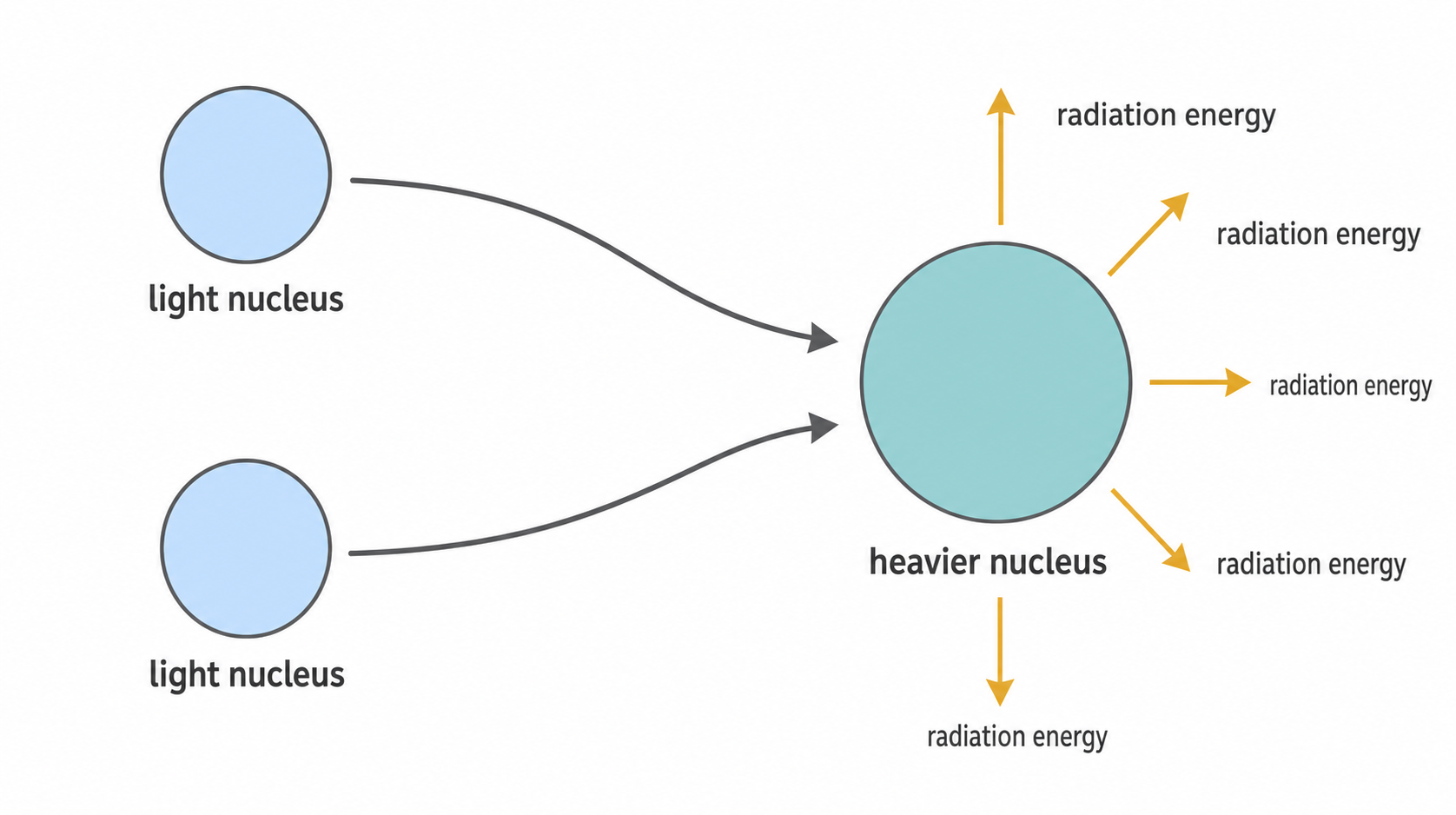
Nuclear fusion is a physics-only idea about changes inside atomic nuclei. In fusion, two light nuclei join to form one heavier nucleus. The key exam point is that this nuclear change can release energy because some of the mass may be converted into the energy of radiation.
What nuclear fusion is
The nucleus is the tiny central part of an atom that contains protons and neutrons. Nuclear fusion happens when two light nuclei join together. The product is a heavier nucleus.
Nuclear fusion
Nuclear fusion is the joining of two light nuclei to form a heavier nucleus.
The word light means the starting nuclei have relatively low mass numbers. At GCSE, the most common context is hydrogen nuclei joining in stars to form heavier nuclei such as helium. You do not need a detailed fusion equation for this specification point.
[DIAGRAM: asset_name: Nuclear Fusion Process - diagram 1; asset_slug: 052_4_4_4_2_nuclear_fusion_diagram1; file: diagram_assets/052_4_4_4_2_nuclear_fusion_diagram1.png; recommended_method: image_gen; description: Assessed conceptual process diagram showing two labelled light nuclei moving together, one heavier nucleus after joining, and outward arrows labelled radiation energy. No specific isotope symbols or mass numbers are required. Image generation is used with a restrained prompt so the labels and process direction remain clear and the visual does not imply fission or a chain reaction.]
Do not describe fusion as two complete atoms sticking together. The important change is in the nuclei, not in the electrons outside the nucleus.
Mass and radiation energy
Fusion is a nuclear process, so it can involve much larger energy changes than ordinary chemical reactions. During fusion, the total mass after the reaction may be slightly less than the total mass before the reaction. The missing mass is not simply lost; it may be converted into the energy of radiation.
For this lesson, the specification is qualitative. You should be able to say that some of the mass may be converted into radiation energy. You do not need to calculate the energy from the mass change.
Radiation energy means energy carried away from the nuclear reaction as radiation. In a star, this energy is part of the reason the star gives out light and other electromagnetic radiation.
Continue this lesson.
You’re previewing NovaLearn without an account. Create a free account to read the rest.
Create free account