4.8.1.2 - The Life Cycle of a Star
Stars are not fixed forever. A star forms, spends a long stable period shining, and then changes as its fuel changes. In this physics-only lesson, the route through the life cycle depends mainly on the star's mass: a star about the size of the Sun has a different ending from a star much more massive than the Sun.
Birth and main sequence
All stars begin from a cloud of gas and dust called a nebula. Gravity pulls parts of the nebula together. As the material is pulled inward, it becomes hotter and denser, forming a protostar.
Nebula
A nebula is a cloud of gas and dust in space.
The protostar is not yet a stable star like the Sun. As the temperature in its core rises, nuclear fusion can begin. In the main sequence stage, hydrogen nuclei fuse to form helium nuclei, releasing energy.
[DIAGRAM: asset_name: star_birth_concept - diagram 1; asset_slug: 114_4_8_1_2_the_life_cycle_of_a_star_diagram1; file: diagram_assets/114_4_8_1_2_the_life_cycle_of_a_star_diagram1.png; recommended_method: image_gen; description: Illustrative, non-assessed visual showing a nebula of gas and dust, a glowing protostar and a stable main-sequence star as a left-to-right conceptual progression. No labels, equations, axes or assessed details are needed in the image; nearby prose supplies the exact terms.]
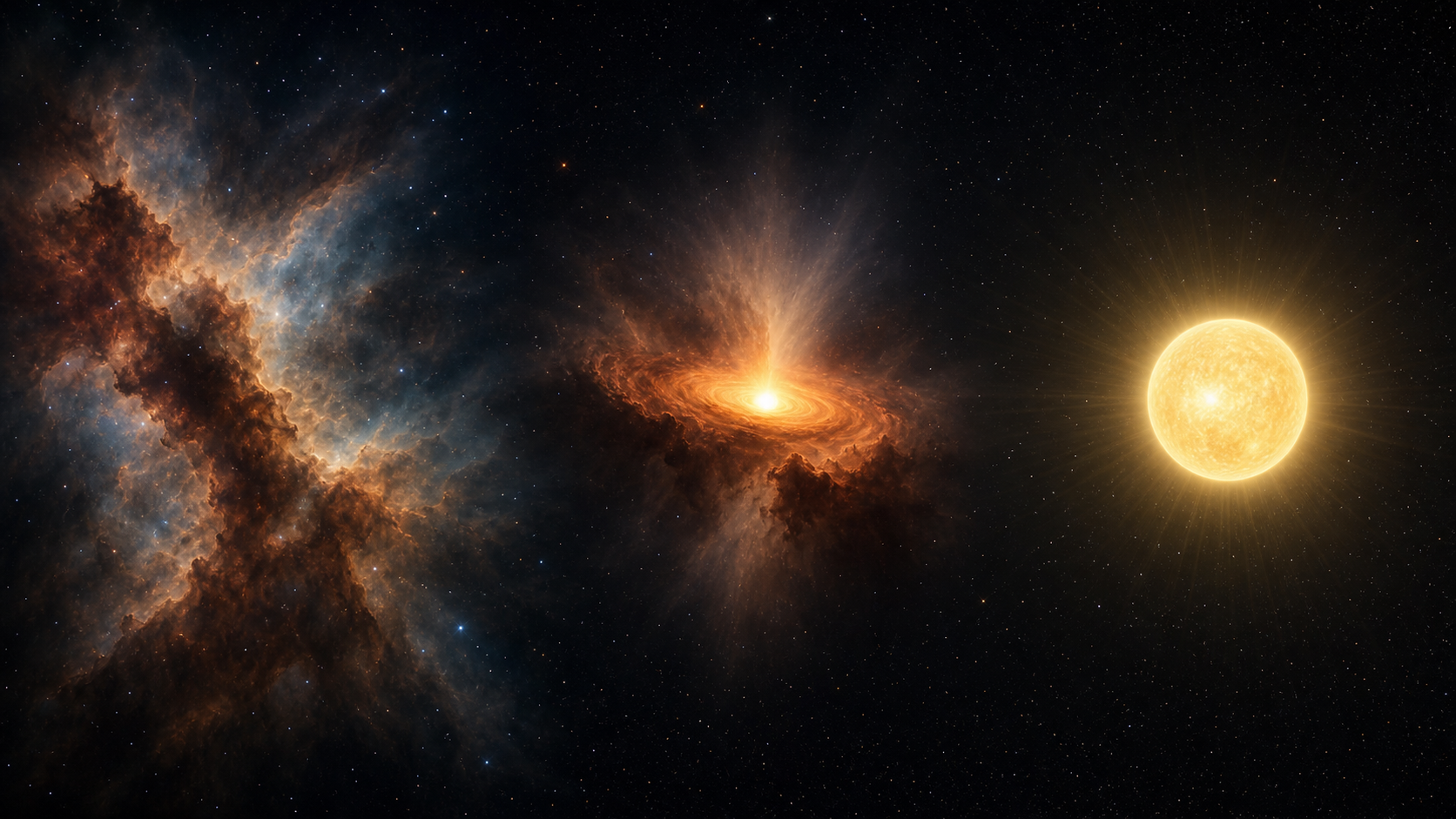
Main Sequence Star
A main sequence star is a stable star in the long part of its life cycle where hydrogen fusion in the core releases energy.
During the main sequence, inward gravitational forces are balanced by outward effects from the energy released by fusion. This balance is why a main sequence star can stay stable for a long time.
Sun-sized stars
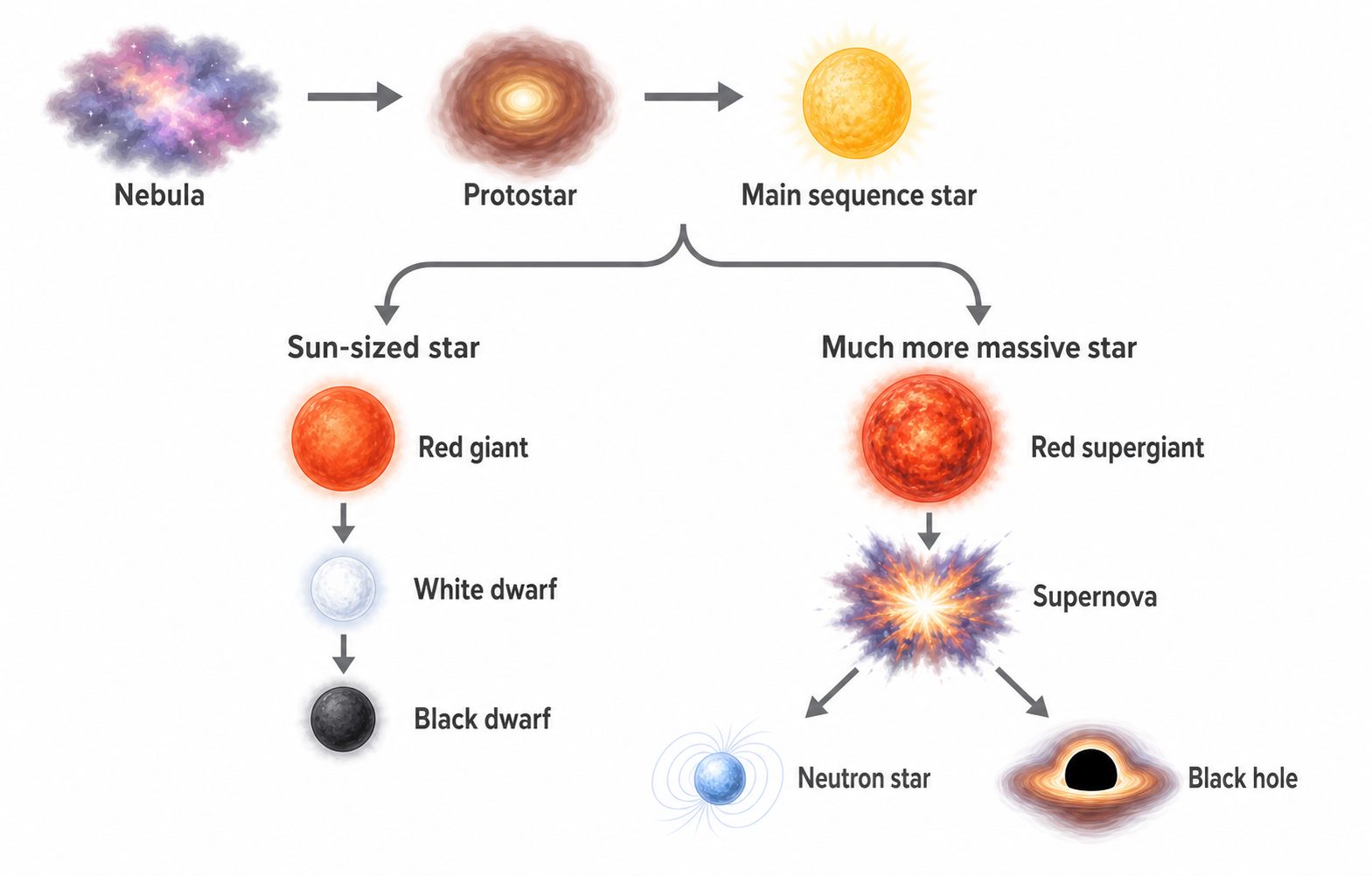
A star about the size of the Sun spends most of its life as a main sequence star. During this time, hydrogen nuclei fuse to make helium nuclei in the core.
When the hydrogen in the core begins to run out, the balance changes. The outer layers expand and the star becomes a red giant. This does not mean the star has exploded; it has expanded and cooled at the surface compared with its earlier state.
After the red giant stage, the star loses its outer layers. The remaining hot, dense core is called a white dwarf. Over a very long time, the white dwarf cools and fades. In the GCSE life-cycle sequence, this cooled remnant is called a black dwarf.
White Dwarf
A white dwarf is the hot, dense core left behind after a Sun-sized star has passed through the red giant stage.
Use the route:
nebula -> protostar -> main sequence -> red giant -> white dwarf -> black dwarf
Massive stars
A star much more massive than the Sun also begins as a nebula, then becomes a protostar and a main sequence star. The early route is shared. The later route is different because the star has much more mass.
When the massive star leaves the main sequence, it expands into a red supergiant. In its later stages, fusion can make heavier and heavier elements in the star. Eventually, the massive star explodes as a supernova.
Supernova
A supernova is the explosion of a massive star.
After the supernova, the remaining core becomes either a neutron star or a black hole. Which remnant forms depends on how massive the core is.
[DIAGRAM: asset_name: star_life_cycle_mass_routes - diagram 2; asset_slug: 114_4_8_1_2_the_life_cycle_of_a_star_diagram2; file: diagram_assets/114_4_8_1_2_the_life_cycle_of_a_star_diagram2.png; recommended_method: image_gen; description: Exact assessed flowchart comparing a Sun-sized star and a much more massive star. Show the shared start nebula -> protostar -> main sequence, then split to red giant -> white dwarf -> black dwarf for Sun-sized stars and red supergiant -> supernova -> neutron star or black hole for much more massive stars. Image generation prompt should preserve the assessed stage order and labels.]
Continue this lesson.
You’re previewing NovaLearn without an account. Create a free account to read the rest.
Create free account