4.6.2.6 - Visible Light
Visible light is the part of the electromagnetic spectrum that human eyes can detect. In this physics-only lesson, the important idea is selective interaction: different wavelengths of visible light can be reflected, transmitted, scattered or absorbed by different materials. That explains why surfaces look shiny or matt, why filters change the light that passes through them, and why objects have the colours we see.
Colour bands in visible light
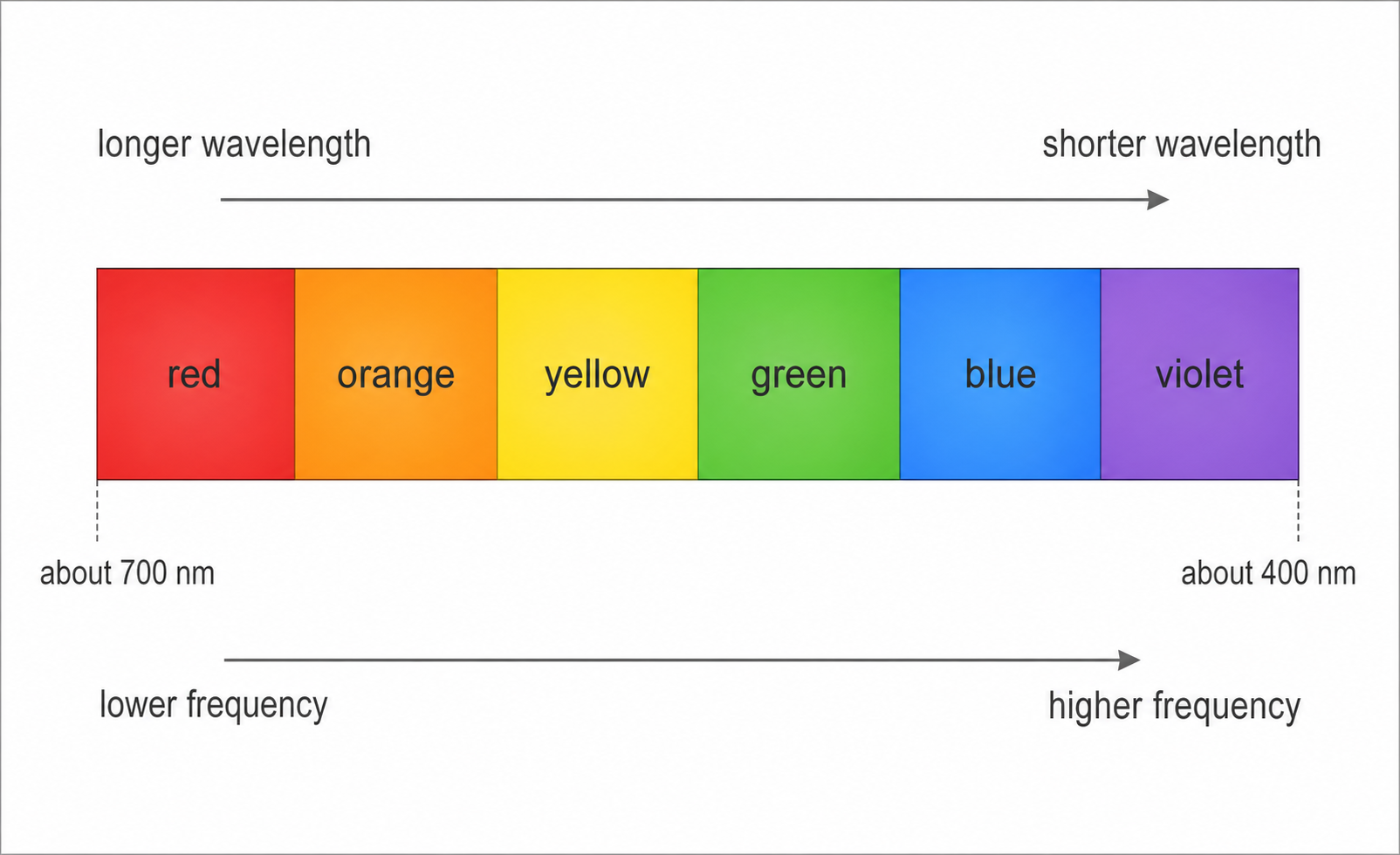
Visible light is not one single wavelength. It is a continuous range of wavelengths and frequencies, and each colour occupies its own narrow band within that range.
The usual order from long wavelength to short wavelength is:
red, orange, yellow, green, blue, violet
Red light has a longer wavelength and lower frequency than violet light. Violet light has a shorter wavelength and higher frequency than red light. The exact boundaries between named colours are not sharp, so it is better to treat the colours as neighbouring bands rather than separate boxes.
[DIAGRAM: asset_name: visible_spectrum_colour_bands - diagram 1; asset_slug: 098_4_6_2_6_visible_light_diagram1; file: diagram_assets/098_4_6_2_6_visible_light_diagram1.png; recommended_method: image_gen; description: Image-generated visible-spectrum band diagram. Shows red, orange, yellow, green, blue and violet arranged from longer wavelength/lower frequency to shorter wavelength/higher frequency, with approximate labels near 700 nm at the red end and 400 nm at the violet end. It teaches that each colour has a narrow wavelength/frequency band.]
White light is what we see when a mixture of visible wavelengths reaches the eye. For GCSE colour questions, it is often useful to model white light as containing red, green and blue components, because these can combine to produce the range of colours detected by the eye.
Specular and diffuse reflection
Reflection can happen in different ways depending on the surface.
Specular reflection
Specular reflection is reflection from a smooth surface in a single direction.
A mirror is a good everyday example. Parallel rays that hit a smooth surface remain organised after reflection, so the surface can form a clear image.
Diffuse reflection
Diffuse reflection is reflection from a rough surface where light is scattered in many directions.
On a rough or matt surface, tiny parts of the surface face slightly different directions. The reflected light is scattered, so the surface can still be seen, but it does not form a clear mirror image.
[DIAGRAM: asset_name: specular_and_diffuse_reflection - diagram 2; asset_slug: 098_4_6_2_6_visible_light_diagram2; file: diagram_assets/098_4_6_2_6_visible_light_diagram2.png; recommended_method: image_gen; description: Image-generated two-panel ray diagram comparing specular reflection from a smooth surface and diffuse reflection from a rough surface. The smooth panel shows parallel incident rays reflecting in one organised direction; the rough panel shows parallel incident rays scattering in several directions. It teaches the official smooth/rough distinction.]
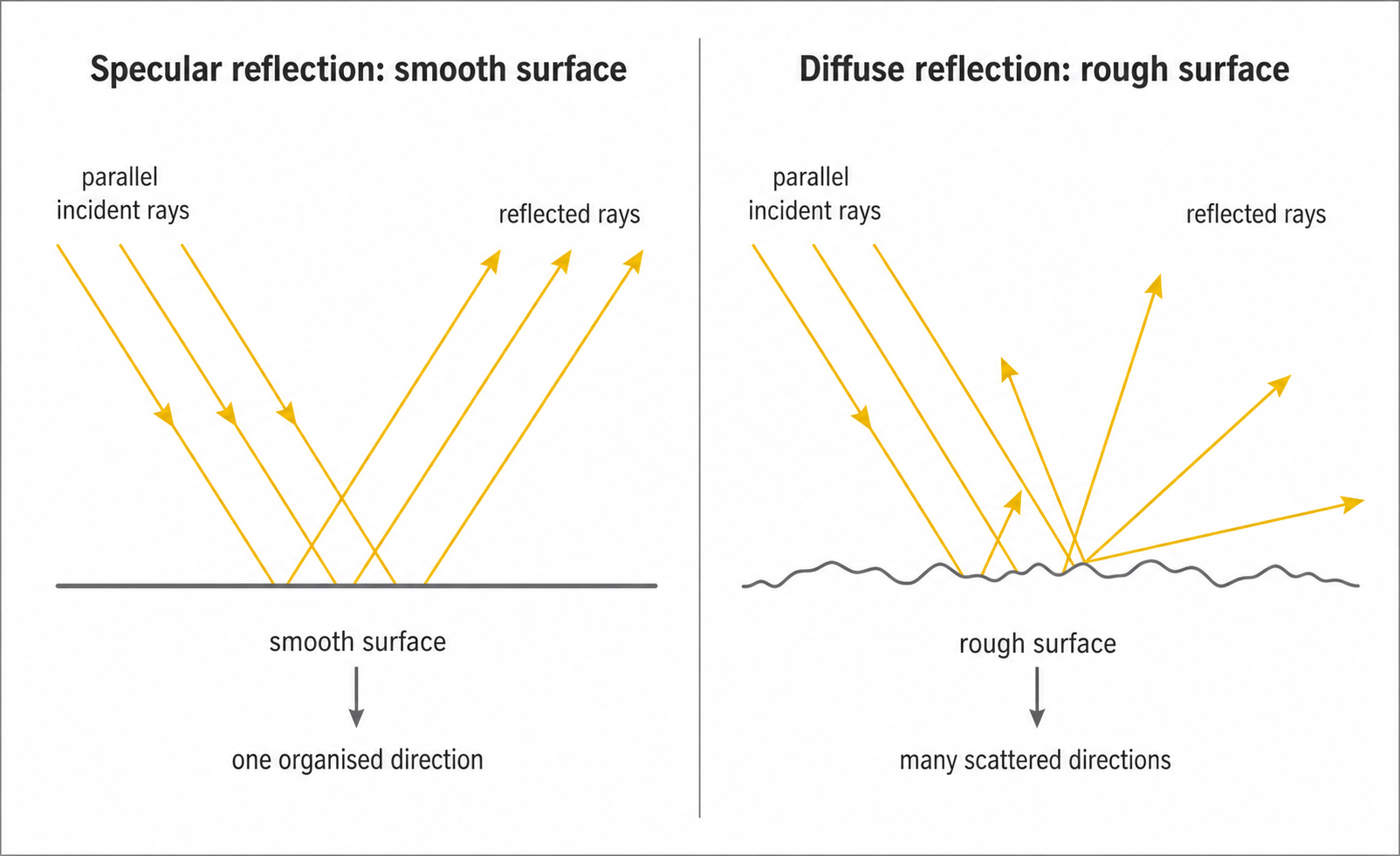
Both types are reflection. The difference is the direction of the reflected light: one organised direction for specular reflection, many scattered directions for diffuse reflection.
Colour filters
A colour filter does not add its colour to the light. It absorbs some wavelengths and transmits others.
Colour filter
A colour filter is a material that transmits some visible wavelengths and absorbs other visible wavelengths.
For example, in the ideal GCSE model, a red filter transmits red light and absorbs most other colours. If white light passes through a red filter, the transmitted light is red because the other colours have been absorbed by the filter.
[DIAGRAM: asset_name: colour_filter_transmission_and_absorption - diagram 3; asset_slug: 098_4_6_2_6_visible_light_diagram3; file: diagram_assets/098_4_6_2_6_visible_light_diagram3.png; recommended_method: image_gen; description: Image-generated colour-filter reasoning diagram using red, green and blue light tokens. Panel A shows white light components red, green and blue entering a red filter; red is transmitted while green and blue are absorbed. Panel B shows red light entering a blue filter and no light transmitted. It teaches assessed filter absorption/transmission logic.]
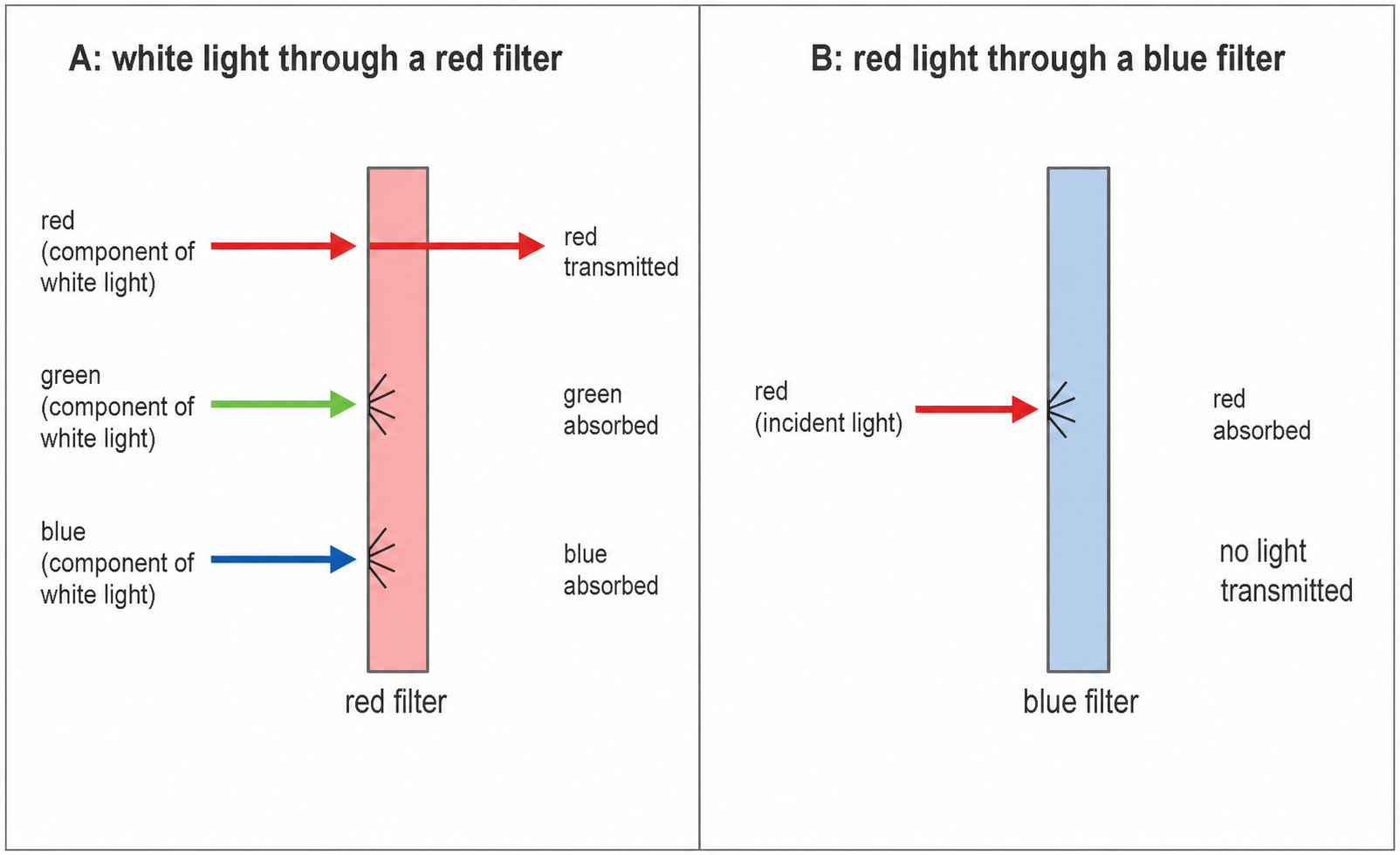
The wavelength has to be present before it can be transmitted. If only red light reaches a blue filter, the blue filter cannot transmit blue light because there is no blue wavelength in the incident light. The red wavelength is absorbed, so little or no light passes through.
Real filters may transmit a small range of wavelengths rather than one perfectly pure colour, but exam explanations use the same principle: transmitted wavelengths pass through; absorbed wavelengths do not.
Colour of opaque objects
An opaque object does not transmit visible light through it. Its colour is determined by which visible wavelengths are more strongly reflected from its surface. Wavelengths that are not reflected are absorbed.
For an ideal opaque object in white light:
- a red object appears red because it reflects red wavelengths more strongly and absorbs many other wavelengths
- a blue object appears blue because it reflects blue wavelengths more strongly and absorbs many other wavelengths
- a white object appears white because it reflects all visible wavelengths about equally
- a black object appears black because it absorbs all visible wavelengths and reflects very little light
Continue this lesson.
You’re previewing NovaLearn without an account. Create a free account to read the rest.
Create free account