4.3.1.2 - Changes of State
Substances can change between solid, liquid and gas. In a change of state, the substance looks different and its particles are arranged or moving differently, but the substance itself has not become a new substance. The key exam idea is that mass is conserved when a substance changes state.
The six state changes
A change of state is a change between solid, liquid and gas. The particles are not destroyed and they do not become different particles; the physical state of the substance changes.
Change of state
A change of state is a physical change in which a substance changes between solid, liquid and gas.
The six state changes in this lesson are:
| Change of state | Direction |
|---|---|
| melting | solid to liquid |
| freezing | liquid to solid |
| boiling | liquid to gas throughout the liquid, at its boiling point |
| evaporating | liquid to gas from the surface of the liquid |
| condensing | gas to liquid |
| sublimating | solid to gas without becoming a liquid first |
[DIAGRAM: asset_name: State-change map - diagram 1; asset_slug: 031_4_3_1_2_changes_of_state_diagram1; file: diagram_assets/031_4_3_1_2_changes_of_state_diagram1.png; recommended_method: image_gen; description: Exact assessed state-change map showing three labelled boxes, Solid, Liquid and Gas, with arrows labelled melting, freezing, boiling/evaporating, condensing and sublimating. The visual teaches the required names and directions, so labels must be readable and exact.]
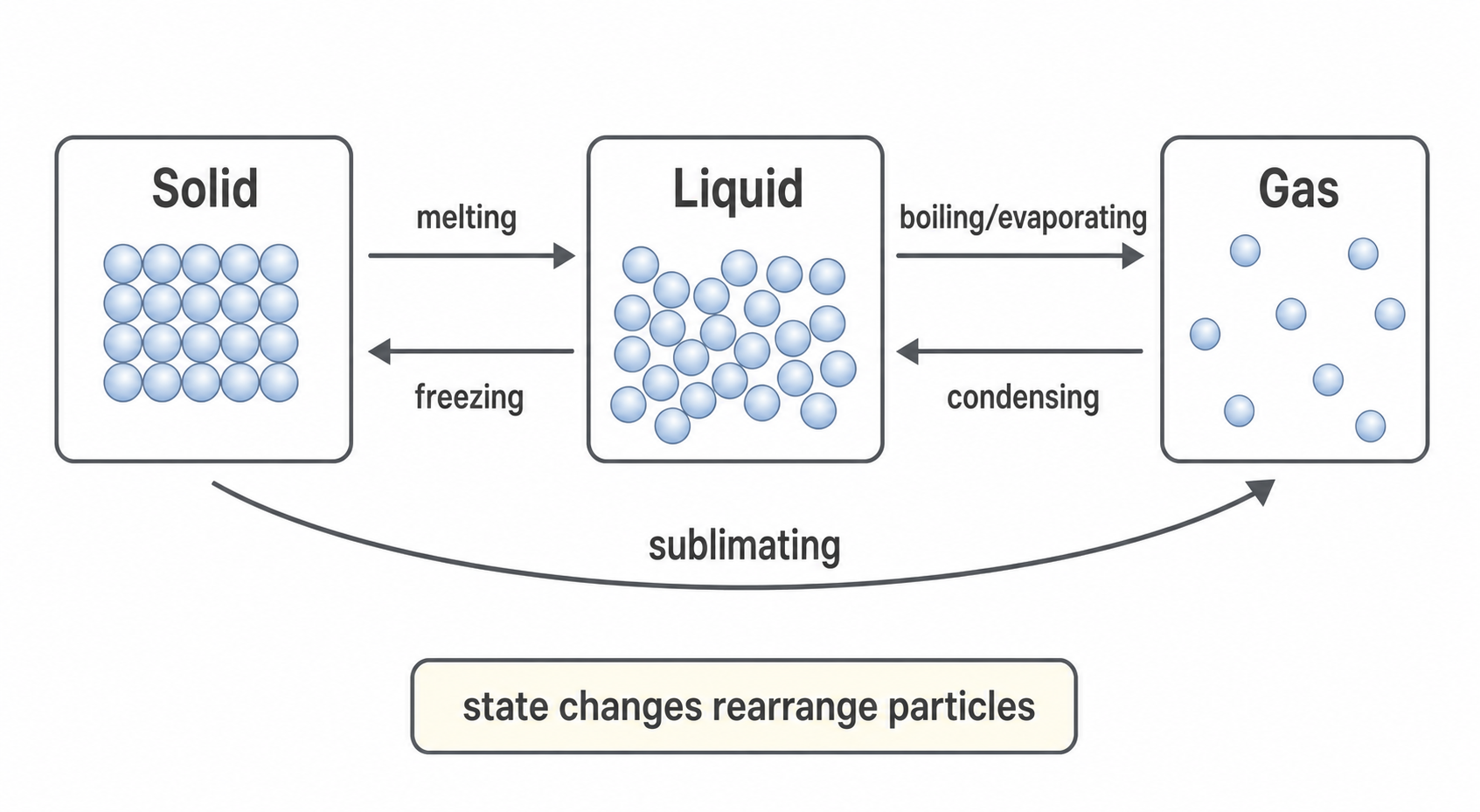
Boiling and evaporating both change a liquid into a gas, but they are not identical. Boiling happens throughout the liquid at the boiling point. Evaporation happens from the surface and can happen below the boiling point, such as water slowly drying from a wet surface.
Mass is conserved
When a substance changes state, its mass is conserved. This means the mass of the substance before the change is equal to the mass of the substance after the change, as long as all the substance is still included in the measurement.
The reason is simple: the same particles are still there. In melting, freezing, boiling, evaporating, condensing and sublimating, particles are not created or destroyed. The particles may become more spread out, closer together, or able to move in a different way, but the total amount of matter stays the same.
[DIAGRAM: asset_name: Sealed system mass conservation - diagram 2; asset_slug: 031_4_3_1_2_changes_of_state_diagram2; file: diagram_assets/031_4_3_1_2_changes_of_state_diagram2.png; recommended_method: image_gen; description: Exact assessed conceptual diagram of a sealed flask on a balance before and after a state change, both readings 50.0 g, with a label that no particles leave the sealed system. The visual supports the conservation-of-mass explanation and must not imply a chemical reaction.]
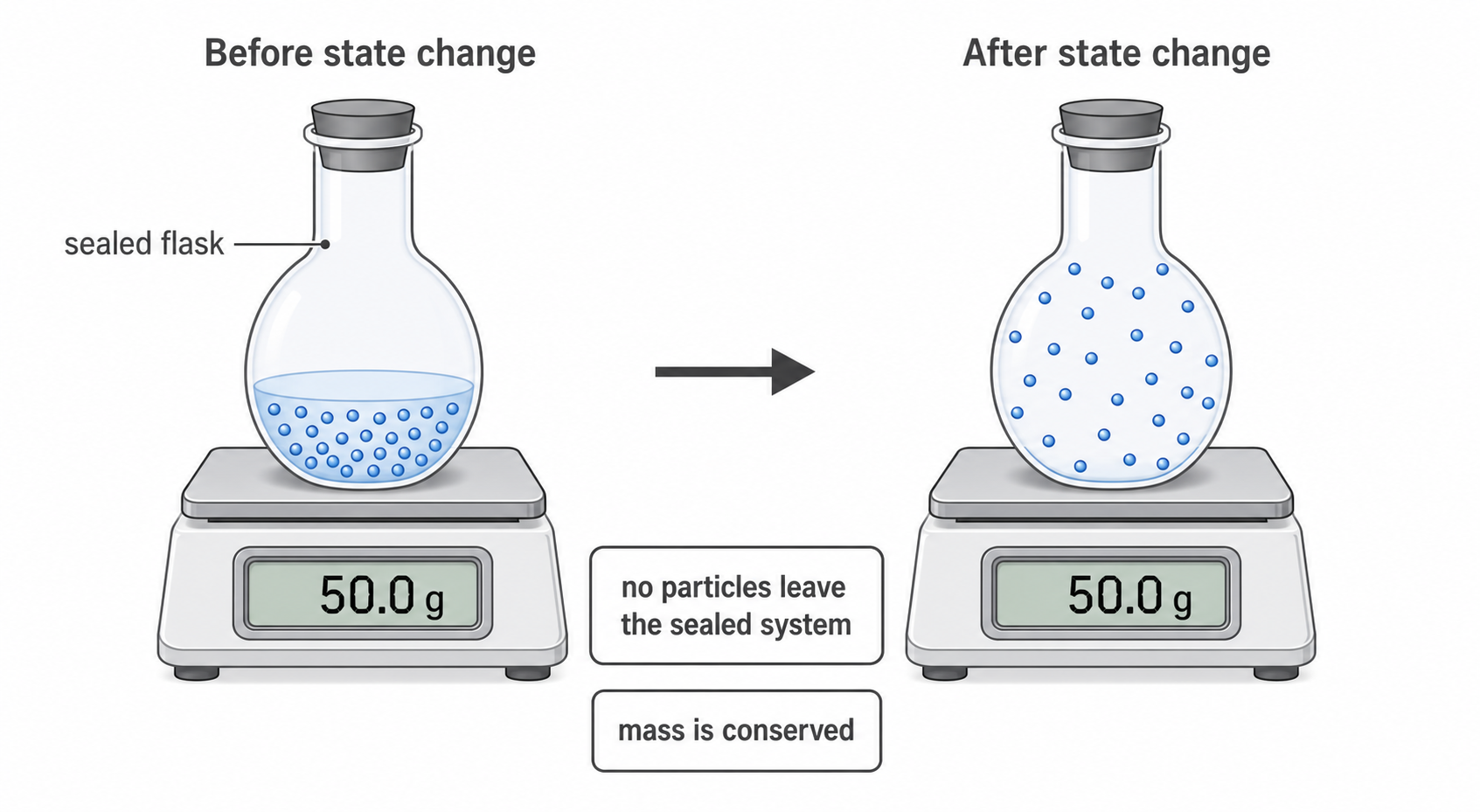
Be careful with open containers. If water boils in an open beaker, the measured mass of the beaker and remaining liquid can decrease because water vapour has escaped into the air. That does not mean mass has been destroyed. If the vapour is included, the total mass of the water is conserved.
mass before state change = mass after state change
Continue this lesson.
You’re previewing NovaLearn without an account. Create a free account to read the rest.
Create free account