4.3.3.3 - Increasing the Pressure of a Gas
This Physics-only, Higher-only lesson is about what happens when work is done on an enclosed gas. The key example is a bicycle pump: a force moves the piston, energy is transferred to the trapped air, and the air can get warmer. The important exam skill is explaining the chain of causes clearly.
Work done on a gas
Work is the transfer of energy by a force. In this topic, the force is applied to a piston or plunger, and the gas is enclosed so it cannot simply escape.
Work done on a gas
Work is done on a gas when an external force moves a boundary, such as a piston, so energy is transferred to the gas.
The word "on" matters. If you push the piston of a pump inwards, your force does work on the enclosed gas. Energy is transferred from your muscles to the gas and the pump. The gas is the system receiving energy.
This lesson is qualitative. You do not need to calculate work done or use the pressure-volume equation here. The exam focus is the explanation: force, movement, energy transfer, internal energy, temperature.
Internal energy and temperature
Internal energy is the energy stored by the particles in a system. For a gas, the particles are moving in constant random motion. A higher temperature means the particles have a higher average kinetic energy.
Internal Energy
Internal energy is the total kinetic energy and potential energy of all the particles that make up a system.
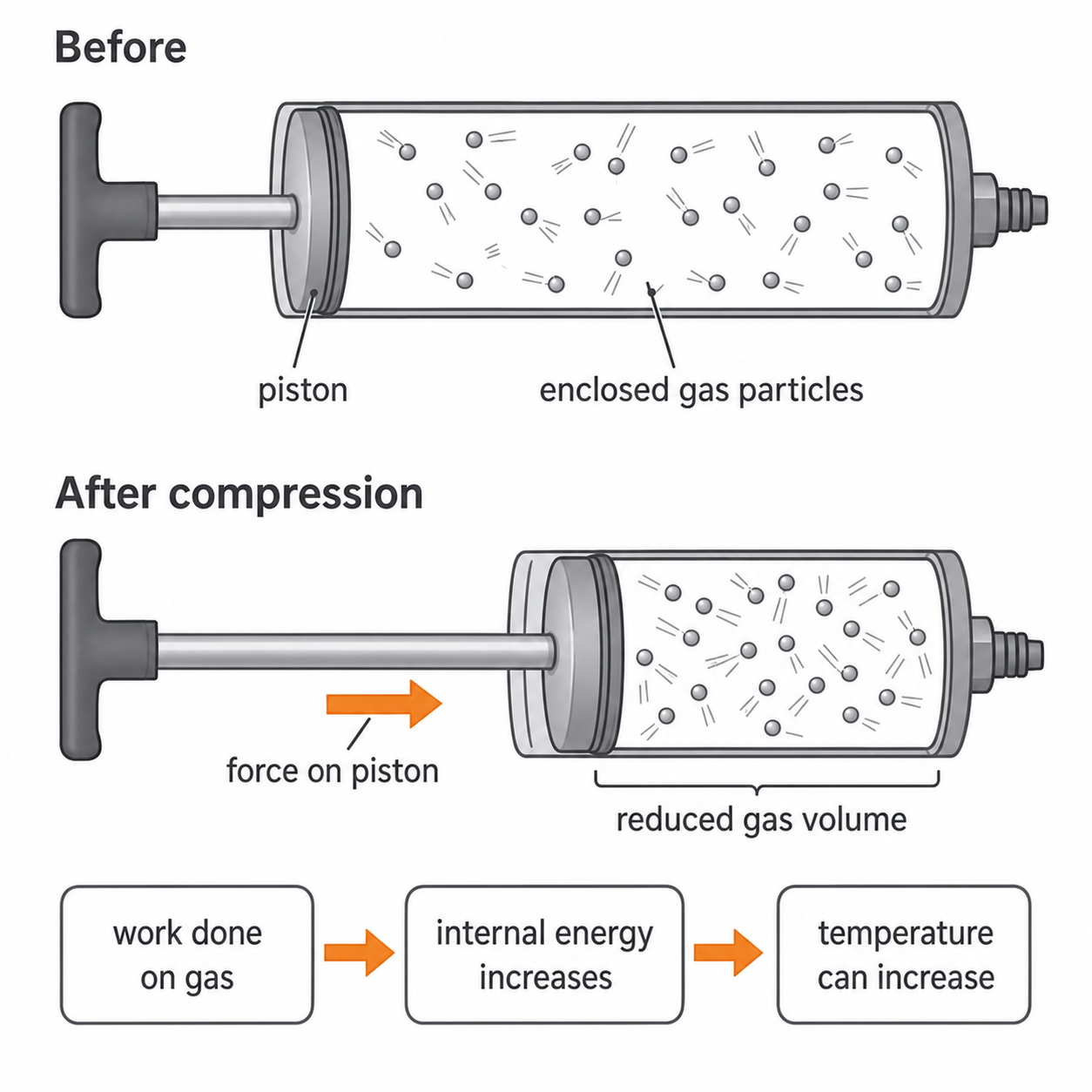
When work is done on a gas, energy is transferred to the gas. This increases the gas's internal energy. If the average kinetic energy of the gas particles increases, the temperature of the gas increases.
The official wording says work done on a gas "can cause" a temperature increase. That is careful wording: in a real pump, some transferred energy may warm the pump body or be transferred to the surroundings. Even so, rapid compression of trapped air commonly makes the gas and nearby pump parts warmer.
The bicycle pump example
A bicycle pump is a good example because it has a piston and a small volume of trapped air. If the outlet is closed or the pump is being used against a tyre valve, the air is enclosed while the piston is pushed in.
[DIAGRAM: asset_name: bicycle_pump_compression_chain - diagram 1; asset_slug: 038_4_3_3_3_increasing_gas_pressure_diagram1; file: diagram_assets/038_4_3_3_3_increasing_gas_pressure_diagram1.png; recommended_method: image_gen; description: Two-stage schematic of a bicycle pump barrel before and after compression. It must label the piston, force on piston, enclosed gas particles, reduced gas volume, work done on gas, increased internal energy, and temperature can increase. Assessed meaning: a force moves the piston, doing work on the enclosed gas and transferring energy to it. Nearby prose explains all assessed physics, so the diagram supports the causal chain.]
Continue this lesson.
You’re previewing NovaLearn without an account. Create a free account to read the rest.
Create free account