4.5.6.2.1 - Newton's First Law
Newton's First Law links force to changes in velocity. If the resultant force on an object is zero, the object does not suddenly choose to stop or start. A stationary object stays stationary, and a moving object keeps moving at the same speed in the same direction. Its velocity stays the same.
Zero resultant force
The resultant force is the single force that has the same effect as all the forces acting together. For this lesson, the most important case is:
Newton's First Law
If the resultant force acting on an object is zero, a stationary object remains stationary and a moving object continues to move at the same speed in the same direction.
Same speed and same direction means same velocity. That is why Newton's First Law is often written using the idea of constant velocity.
Zero resultant force has two possible outcomes:
- if the object is stationary, it remains stationary
- if the object is already moving, it keeps moving with uniform velocity
[DIAGRAM: asset_name: zero_resultant_stationary_and_uniform_velocity - diagram 1; asset_slug: 072_4_5_6_2_1_newtons_first_law_diagram1; file: diagram_assets/072_4_5_6_2_1_newtons_first_law_diagram1.png; recommended_method: image_gen; description: Image-generated schematic with two side-by-side cases. Case A shows a stationary object with equal and opposite 40 N horizontal forces, resultant force 0 N, and label remains stationary. Case B shows a moving object with equal and opposite 80 N horizontal forces plus a constant velocity arrow labelled same speed and same direction. Students should learn that zero resultant force can mean stationary or moving at uniform velocity.]
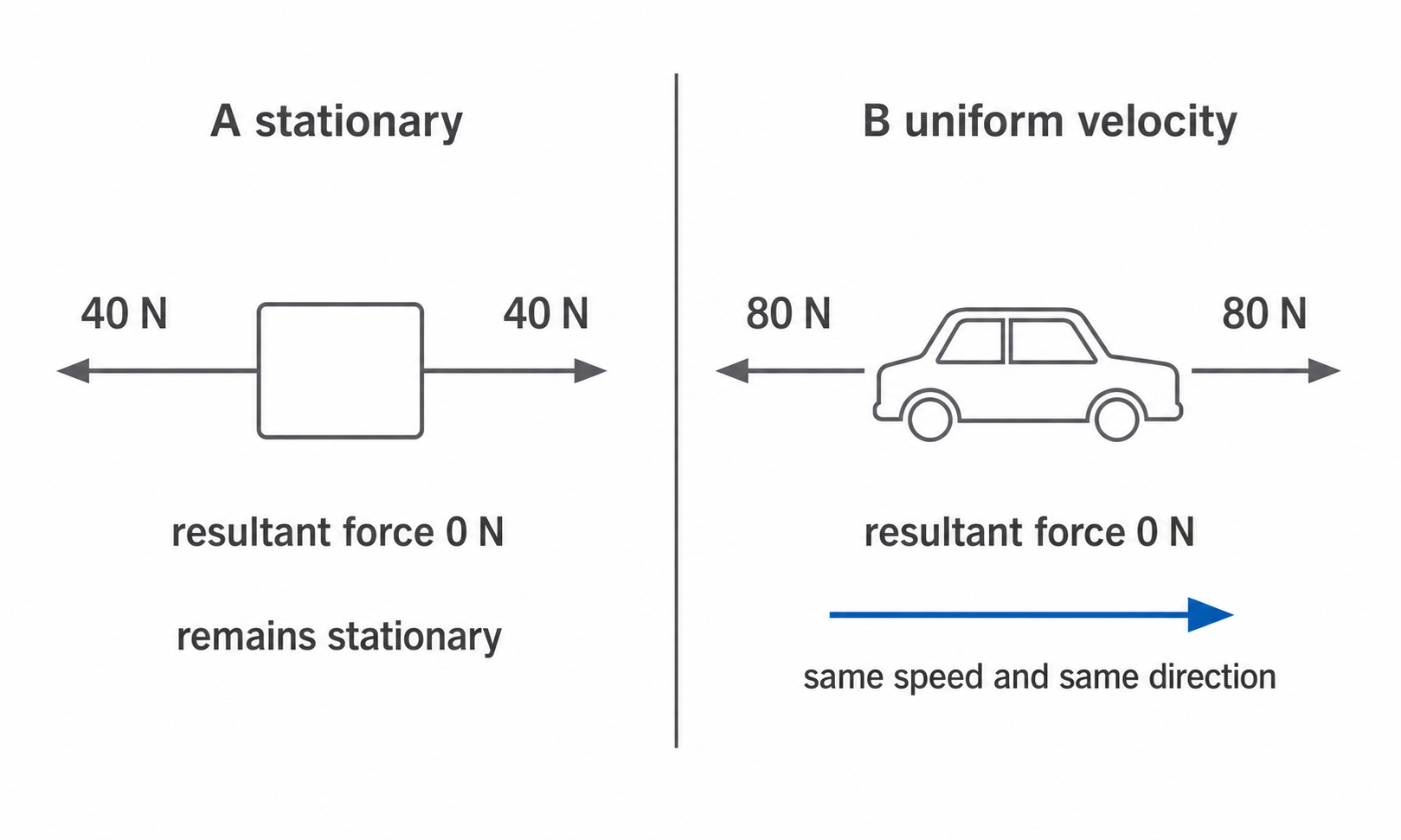
A common mistake is to think that zero resultant force means "not moving". It does not. It means "no change in velocity". A moving object can have a zero resultant force if the forces on it are balanced.
Steady speed vehicles
In real journeys, a vehicle usually has resistive forces acting against its motion. These include air resistance and friction. At a steady speed, the vehicle is moving, but its velocity is not changing.
For a vehicle travelling at a steady speed in a straight line:
- the driving force acts forwards
- the resistive forces act backwards
- the driving force and resistive forces balance
- the resultant force is zero
[DIAGRAM: asset_name: steady_speed_vehicle_balanced_forces - diagram 2; asset_slug: 072_4_5_6_2_1_newtons_first_law_diagram2; file: diagram_assets/072_4_5_6_2_1_newtons_first_law_diagram2.png; recommended_method: image_gen; description: Assessed deterministic schematic of a car travelling to the right at steady speed. Show driving force 1200 N to the right, resistive forces 1200 N to the left, constant velocity arrow to the right, and resultant force 0 N. Students should learn that a steady-speed vehicle can have forces acting on it, but the forward and backward forces balance; exact directions and labels are required.]
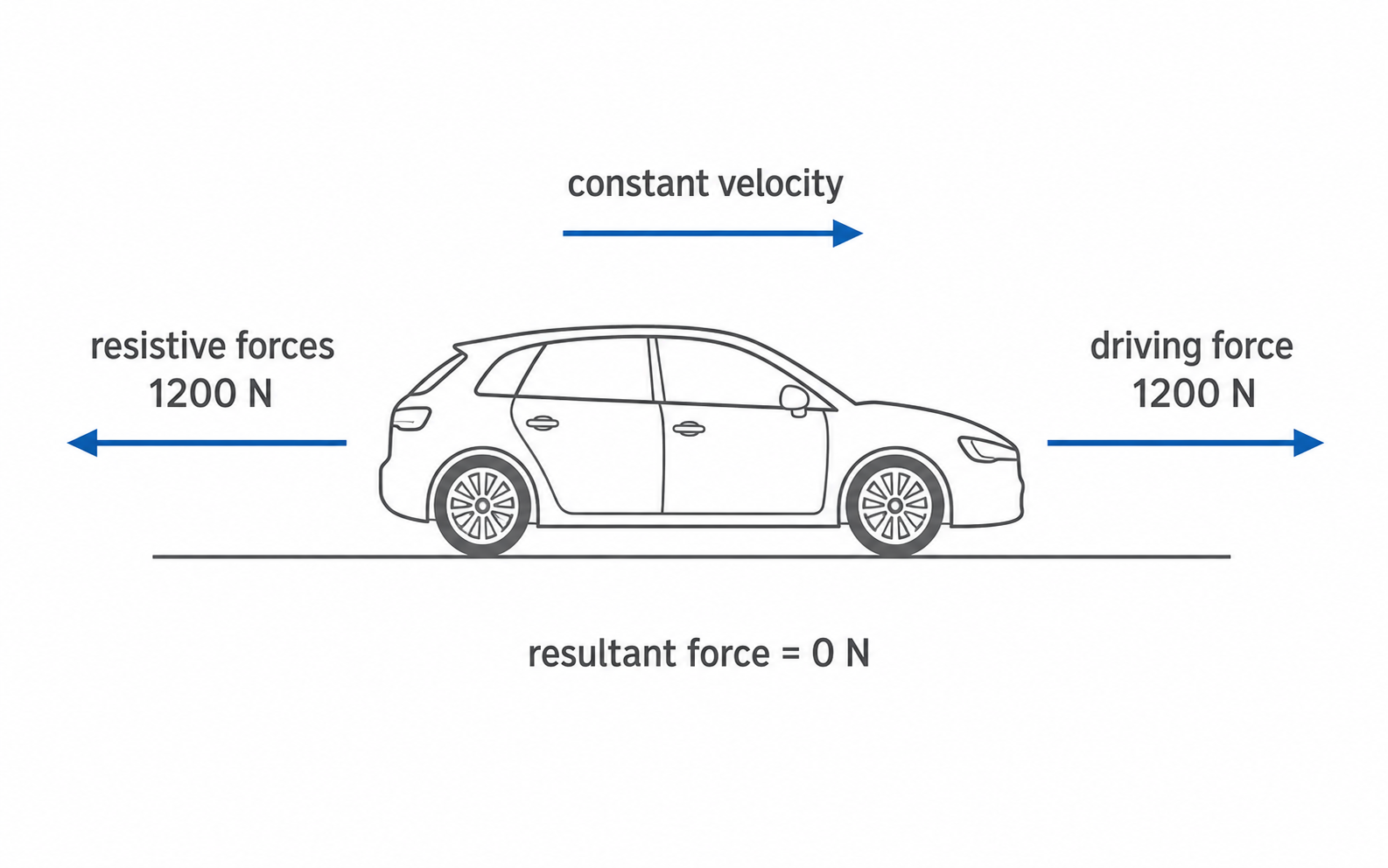
The driving force is not "extra" force that makes the vehicle keep moving faster. At steady speed it is just large enough to balance the resistive forces. If the driving force became larger than the resistive forces, there would be a resultant force forwards and the vehicle's speed would increase. If the driving force became smaller, there would be a resultant force backwards and the vehicle's speed would decrease.
Steady speed in a straight line means zero resultant force, not zero forces.
Changing velocity
Velocity includes both speed and direction. An object's velocity changes if:
- it speeds up
- it slows down
- it changes direction
Continue this lesson.
You’re previewing NovaLearn without an account. Create a free account to read the rest.
Create free account