4.5.1.3 - Gravity, Weight and Mass
Mass and weight are closely linked, but they are not the same quantity. Mass tells you how much matter is in an object, while weight is the gravitational force acting on that object. In this lesson you will connect weight to gravitational field strength, calculate weight using W = mg, and describe where an object's weight may be considered to act.
Weight, mass and gravity
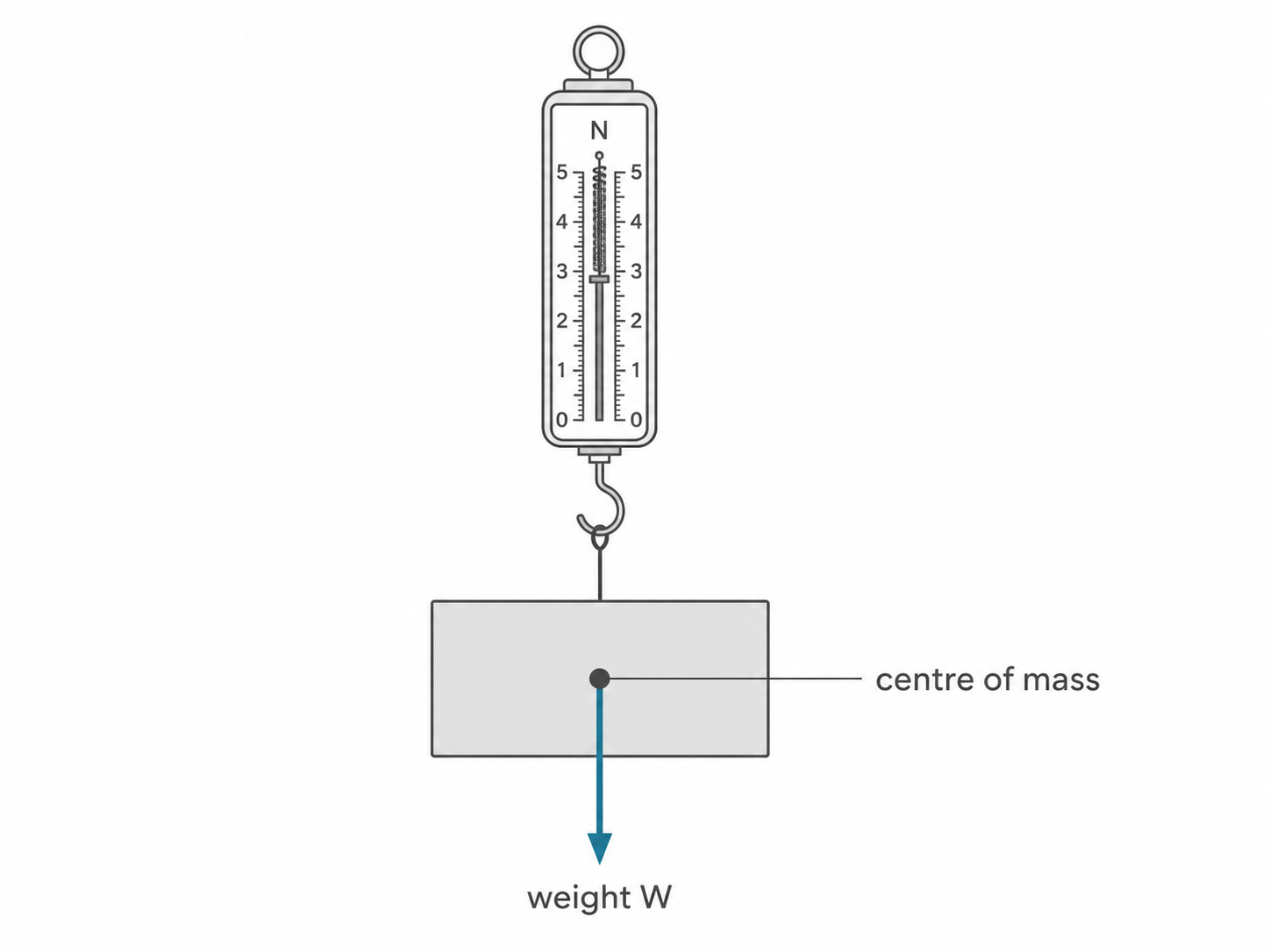
Weight is a force. It acts on an object because the object is in a gravitational field. Close to the Earth, this means the Earth pulls the object towards its centre.
Weight
The force acting on an object due to gravity.
Mass is different. Mass is measured in kilograms, kg, and it does not depend on where the object is. Weight is measured in newtons, N, and it depends on the gravitational field strength at the object's position.
Gravitational Field Strength
The gravitational force acting on each kilogram of mass at a point in a gravitational field.
Gravitational field strength has the unit newtons per kilogram, N/kg. A gravitational field strength of 10 N/kg means each 1 kg of mass has a weight of 10 N at that place.
[DIAGRAM: asset_name: Weight acting at the centre of mass and measured by a newtonmeter - diagram 1; asset_slug: 055_4_5_1_3_gravity_weight_and_mass_diagram1; file: diagram_assets/055_4_5_1_3_gravity_weight_and_mass_diagram1.png; recommended_method: image_gen; description: Exact GCSE apparatus/force visual showing a calibrated spring-balance labelled newtonmeter holding a block, with a downward arrow labelled weight W acting from a marked centre of mass. The visual is assessed/exact because it fixes labels, force direction, measurement unit N, and the point where weight is considered to act.]
The weight equation
For AQA GCSE Physics exams in 2026 and 2027, this equation is supplied on the Physics Equations Sheet. You still need to recognise when it applies and use it accurately. The relationship is:
Weight
In words:
weight = mass x gravitational field strength
The symbols and units are:
| Symbol | Quantity | Unit |
|---|---|---|
W | weight | newtons, N |
m | mass | kilograms, kg |
g | gravitational field strength | newtons per kilogram, N/kg |
The value of g will be given in any calculation. Use the value in the question rather than trying to remember a particular number.
Example: A bag has a mass of 3.0 kg. The gravitational field strength is 9.8 N/kg. Calculate the weight of the bag.
- Write the equation:
W = mg - Substitute values:
W = 3.0 x 9.8 - Calculate:
W = 29.4 - Add the unit:
W = 29.4 N
The bag's weight is 29.4 N.
Rearranging the equation
The same equation can be rearranged if the question gives weight and asks for mass or gravitational field strength.
To find mass:
m = W / g
To find gravitational field strength:
g = W / m
Example: A rock has a weight of 48 N. The gravitational field strength is 12 N/kg. Calculate the mass of the rock.
m = W / g
m = 48 / 12
m = 4.0 kg
Notice the unit. The answer is a mass, so the unit is kilograms, not newtons.
Weight is directly proportional to mass
For a fixed gravitational field strength, weight and mass are directly proportional:
Continue this lesson.
You’re previewing NovaLearn without an account. Create a free account to read the rest.
Create free account