4.5.6.2.3 - Newton's Third Law
Newton's Third Law describes what happens when two objects interact. The two objects exert forces on each other. Those forces are equal in size and opposite in direction, but they act on different objects. In this lesson you will identify third-law force pairs and use them correctly in simple equilibrium examples.
Newton's Third Law
A force is not something that one object has by itself. A force is part of an interaction between objects.
Newton's Third Law
Whenever two objects interact, the forces they exert on each other are equal and opposite.
The wording matters. If object A exerts a force on object B, then object B exerts an equal and opposite force on object A.
For example, if a hand pushes a wall to the right, the wall pushes the hand to the left. The forces are the same size, but they act on different objects:
- force of the hand on the wall
- force of the wall on the hand
These two forces form a Newton's third-law pair.
Recognising force pairs
A third-law force pair is easiest to spot if you name the two objects carefully. Use the pattern:
force of A on B and force of B on A
The object names swap around. The force type stays the same.
Useful checks for a Newton's third-law pair:
- the forces are caused by the same interaction
- the forces are the same type, such as both contact forces or both gravitational forces
- the forces are equal in size
- the forces are in opposite directions
- the forces act on two different objects
[DIAGRAM: asset_name: book_table_contact_pair - diagram 1; asset_slug: 075_4_5_6_2_3_newtons_third_law_diagram1; file: diagram_assets/075_4_5_6_2_3_newtons_third_law_diagram1.png; recommended_method: image_gen; description: Exact force-pair diagram for a stationary book on a table. Show the upward normal contact force of the table on the book and the downward contact force of the book on the table as a Newton's third-law pair. Also show the book's weight downward so students can distinguish a third-law pair from balanced forces on the book.]
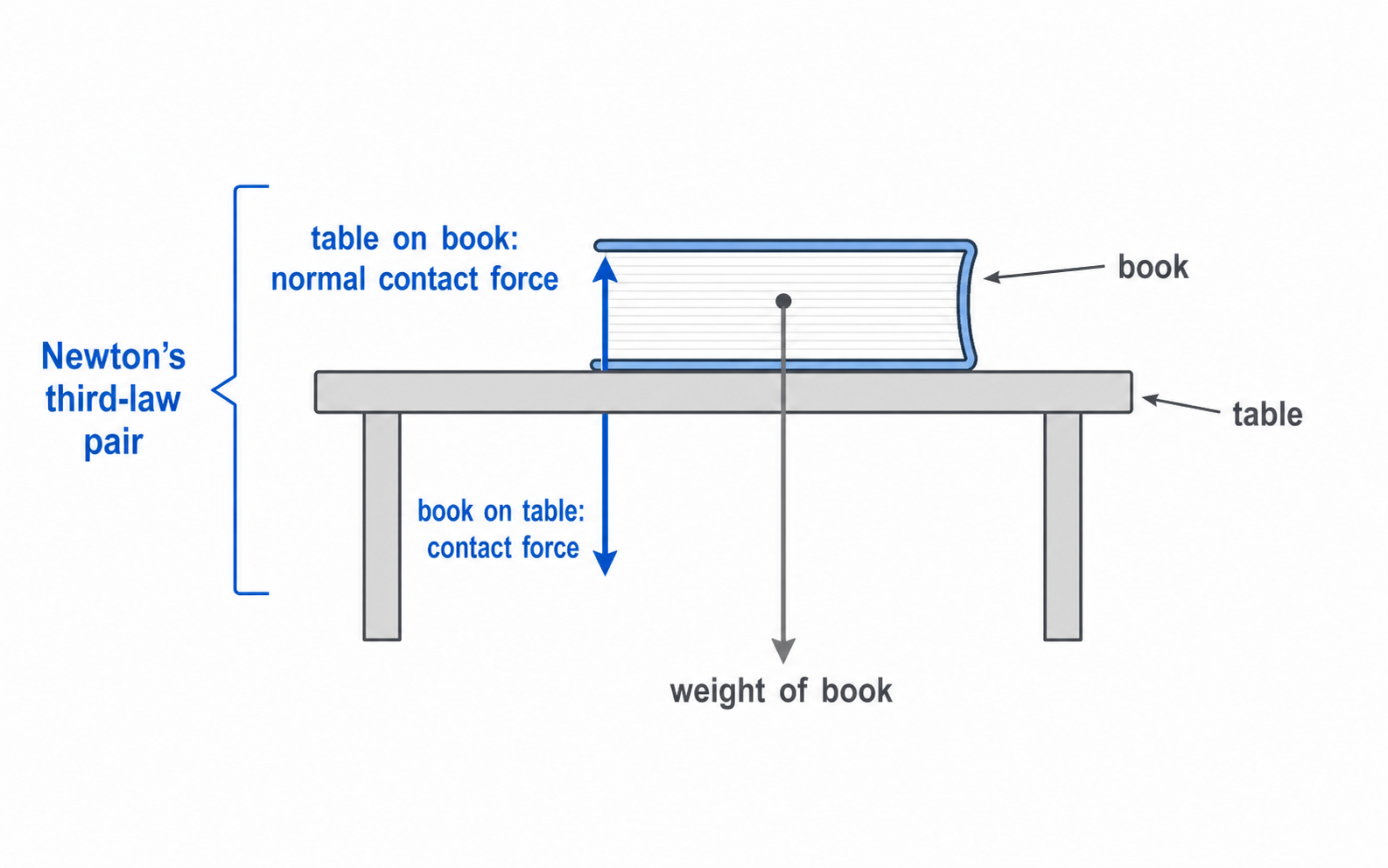
In the diagram, the contact force of the table on the book and the contact force of the book on the table are a third-law pair. They are equal and opposite because they are the two forces in the same contact interaction.
The book's weight is not the third-law partner of the table's contact force on the book. Weight is a gravitational force from the Earth on the book. Its third-law partner would be the gravitational pull of the book on the Earth.
Equilibrium and force pairs
An object is in equilibrium when the resultant force on that object is zero. In the examples in this lesson, that means the object is stationary because the forces on it balance.
Equilibrium is about the forces acting on one object.
Newton's Third Law is about the forces two objects exert on each other.
This is the common trap. Equal and opposite forces can be either:
- balanced forces acting on the same object, giving zero resultant force on that object
- a third-law pair acting on two different objects, so they do not cancel on one object
For the stationary book on the table:
- the upward contact force from the table on the book and the downward weight of the book can balance on the book
- the upward contact force from the table on the book and the downward contact force from the book on the table are a third-law pair
So, the contact force can appear in both ideas, but the partner force you choose depends on the question.
Continue this lesson.
You’re previewing NovaLearn without an account. Create a free account to read the rest.
Create free account