4.5.3a - Elastic Deformation and Hooke's Law
Objects can change shape when forces act on them. A spring can stretch, a sponge can compress, and a ruler can bend. This lesson is about the forces needed to deform a stationary object, the difference between elastic and inelastic deformation, and how Hooke's law links force, spring constant and extension.
Forces that deform objects
Deformation means a change in shape. At GCSE level, the three important examples are stretching, compressing and bending.
Deformation
Deformation is a change in the shape of an object caused by forces.
Stretching happens when parts of an object are pulled further apart. A spring stretches when its ends are pulled outwards. A rubber band stretches when fingers pull on both ends.
Compressing happens when parts of an object are pushed closer together. A spring compresses when its ends are pushed inwards. A foam block compresses when it is squeezed between two hands.
Bending happens when forces make one part of an object move relative to another part so the object curves. A ruler bends if it is supported at its ends and pushed down in the middle.
[DIAGRAM: asset_name: deformation_force_pairs - diagram 1; asset_slug: 059_4_5_3a_elastic_deformation_and_hookes_law_diagram1; file: diagram_assets/059_4_5_3a_elastic_deformation_and_hookes_law_diagram1.png; recommended_method: image_gen; description: Exact assessed force diagram with three labelled panels: stretching, compressing and bending. Stretching shows a horizontal spring with outward forces on both ends; compressing shows a horizontal spring with inward forces on both ends; bending shows a ruler supported at both ends with upward support forces and a downward force at the centre. The visual teaches that a stationary object needs more than one force to change shape. Deterministic drawing is required because force directions and labels carry assessed meaning.]
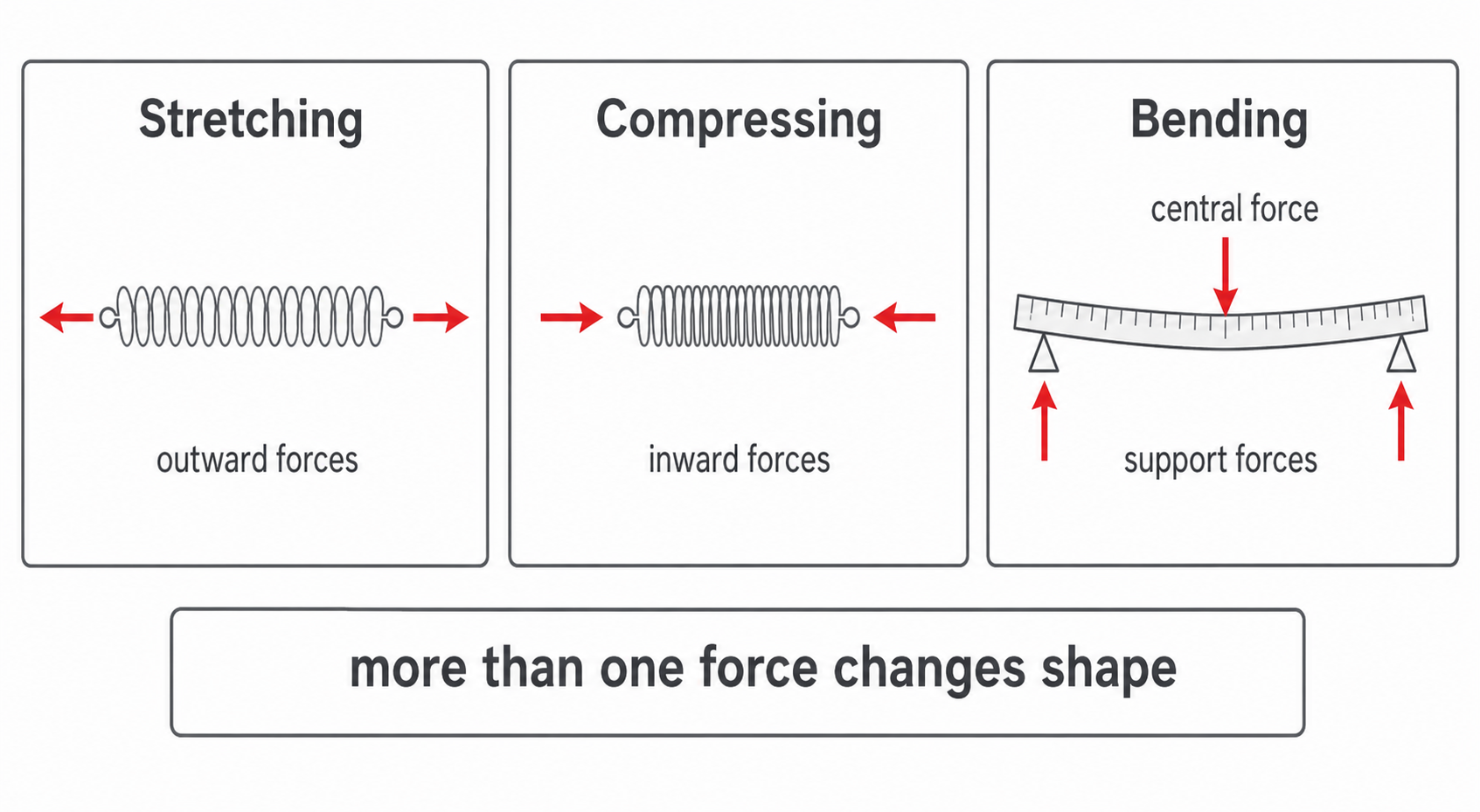
For a stationary object to change shape, more than one force has to be applied. If only one unbalanced force acted on the object as a whole, the object would tend to accelerate instead of simply changing shape while staying stationary.
The forces must act at different places or in different directions so that different parts of the object are affected. In a stretched spring, one end is pulled one way and the other end is pulled the opposite way. In a compressed spring, the ends are pushed towards each other.
Elastic and inelastic deformation
The word elastic has a precise meaning in physics. It is about whether the object returns to its original shape when the deforming force is removed.
Elastic Deformation
Elastic deformation is deformation where the object returns to its original shape after the forces are removed.
A spring stretched gently usually shows elastic deformation. When the force is removed, the spring returns to its original length. A rubber band pulled gently can do the same.
Inelastic deformation is different. The object does not return fully to its original shape when the forces are removed.
Inelastic Deformation
Inelastic deformation is deformation where the object does not return to its original shape after the forces are removed.
If a spring is stretched too far, it may stay longer than it was before. If a metal paperclip is bent strongly, it may remain bent. Those are examples of inelastic deformation.
Be careful with everyday language. "Elastic" does not mean "easy to stretch". A stiff metal spring may be harder to stretch than a rubber band, but it can still deform elastically if it returns to its original shape.
After a deformation, compare the final shape with the original shape. That is the evidence you need.
Hooke's law
For an elastic object such as a spring, the extension is the change in length caused by the force. It is not the total length of the spring.
Continue this lesson.
You’re previewing NovaLearn without an account. Create a free account to read the rest.
Create free account