4.5.5.1.2 - Pressure in Liquids, Upthrust and Sinking
This AQA GCSE Physics point is physics-only and Higher Tier only. You will use the liquid-pressure equation, explain why pressure changes with depth and density, and connect pressure differences to upthrust. The key exam habit is to link the calculation to the physical picture: more liquid above a point means more weight of liquid pressing down.
Liquid column pressure
In a liquid, pressure at a point is caused by the weight of the liquid above that point. The deeper the point is below the surface, the taller the column of liquid above it.
From the previous pressure idea, pressure on a surface causes a force at right angles to that surface. In this lesson, the pressure is inside a liquid, and it depends on the liquid column above the point.
Height of liquid column
The height of liquid column, , is the vertical height of liquid above the point where the pressure is being calculated.
The equation for pressure due to a column of liquid is:
Pressure due to a liquid column
The quantities and units are:
| Quantity | Symbol | Unit |
|---|---|---|
| pressure | pascal, Pa | |
| height of the liquid column | metre, m | |
| density of the liquid | kilogram per metre cubed, kg/m^3 | |
| gravitational field strength | newton per kilogram, N/kg |
AQA gives this equation on the Physics equation sheet. In any calculation, the value of will be given, so the skill is choosing the right quantities and using SI units.
[DIAGRAM: asset_name: liquid_column_pressure_depth_density - diagram 1; asset_slug: 064_4_5_5_1_2_pressure_in_liquids_upthrust_and_sinking_diagram1; file: diagram_assets/064_4_5_5_1_2_pressure_in_liquids_upthrust_and_sinking_diagram1.png; recommended_method: image_gen; description: Assessed deterministic schematic of a liquid container with two marked points A at h = 0.50 m and B at h = 1.50 m below the surface. Use water density rho = 1000 kg/m^3 and g = 10 N/kg. Show p_A = 5000 Pa and p_B = 15000 Pa, with larger pressure arrows at the deeper point. Include a side note that a denser liquid gives greater pressure at the same depth. Students should learn that pressure depends on height of liquid column, density and gravitational field strength; exact labels and values are required.]
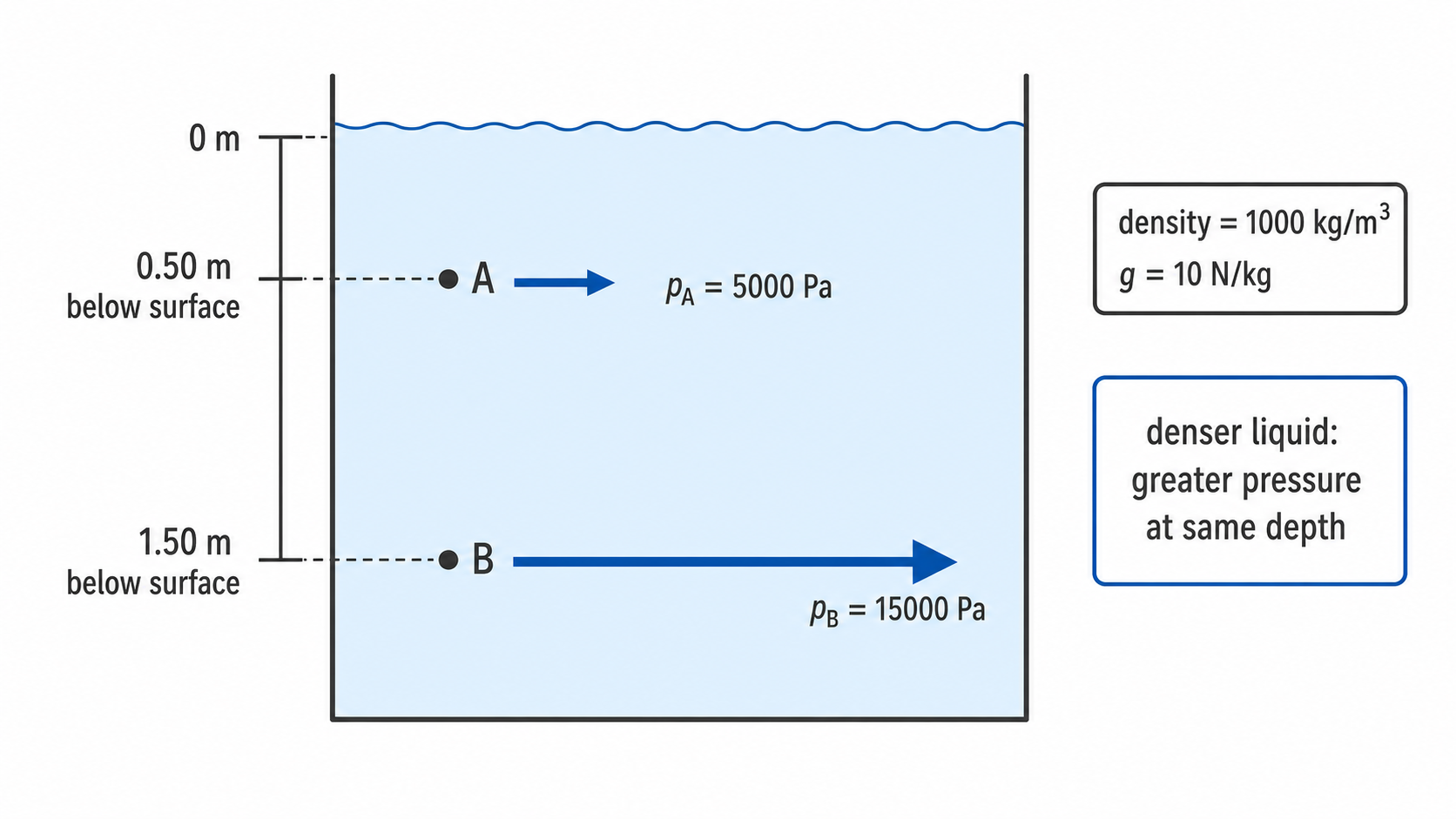
The diagram shows why the word "height" matters. Point B has a taller column of liquid above it than point A, so the pressure at B is larger.
Density matters as well. For the same height and the same value of , a denser liquid contains more mass in each cubic metre, so the column has more weight and produces a greater pressure.
Using the equation
Use with the height in metres and the density in kg/m^3. If the question gives a depth in centimetres, convert it before substituting.
Worked example: a point is below the surface of fresh water. The density of the water is , and . Calculate the pressure due to the water column.
The answer is in pascals because is pressure. A common mistake is to give , but newtons measure force, not pressure.
You may also need to rearrange the equation. If , then:
Example: if , , and , then:
Pressure differences
AQA can ask for the difference in pressure between two depths. You can calculate each pressure separately and subtract, but it is usually quicker to use the difference in height.
If two points are in the same liquid:
This is not a new equation to memorise. It comes from subtracting two values of .
Worked example: point X is below the surface of water and point Y is below the surface. The density of the water is , and . Calculate the pressure difference between Y and X.
Point Y is deeper, so the pressure at Y is greater than the pressure at X.
For pressure differences in one liquid, use the vertical difference in depth, not the total depth of the deeper point unless the shallower point is the surface.
This matters in upthrust. The bottom of a submerged object is deeper than the top, so the pressure at the bottom is greater.
Upthrust from pressure
A submerged object has liquid pressing on all of its surfaces. The horizontal pressure forces on opposite sides usually balance because they act in opposite directions at the same depth. The top and bottom are different: the bottom surface is deeper, so the liquid pressure on the bottom is greater than the liquid pressure on the top.
Continue this lesson.
You’re previewing NovaLearn without an account. Create a free account to read the rest.
Create free account