4.5.7.2 - Conservation of Momentum
Momentum can be used as a model for what happens during a collision. In this Higher Tier lesson, you will use the idea that total momentum is conserved in a closed system. The calculation questions in this specification point are Physics-only, but the core idea is the same throughout: count all the momentum before the event and all the momentum after it.
The closed-system rule
Momentum is not created or destroyed in a closed system. It can be passed from one object to another during an event, but the total amount of momentum for the system stays the same.
Conservation of momentum
In a closed system, the total momentum before an event is equal to the total momentum after the event.
For collision questions, the system means the objects you are choosing to study. A closed system is one where there is no resultant external force on those objects during the event, or any external forces are small enough to ignore for the short collision time.
This means:
- include all the objects taking part in the collision
- work out each object's momentum before the collision
- work out each object's momentum after the collision
- compare the totals, not just one object
The total momentum of one object may change. The total momentum of the whole closed system does not.
Momentum accounting
Conservation of momentum is an accounting method. Add all the momenta before the collision. Then add all the momenta after the collision. For a closed system, the totals must be equal.
Conservation of momentum model
For one-dimensional collisions, choose one direction as positive. Then use for each object, remembering that velocity and momentum can be negative if the object moves in the opposite direction.
For two objects moving along a straight line:
[DIAGRAM: asset_name: sticky_trolley_collision_accounting - diagram 1; asset_slug: 081_4_5_7_2_conservation_of_momentum_diagram1; file: diagram_assets/081_4_5_7_2_conservation_of_momentum_diagram1.png; recommended_method: image_gen; description: Image-generated two-panel collision schematic. Before: Trolley A has mass 2.0 kg and velocity +3.0 m/s, so p = +6.0 kg m/s; Trolley B has mass 1.0 kg and velocity 0 m/s, so p = 0. After: the trolleys stick together with combined mass 3.0 kg and velocity +2.0 m/s, so p = +6.0 kg m/s. The visual shows total momentum before = total momentum after, with right chosen as positive.]
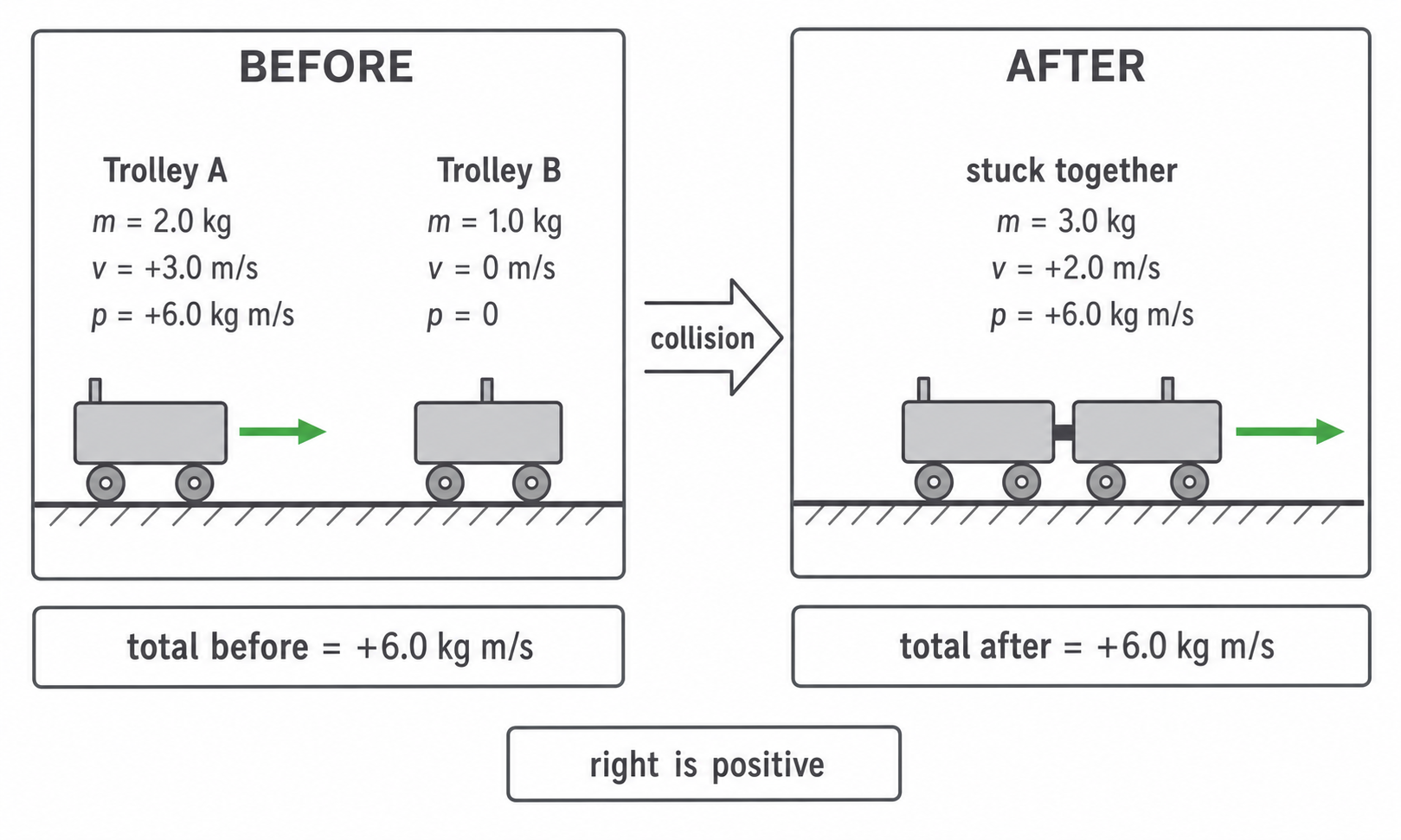
Worked example: a 2.0 kg trolley moving right at 3.0 m/s collides with a stationary 1.0 kg trolley. They stick together. Calculate their velocity after the collision.
Before the collision:
After the collision, the trolleys move together, so the combined mass is:
Momentum is conserved:
The velocity after the collision is 2.0 m/s to the right.
Direction and signs
Momentum has direction because velocity has direction. In a straight-line collision, set up a sign convention before calculating.
For example:
- right is positive
- left is negative
An object moving right has positive velocity and positive momentum. An object moving left has negative velocity and negative momentum. Negative momentum does not mean "less momentum"; it means momentum in the negative direction.
Worked example: Trolley A has mass 1.2 kg and moves right at 4.0 m/s. Trolley B has mass 0.80 kg and moves left at 3.0 m/s. The trolleys stick together. Calculate their velocity after the collision.
Taking right as positive:
After collision, the combined mass is:
The positive answer means the joined trolleys move right at 1.2 m/s.
In collision calculations, add momenta with signs. Do not add all speeds as positive numbers.
The next check focuses only on finding the signed total momentum before any further collision calculation.
Explaining collisions
Momentum conservation can explain what happens in a collision without needing every detail of the contact forces.
Imagine a moving trolley hitting a stationary trolley. During the collision:
- the moving trolley loses some momentum
- the stationary trolley gains momentum
- the total momentum of both trolleys stays the same if the system is closed
Continue this lesson.
You’re previewing NovaLearn without an account. Create a free account to read the rest.
Create free account