4.5.1.4a - Resultant Forces in Straight Lines
When more than one force acts on an object, their combined effect can be replaced by one single force. That single equivalent force is called the resultant force. In this lesson, all forces act along one straight line, so the calculation is about size and direction: add forces that pull or push the same way, and subtract forces that act in opposite ways.
What resultant force means
A force is measured in newtons, N, and has a direction. If two people push a box, the box does not experience two separate "stories" of motion; the forces combine into one overall effect.
Resultant Force
The resultant force is the single force that has the same effect as all the original forces acting together.
For this lesson, the forces are in one straight line. Directions can be named using pairs such as right/left, forwards/backwards, upward/downward, or east/west. A full answer to a resultant-force calculation should include both:
- the size of the resultant force in newtons
- the direction of the resultant force
[DIAGRAM: asset_name: Resultant Forces in Straight Lines - diagram 1; asset_slug: 056_4_5_1_4a_resultant_forces_in_straight_lines_diagram1; file: diagram_assets/056_4_5_1_4a_resultant_forces_in_straight_lines_diagram1.png; recommended_method: image_gen; description: Exact force-arrow diagram showing an object with two straight-line forces, 6 N to the right and 2 N to the left, replaced by one equivalent resultant force of 4 N to the right. This visual teaches the definition of resultant force as a single equivalent force, with assessed labels and directions.]
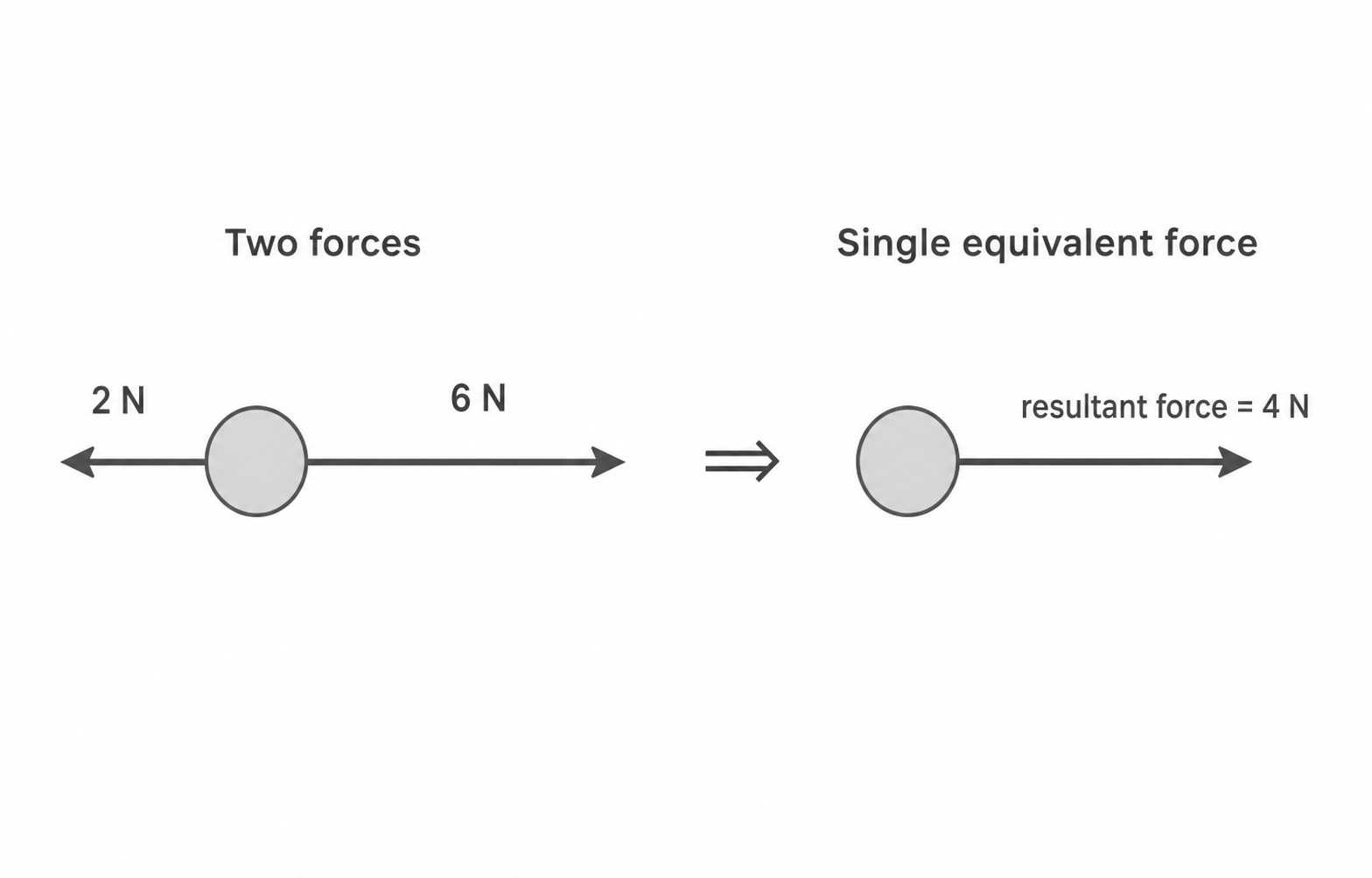
The diagram does not mean the smaller force disappears. It means that, for the overall effect on the object, the two original forces are equivalent to one 4 N force to the right.
Forces in the same direction
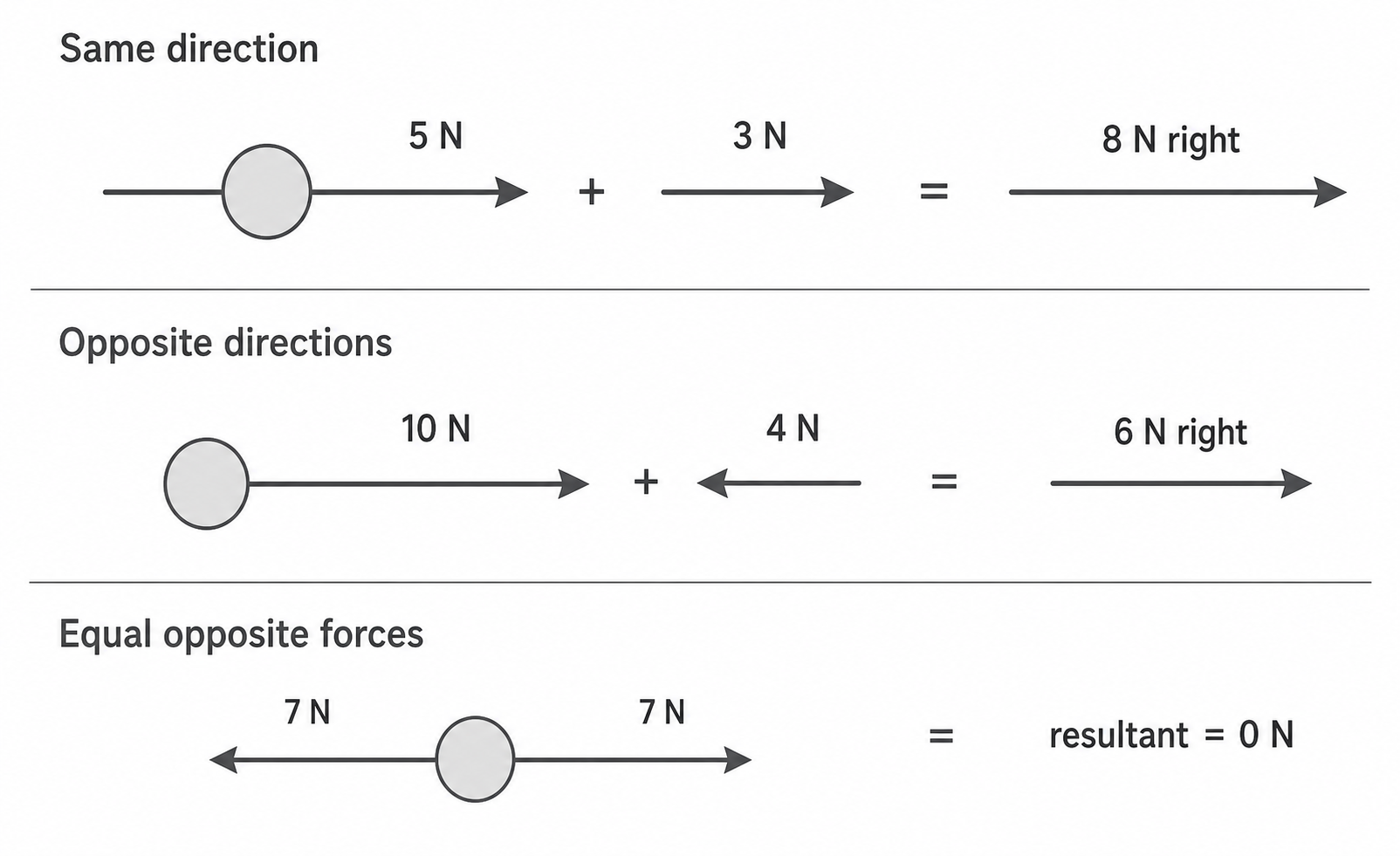
When two forces act along the same straight line and in the same direction, their effects support each other. Add the forces.
For example, if two students push a trolley to the right with forces of 12 N and 8 N:
The direction stays the same because both forces act the same way.
| Force 1 | Force 2 | Calculation | Resultant force |
|---|---|---|---|
5 N right | 3 N right | 5 + 3 | 8 N right |
40 N forward | 25 N forward | 40 + 25 | 65 N forward |
2.0 N upward | 1.5 N upward | 2.0 + 1.5 | 3.5 N upward |
Forces in opposite directions
When two forces act along the same straight line but in opposite directions, their effects work against each other. Subtract the smaller force from the larger force, then give the direction of the larger force.
[DIAGRAM: asset_name: Resultant Forces in Straight Lines - diagram 2; asset_slug: 056_4_5_1_4a_resultant_forces_in_straight_lines_diagram2; file: diagram_assets/056_4_5_1_4a_resultant_forces_in_straight_lines_diagram2.png; recommended_method: image_gen; description: Exact three-row force-arrow calculation diagram for two collinear forces: same direction 5 N right plus 3 N right gives 8 N right; opposite directions 10 N right and 4 N left gives 6 N right; equal opposite forces 7 N right and 7 N left give 0 N. Labels, directions and resultant values are assessed.]
Continue this lesson.
You’re previewing NovaLearn without an account. Create a free account to read the rest.
Create free account