4.4.2.1b - Properties and Uses of Nuclear Radiation
Alpha, beta and gamma radiation behave differently as they travel through air and materials. This lesson is about those properties: penetration, range in air and ionising power. The exam skill is to use those properties to choose the best radiation source for a situation and to justify why the other sources are less suitable.
The properties to compare
In this specification point, you only need to compare alpha radiation, beta radiation and gamma radiation. The required comparison is limited to three properties:
| Property | Meaning in this lesson |
|---|---|
| penetration through materials | how easily the radiation passes through absorbers such as paper, aluminium or lead |
| range in air | how far the radiation can travel through air before it is absorbed or becomes too weak to detect |
| ionising power | how strongly the radiation can remove electrons from atoms and make ions |
Ionising radiation
Ionising radiation has enough energy to remove electrons from atoms, producing ions.
Ionising power matters because ionisation is both useful and hazardous. A source can be useful if ionisation makes a detector respond, but a highly ionising source can damage living cells if the radiation reaches them.
For this lesson, keep the focus on alpha, beta and gamma. Neutron radiation, nuclear equations, half-life and contamination are separate specification points.
Penetration and range
Alpha radiation is the least penetrating. It is stopped by a thin sheet of paper, the outer dead layer of skin, or a few centimetres of air. That means alpha radiation has a short range in air.
Beta radiation is more penetrating than alpha radiation. It can pass through paper and travel further through air, but it is usually stopped by a few millimetres of aluminium or plastic.
Gamma radiation is the most penetrating of the three. It can travel a long distance through air and can pass through paper and thin aluminium. Thick lead or concrete reduces gamma radiation, but it is better to say gamma is "reduced" rather than completely stopped.
[DIAGRAM: asset_name: alpha-beta-gamma-penetration-range-and-ionising-power - diagram 1; asset_slug: 043_4_4_2_1b_properties_and_uses_of_nuclear_radiation_diagram1; file: diagram_assets/043_4_4_2_1b_properties_and_uses_of_nuclear_radiation_diagram1.png; recommended_method: image_gen; description: Assessed comparison diagram showing alpha stopped by paper/skin after a few centimetres of air, beta passing through paper but stopped by thin aluminium or plastic, and gamma passing through paper and aluminium but being reduced by thick lead or concrete. It also labels the relative ionising power as alpha strong, beta medium and gamma weak, and the relative range in air as short, medium and long. The lesson prose gives the same information for accessibility.]
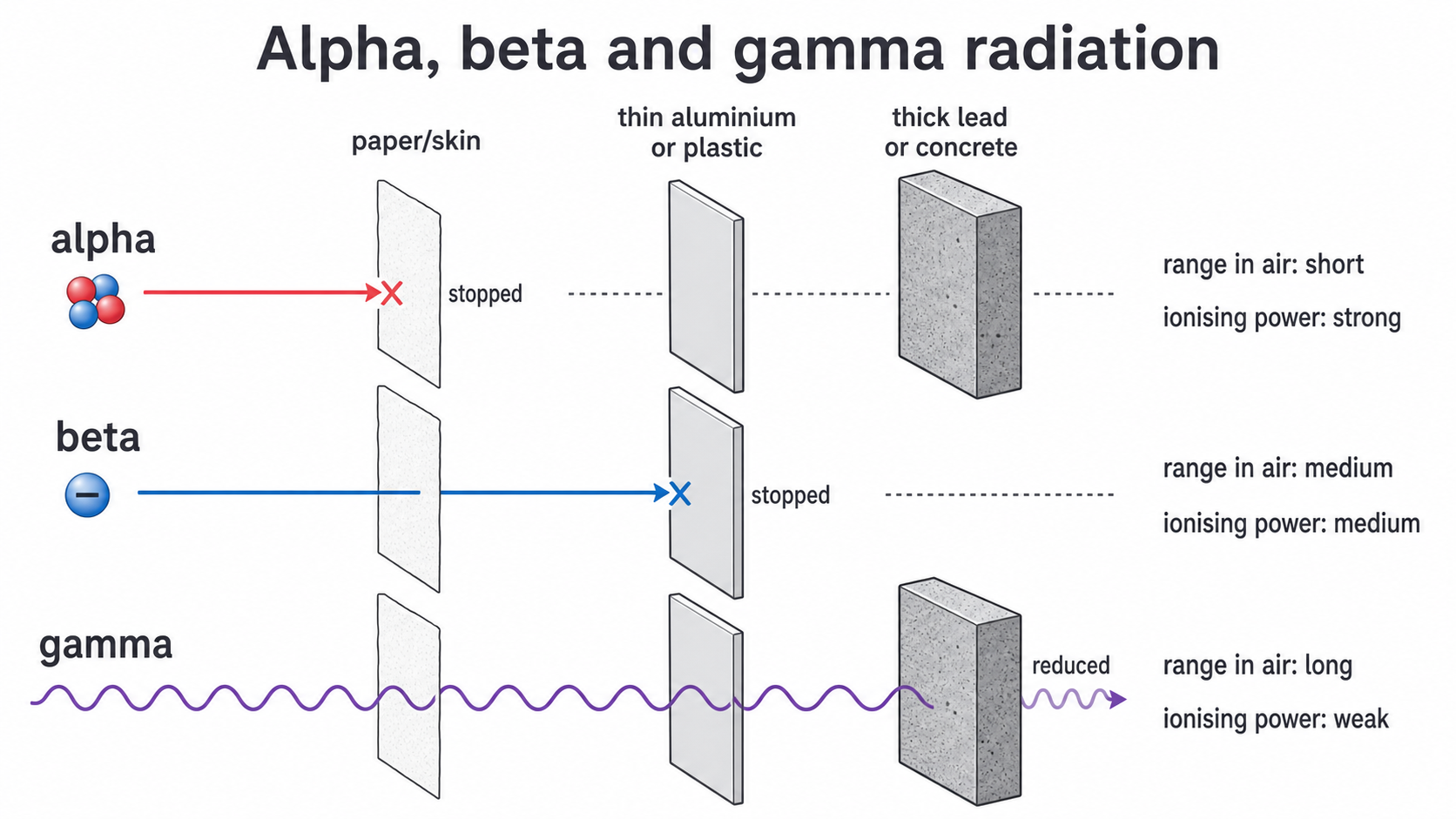
The easiest memory order is:
penetration and range: alpha < beta < gamma
That order is reversed for ionising power, which comes next.
Ionising power
Ionising power tells you how strongly the radiation interacts with atoms along its path.
Alpha radiation is strongly ionising. It loses its energy quickly because it interacts strongly with atoms, so it does not travel far.
Beta radiation is moderately ionising. It interacts less strongly than alpha radiation, so it can travel further and penetrate more material.
Gamma radiation is weakly ionising. It interacts least often with atoms, so it has the greatest penetration and longest range.
| Radiation | Ionising power | Penetration and range |
|---|---|---|
| alpha | strongest | shortest range, least penetrating |
| beta | medium | medium range and penetration |
| gamma | weakest | longest range, most penetrating |
Strongly ionising does not mean "most useful" in every situation. If the radiation cannot reach the place where it is needed, its strong ionising power is no help.
Continue this lesson.
You’re previewing NovaLearn without an account. Create a free account to read the rest.
Create free account