4.5.6.1.2 - Speed
Speed tells you how fast something is moving. In physics, speed is a scalar quantity, so it has a size and a unit but no direction. This lesson covers typical speeds, measuring distance and time, and using s = vt for constant speed and average speed.
Speed as a scalar
Speed is a measure of how quickly distance is travelled. A faster object travels more distance in the same time, or the same distance in less time.
Speed
Speed is the distance travelled per unit time.
Speed does not include direction. For example, 4 m/s is a speed. If an answer says 4 m/s north, the direction has been added, so that is no longer just a speed statement.
Scalar quantity
A scalar quantity has magnitude only; it has no associated direction.
The unit m/s means metres per second. A speed of 4 m/s means the object travels 4 m every second if the speed stays constant.
Typical speeds
The speed of a moving object is rarely constant. When people walk, run, cycle or travel in vehicles, their speed changes during the journey.
For people, speed depends on factors such as age, terrain, fitness and distance travelled. A person may walk more slowly uphill than on level ground, and a sprint is not the same as a long run.
The AQA typical values to recall are:
| Motion | Typical speed |
|---|---|
| walking | about 1.5 m/s |
| running | about 3 m/s |
| cycling | about 6 m/s |
| sound in air | about 330 m/s |
[DIAGRAM: asset_name: Typical speed values - diagram 1; asset_slug: 067_4_5_6_1_2_speed_diagram1; file: diagram_assets/067_4_5_6_1_2_speed_diagram1.png; recommended_method: image_gen; description: Image-generated two-panel comparison chart showing AQA typical values: walking 1.5 m/s, running 3 m/s, cycling 6 m/s, and sound in air 330 m/s. The visual teaches the recall values and shows why sound needs a separate scale.]
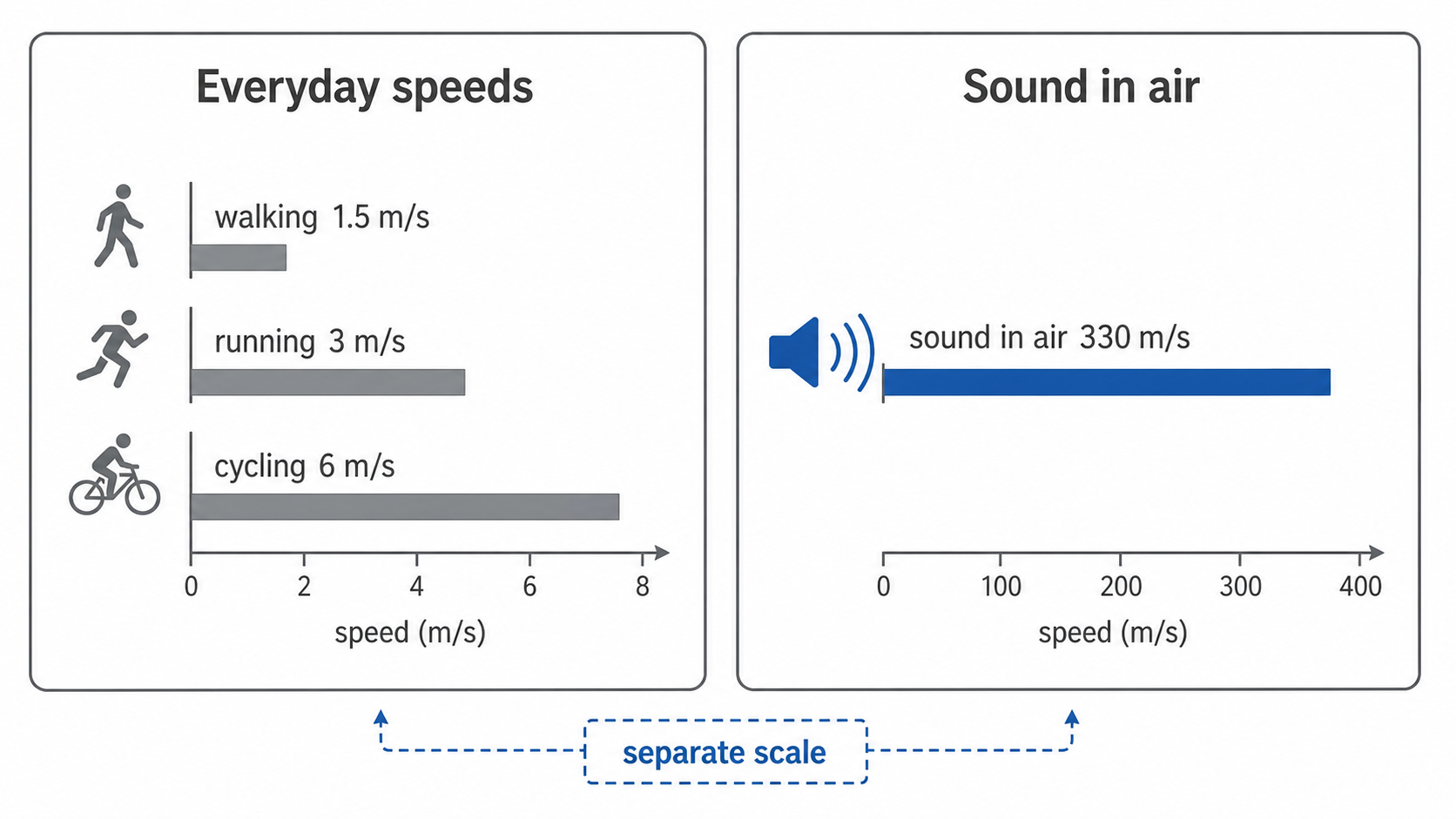
The word typical matters. These are useful values for estimates, not promises about every person or every situation.
Speed is not only used for visible objects moving from one place to another. Wind speed varies, and the speed of sound in air also varies with conditions, but 330 m/s is the typical value to recall for sound in air.
For transportation systems, learn the order of size. A town car or bus may be around 10 m/s, a train may be tens of metres per second, and an aeroplane may be hundreds of metres per second. In an exam, these values help you reject answers that are clearly too small or too large.
Measuring speed
To calculate the speed of an object, measure:
- the distance travelled, in metres,
m - the time taken, in seconds,
s
For a simple school measurement, mark out a known distance using a metre ruler, tape measure or trundle wheel. Use a stopwatch, data logger or light gates to measure the time taken to travel that distance.
[DIAGRAM: asset_name: Measuring average speed - diagram 2; asset_slug: 067_4_5_6_1_2_speed_diagram2; file: diagram_assets/067_4_5_6_1_2_speed_diagram2.png; recommended_method: image_gen; description: Image-generated schematic showing start and finish markers 20 m apart, a moving person, a stopwatch reading 8.0 s, and the calculation v = 20 m ÷ 8.0 s = 2.5 m/s. The visual teaches how measured distance and measured time are used to calculate average speed.]
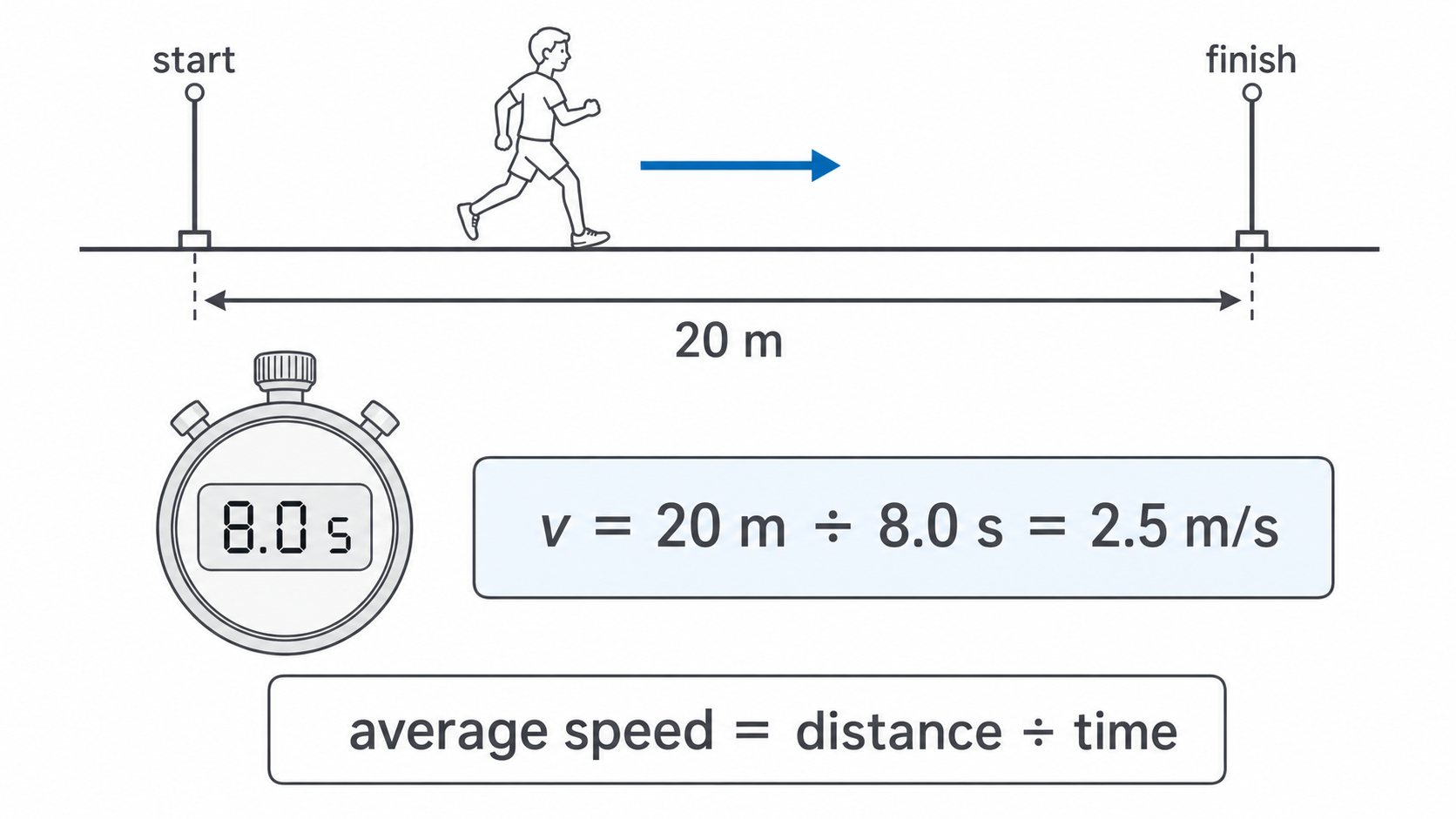
Repeating the timing can make the result more reliable. If one time is very different because the timer started late or the object slipped, treat it as an anomalous reading and do not use it in the mean without a reason.
This scaffold point is not one of the required practicals, but the same measurement habits still matter: clear distance, clear timing, repeated readings, and correct units.
Continue this lesson.
You’re previewing NovaLearn without an account. Create a free account to read the rest.
Create free account