4.7.1.1 - Poles of a Magnet
Magnets can push or pull other magnets even when they are not touching. This lesson is about the poles where those magnetic forces are strongest, how permanent magnets attract or repel, and how induced magnets behave differently from permanent magnets.
Magnetic poles
The poles of a magnet are the places where the magnetic forces are strongest. A simple bar magnet has two poles: a north pole and a south pole.
Magnetic pole
A magnetic pole is a region of a magnet where the magnetic force is strongest.
The poles are usually at the ends of a bar magnet. If a magnet attracts a paperclip, the paperclip is often pulled most strongly towards one end of the magnet because that end is a pole.
Do not describe a pole as the place where a magnet "stores magnetism". The exam idea is about force: the poles are the places where magnetic forces are strongest.
Attraction and repulsion
When two permanent magnets are brought close together, they exert forces on each other. These forces can be attraction or repulsion.
The rule is:
- two like poles repel each other
- two unlike poles attract each other
Like poles means north near north, or south near south. Unlike poles means north near south.
[DIAGRAM: asset_name: permanent magnet pole forces - diagram 1; asset_slug: 101_4_7_1_1_poles_of_a_magnet_diagram1; file: diagram_assets/101_4_7_1_1_poles_of_a_magnet_diagram1.png; recommended_method: image_gen; description: Assessed pole-interaction diagram comparing permanent magnets with like poles facing and unlike poles facing. Top panel: N facing N with arrows on each magnet pointing away to show repulsion. Bottom panel: N facing S with arrows on each magnet pointing towards each other to show attraction. Labels: N, S, like poles repel, unlike poles attract, non-contact force across gap. Image generated with built-in Codex Image Gen.]
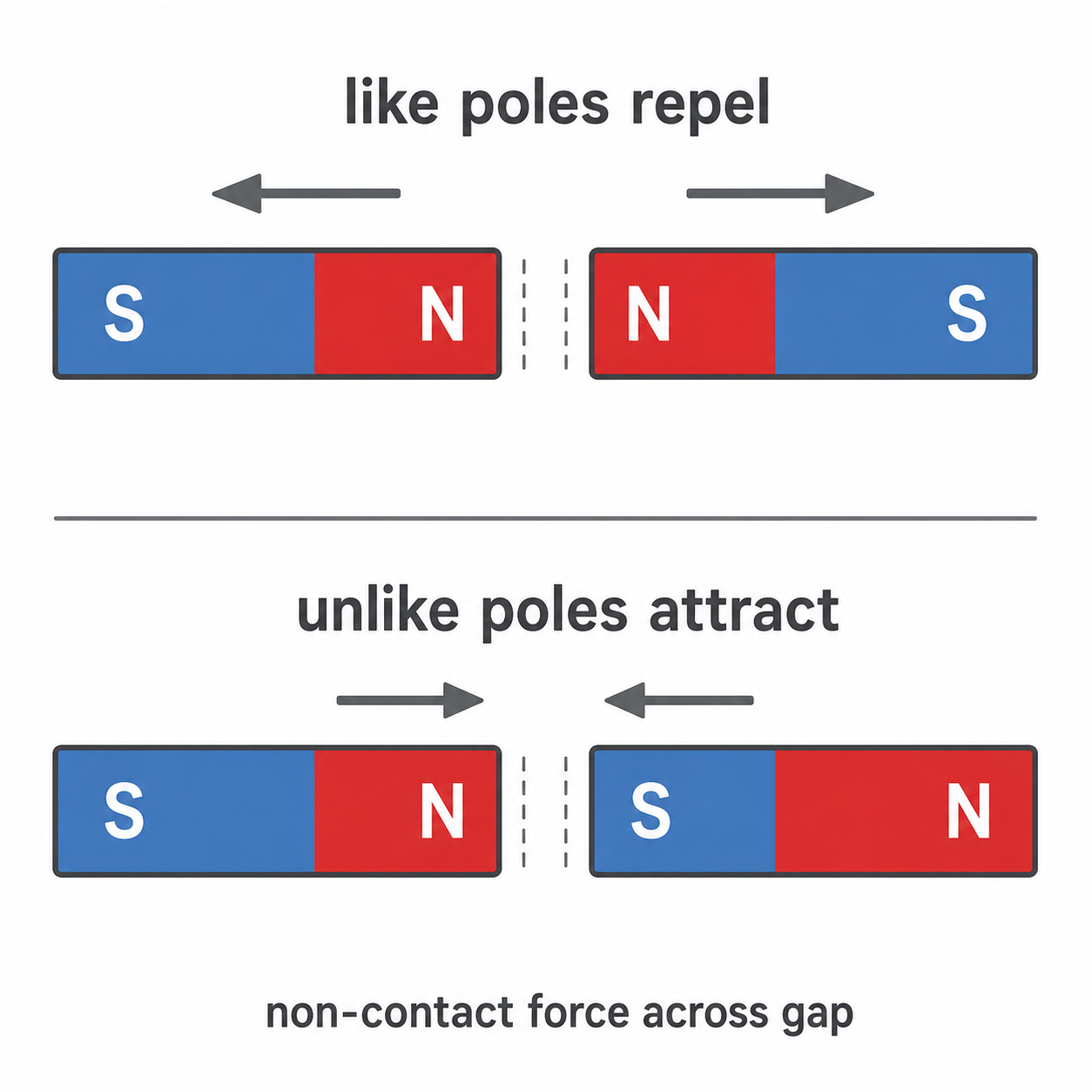
Attraction and repulsion between magnetic poles are non-contact forces. The magnets do not have to touch. The force acts across the gap between them.
A common mistake is to say that "north poles attract" or "south poles repel" on their own. The force depends on the pair of poles facing each other: like poles repel, unlike poles attract.
Permanent magnets
A permanent magnet produces its own magnetic field. That means it can exert magnetic forces without first being placed in another magnet's field.
Permanent magnet
A permanent magnet is a magnet that produces its own magnetic field.
Permanent magnets can attract or repel other permanent magnets. Which one happens depends on which poles face each other. If two north poles face each other, the magnets repel. If a north pole and a south pole face each other, the magnets attract.
The word permanent does not mean the magnet can never be weakened or damaged. It means that, in normal use, it remains magnetised and produces its own magnetic field without needing another magnet nearby.
Continue this lesson.
You’re previewing NovaLearn without an account. Create a free account to read the rest.
Create free account