4.4.1.3 - The Development of the Model of the Atom
The atomic model did not appear fully formed. Scientists changed it when new evidence made the old model unable to explain what had been observed. In this lesson, the important story is not memorising dates; it is explaining why each model replaced or improved the one before it.
Models change with evidence
A scientific model is a simplified picture or description that helps scientists explain observations and make predictions. A model is useful only while it fits the evidence. If new experimental evidence does not fit the model, scientists may change the model or replace it.
Scientific model
A scientific model is a simplified representation of an idea, object or process that helps scientists explain observations and make predictions.
Before the discovery of the electron, atoms were thought to be tiny spheres that could not be divided. This is sometimes called the solid sphere model. It treated atoms as indivisible particles, so it could not include smaller charged particles inside the atom.
[DIAGRAM: asset_name: evidence-driven-atomic-model-timeline - diagram 1; asset_slug: 041_4_4_1_3_development_of_the_atomic_model_diagram1; file: diagram_assets/041_4_4_1_3_development_of_the_atomic_model_diagram1.png; recommended_method: image_gen; description: Assessed timeline showing the sequence tiny indivisible sphere, plum pudding model, nuclear model, Bohr model, and nucleus with protons and neutrons. Each stage has one short evidence trigger: electron discovered, alpha scattering evidence, Bohr calculations matched observations, later evidence for protons and neutrons. The visual teaches model change over time and uses exact GCSE labels.]
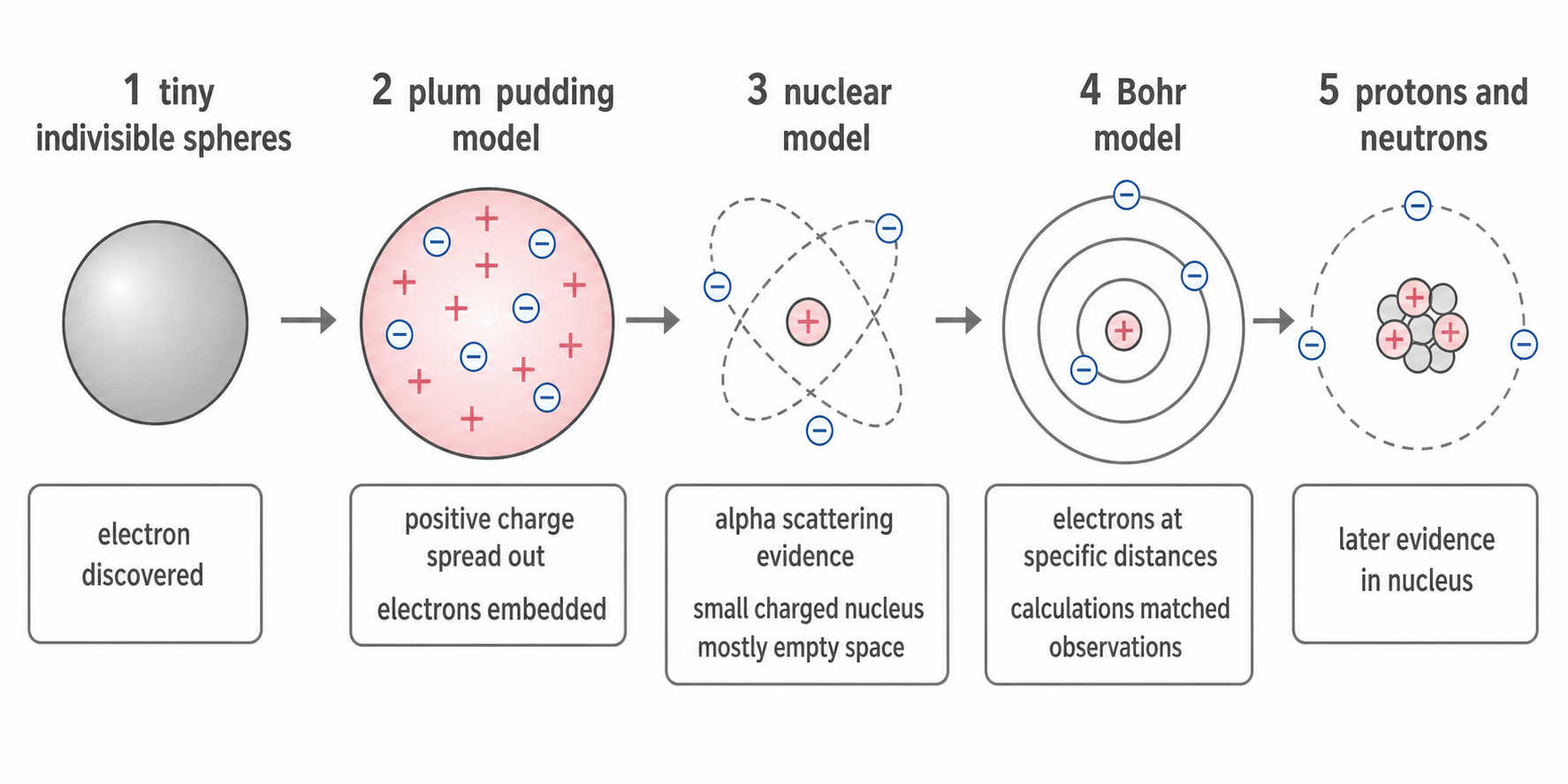
The diagram is a roadmap. The rest of the lesson explains what evidence caused each change and what the new model said about the atom.
The electron and plum pudding model
The discovery of the electron showed that atoms were not indivisible solid spheres. Electrons are negatively charged particles, so the model of the atom had to include smaller parts inside the atom.
The plum pudding model suggested that an atom is a ball of positive charge with negative electrons embedded in it. In this model, the positive charge is spread throughout the atom, with electrons sitting inside the positive material.
Plum pudding model
The plum pudding model describes the atom as a ball of positive charge with negative electrons embedded in it.
The name is only an analogy. The important assessed physics is the charge arrangement: positive charge spread through the atom, with negative electrons embedded in it.
Alpha scattering and the nuclear model
The alpha particle scattering experiment gave evidence that did not fit the plum pudding model. Positive alpha particles were directed at a very thin metal foil. Most alpha particles passed straight through the foil, some were deflected, and a very small number were deflected through large angles or came back.
[DIAGRAM: asset_name: alpha-scattering-evidence-for-the-nuclear-model - diagram 2; asset_slug: 041_4_4_1_3_development_of_the_atomic_model_diagram2; file: diagram_assets/041_4_4_1_3_development_of_the_atomic_model_diagram2.png; recommended_method: image_gen; description: Assessed two-panel diagram comparing alpha particle paths if positive charge were spread out in the plum pudding model with the observed nuclear-model explanation. Left panel shows most alpha particles predicted to pass through with little deflection. Right panel shows most passing through empty space, some deflected by the small charged nucleus, and one rare large deflection. Labels must include positive alpha particles, small charged nucleus, mass concentrated in nucleus, and atom mostly empty space.]
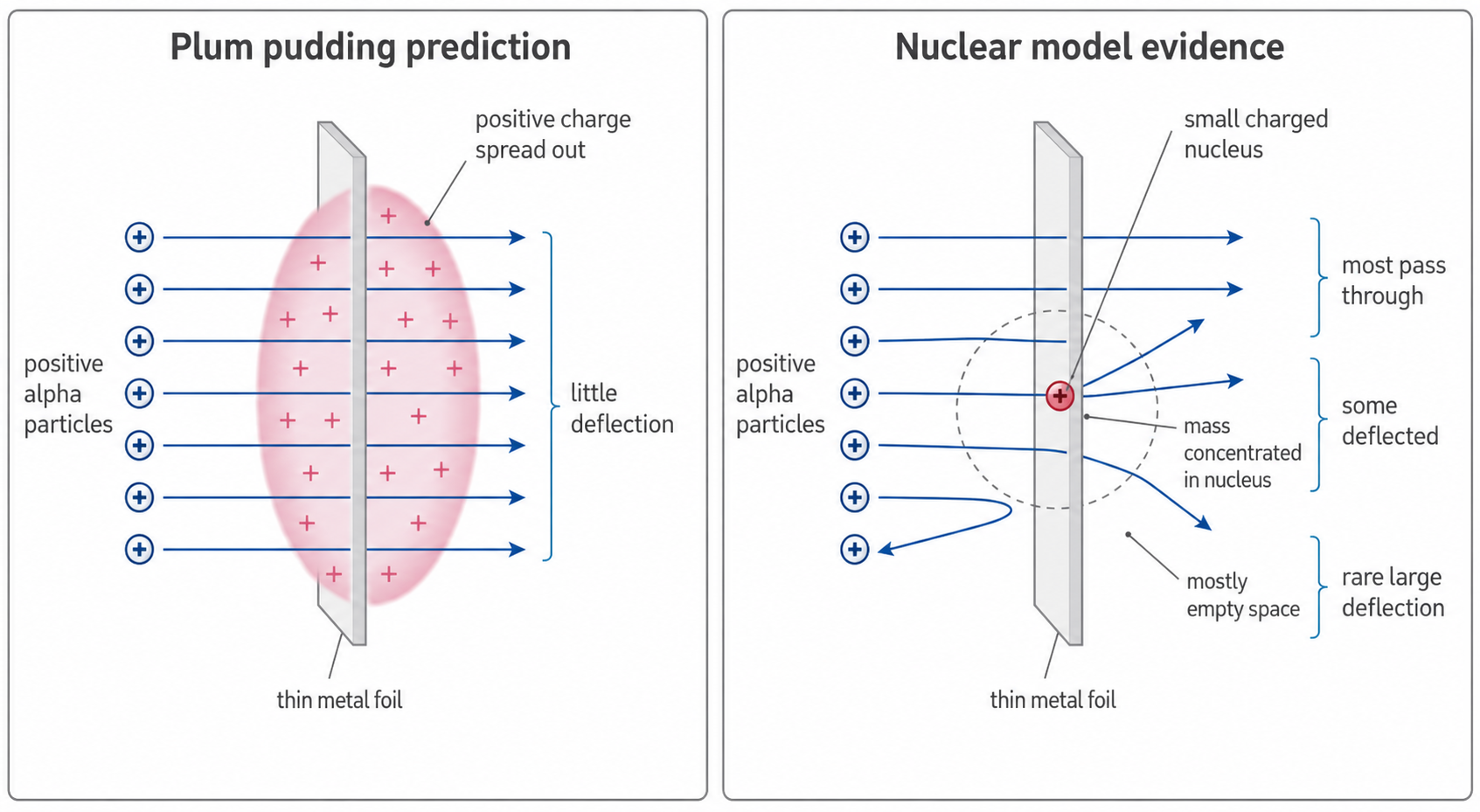
The key reasoning is:
| Observation from scattering | Conclusion about the atom |
|---|---|
| Most alpha particles passed straight through | most of the atom is empty space |
| Some alpha particles were deflected | there is a charged centre that repels positive alpha particles |
| A few alpha particles were deflected through large angles | the charged centre is very small and concentrated |
This led to the nuclear model. The nuclear model replaced the plum pudding model because it placed the mass of the atom at the centre in a small charged nucleus.
Nuclear model
The nuclear model describes the atom as having a small charged nucleus at the centre, where the mass is concentrated, with electrons around the nucleus.
Do not say that alpha particles "hit" the nucleus as the main explanation. In GCSE answers, the important idea is that positive alpha particles are repelled by the charged nucleus, especially when they pass close to it.
Continue this lesson.
You’re previewing NovaLearn without an account. Create a free account to read the rest.
Create free account