4.6.2.1 - The Electromagnetic Spectrum
Electromagnetic waves are one family of transverse waves. They transfer energy from a source to an absorber, and they can travel through empty space. This lesson is about the shared features of the whole electromagnetic spectrum, the order of the groups, and why visible light is only the small part our eyes can detect.
EM waves transfer energy
An electromagnetic wave is a wave made from changing electric and magnetic fields. At GCSE level, the key idea is simpler than that: electromagnetic waves are transverse waves, and they transfer energy.
Transverse wave
In a transverse wave, the oscillations are perpendicular to the direction in which the wave travels.
The source is where the wave is emitted. The absorber is the object or material that receives the wave energy. For example, the Sun can act as a source of electromagnetic waves, and your skin, a black surface, or a solar cell can act as an absorber.
When an absorber takes in electromagnetic radiation, energy is transferred to the absorber. The absorber's energy store may increase. For example, infrared radiation from a heater can increase the thermal energy store of your skin.
A continuous spectrum
The electromagnetic spectrum is continuous. This means it is not made of separate, isolated waves with gaps between them. Instead, electromagnetic waves can have a continuous range of wavelengths and frequencies.
Scientists group that continuous range into named regions. The names are useful because different parts of the spectrum have different wavelengths and frequencies, and are detected or absorbed in different ways. The group boundaries are not the main assessed idea here; the order is.
All types of electromagnetic wave travel at the same velocity through a vacuum or through air. In a vacuum this speed is about 3.0 x 10^8 m/s. The important GCSE point is that gamma rays do not travel faster than radio waves just because they have a higher frequency. In vacuum or air, their speed is the same.
Because the waves have the same speed in vacuum or air, wavelength and frequency change in opposite directions across the spectrum. Longer wavelength means lower frequency. Shorter wavelength means higher frequency.
The electromagnetic spectrum is continuous, but it is grouped by wavelength and frequency for convenience.
Order of the spectrum
Going from long wavelength to short wavelength, the groups are:
- radio
- microwave
- infrared
- visible light
- ultraviolet
- X-rays
- gamma rays
Going in the same direction, frequency increases. So the order from low frequency to high frequency is the same list: radio, microwave, infrared, visible light, ultraviolet, X-rays, gamma rays.
[DIAGRAM: asset_name: electromagnetic_spectrum_order - diagram 1; asset_slug: 091_4_6_2_1_the_electromagnetic_spectrum_diagram1; file: diagram_assets/091_4_6_2_1_the_electromagnetic_spectrum_diagram1.png; recommended_method: image_gen; description: Assessed spectrum-order image-generated visual showing radio, microwave, infrared, visible light, ultraviolet, X-rays and gamma rays from long wavelength/low frequency to short wavelength/high frequency. Include arrows showing wavelength decreases and frequency increases from left to right, a visible-light inset labelled red to violet, and a note that all groups travel at the same velocity through vacuum or air.]
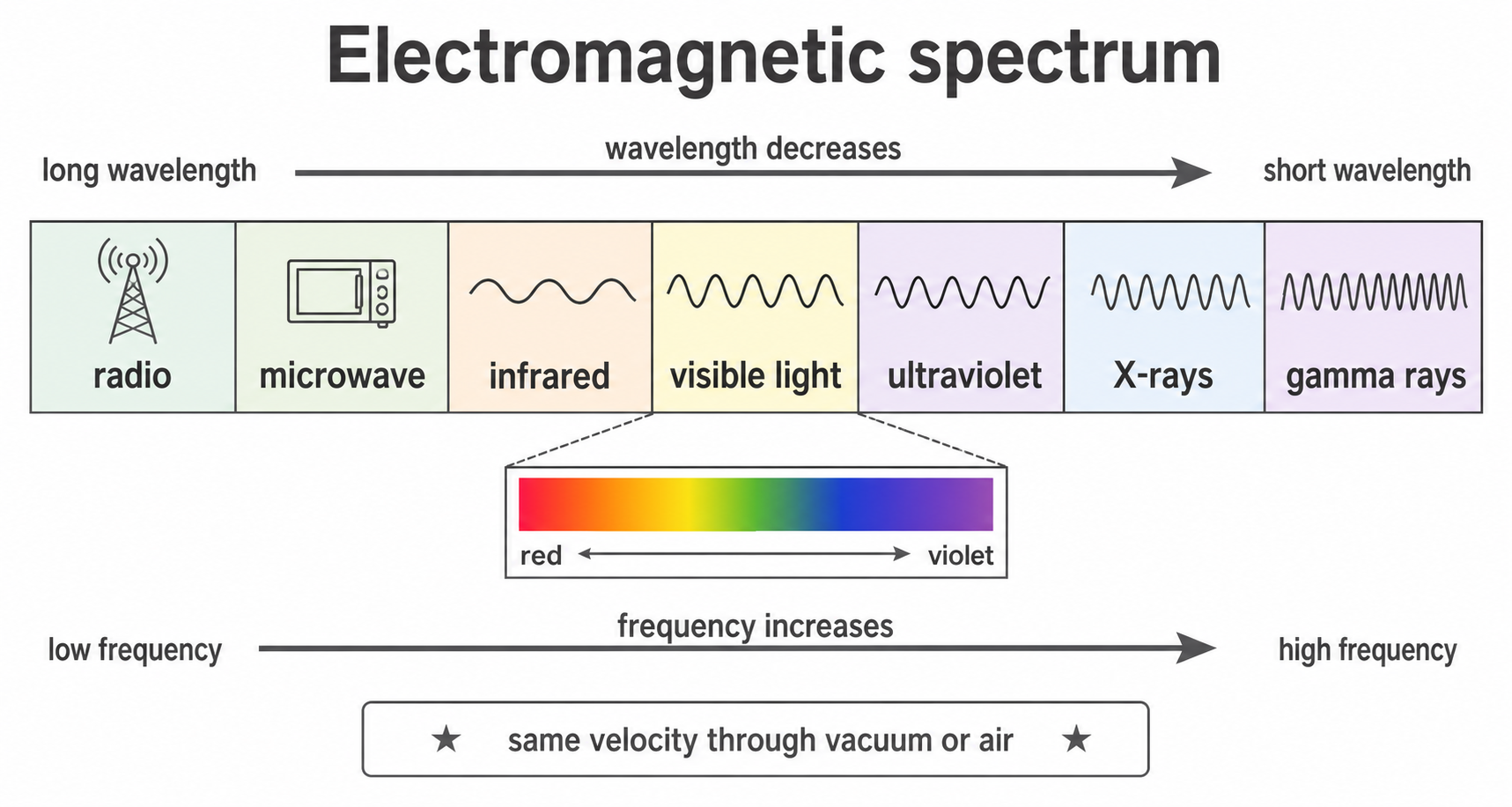
Visible light is itself a small band in the spectrum. In the visible band, red light has the longest wavelength and lowest frequency, and violet light has the shortest wavelength and highest frequency.
A common memory pattern is:
Radio, Microwave, Infrared, Visible, Ultraviolet, X-rays, Gamma
Do not turn this into a speed order. It is a wavelength and frequency order.
Continue this lesson.
You’re previewing NovaLearn without an account. Create a free account to read the rest.
Create free account