4.6.3.2 - Perfect Black Bodies and Radiation Balance
This physics-only lesson looks at radiation as an energy transfer that every object is involved in, not just objects that are glowing. The key idea is that temperature affects both the intensity of radiation emitted and the spread of wavelengths emitted. For Higher tier, you also need to explain temperature using a balance: radiation absorbed in compared with radiation emitted out.
Emission and temperature
All bodies, meaning all objects, emit radiation. A cool desk, a warm person, a hot saucepan and the Sun all emit electromagnetic radiation. Most everyday objects are not hot enough to glow visibly, so much of their emitted radiation is infrared.
A perfect black body is an ideal model used to think about radiation emission and absorption. In this lesson, the important point is how the radiation emitted by a body changes as its temperature changes.
Intensity
Intensity means the amount of radiation energy transferred each second through each square metre. A greater intensity means more radiation is being emitted or received in the same time and area.
Temperature changes the emission in two linked ways:
- a hotter body emits radiation with greater intensity
- a hotter body emits a different wavelength distribution, with the peak of the distribution at a shorter wavelength
The wavelength distribution means how the emitted radiation is spread across different wavelengths. A cooler object may emit mostly longer-wavelength infrared. A much hotter object emits more radiation overall and a larger proportion at shorter wavelengths.
[DIAGRAM: asset_name: Perfect Black Bodies and Radiation Balance - diagram 1; asset_slug: 100_4_6_3_2_perfect_black_bodies_and_radiation_balance_diagram1; file: diagram_assets/100_4_6_3_2_perfect_black_bodies_and_radiation_balance_diagram1.png; recommended_method: deterministic_drawn; description: Exact deterministic graph of relative intensity against wavelength for three black-body temperature curves. The cooler curve is lower with a longer-wavelength peak, the warmer curve is higher with a shorter-wavelength peak, and the hottest curve is highest with the shortest-wavelength peak. Labels show that increasing temperature increases intensity and shifts the peak to shorter wavelength. Deterministic drawing is required because the axes, curve shapes, peaks and labels carry assessed meaning.]
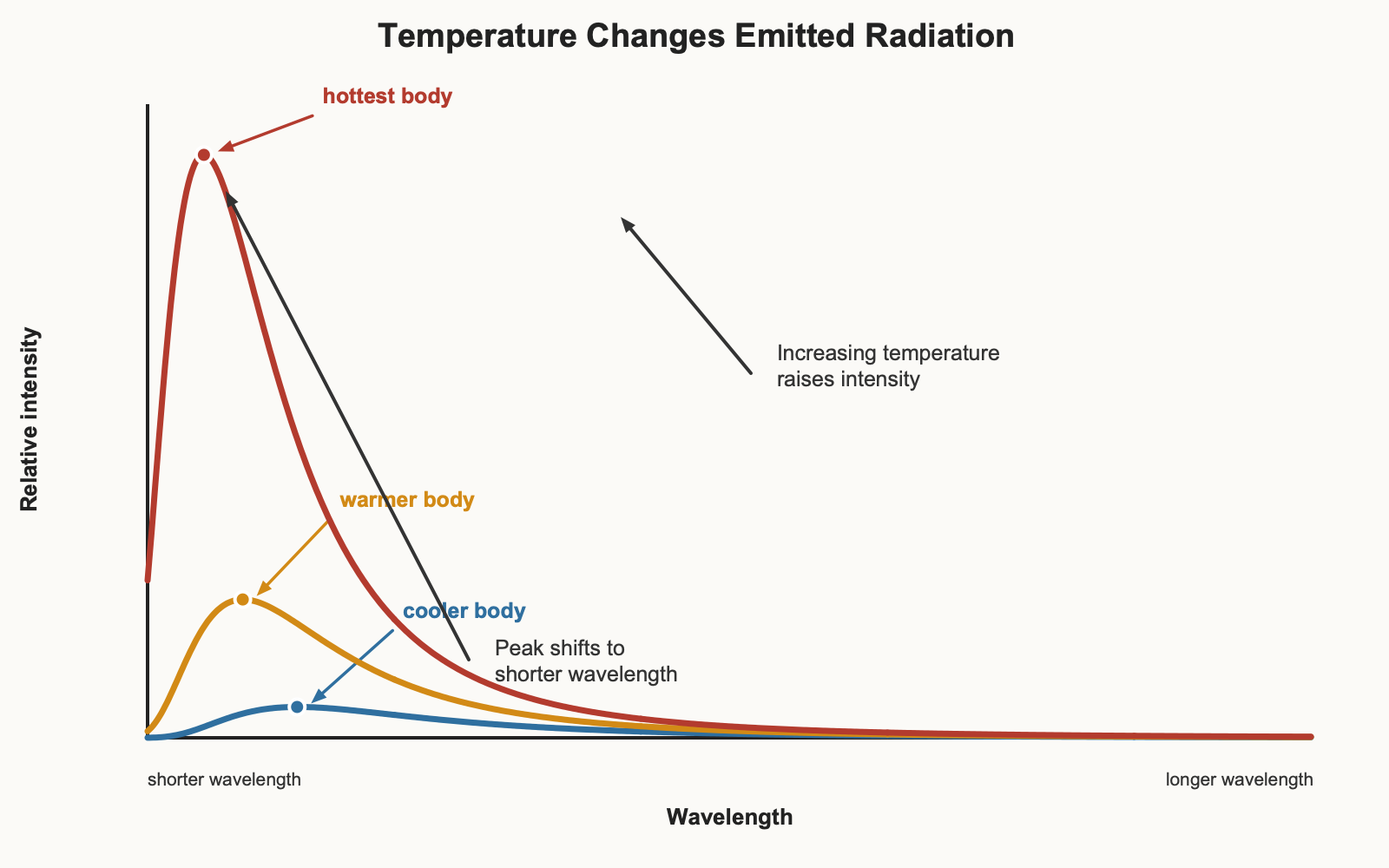
The graph does not give an equation that GCSE students need to recall. It is there to show the pattern: if the temperature increases, the emitted radiation becomes more intense and the peak moves towards shorter wavelengths.
HT: Radiation balance
Higher tier only. A body does not just emit radiation; it also absorbs radiation from its surroundings. Its temperature depends on the rate at which energy is transferred in by absorbed radiation compared with the rate at which energy is transferred out by emitted radiation.
At constant temperature, these two rates are equal:
rate of radiation absorbed = rate of radiation emitted
This does not mean no radiation is being transferred. Radiation is still being absorbed and emitted all the time. The temperature stays constant because there is no overall gain or loss of energy by radiation.
[DIAGRAM: asset_name: Perfect Black Bodies and Radiation Balance - diagram 2; asset_slug: 100_4_6_3_2_perfect_black_bodies_and_radiation_balance_diagram2; file: diagram_assets/100_4_6_3_2_perfect_black_bodies_and_radiation_balance_diagram2.png; recommended_method: image_gen; description: Three-panel radiation-balance diagram for a body. Panel A shows absorbed radiation greater than emitted radiation and temperature increasing. Panel B shows equal absorbed and emitted radiation and constant temperature. Panel C shows emitted radiation greater than absorbed radiation and temperature decreasing. Image generated with built-in Codex Image Gen.]
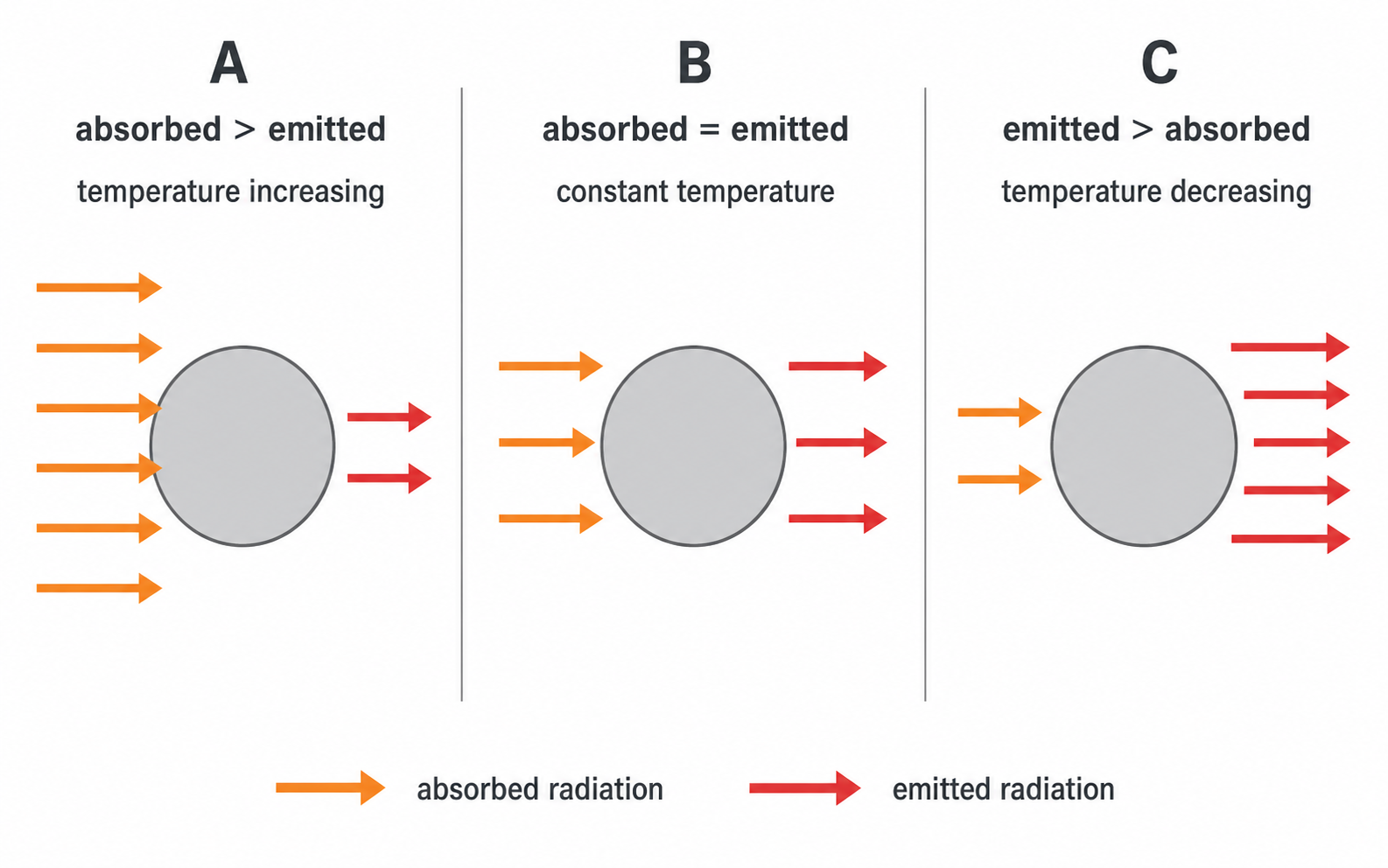
If a body absorbs radiation faster than it emits radiation, it gains energy and its temperature increases. As it gets hotter, it emits radiation more intensely. The temperature may then rise until the emitted rate matches the absorbed rate again.
If a body emits radiation faster than it absorbs radiation, it loses energy and its temperature decreases. As it cools, the intensity of the radiation it emits decreases. Cooling continues until a new balance is reached or another energy transfer changes the situation.
HT: Everyday examples
Higher tier only. Radiation balance can explain many everyday temperature changes. The useful question is always: is the object absorbing radiation faster than it is emitting it, or emitting faster than it is absorbing?
A person standing near a fire absorbs infrared radiation from the fire. If that absorbed radiation is greater than the radiation the person emits to the surroundings, the person feels warmer. If the person moves away, the absorbed radiation from the fire decreases, so the person may emit radiation faster than they absorb it and cool down.
A mug of hot drink in a cooler room emits infrared radiation more intensely than the cooler surroundings emit back to it. Radiation is not the only way the drink cools, but for radiation alone the drink loses energy because emission is greater than absorption.
A parked car in strong sunlight can warm up because it absorbs radiation from the Sun and its surroundings. It will not warm forever. As the car gets hotter, it emits radiation more intensely, so the balance shifts towards a higher steady temperature.
Continue this lesson.
You’re previewing NovaLearn without an account. Create a free account to read the rest.
Create free account