4.6.2.2a - Refraction of Electromagnetic Waves
This Higher Tier lesson is about what happens when electromagnetic waves meet a boundary between substances. Different substances can absorb, transmit, reflect or refract waves differently, and the effect can depend on wavelength. The key idea is that refraction happens because the wave travels at a different speed in the new substance.
Interactions at boundaries
When an electromagnetic wave reaches a substance, all of its energy does not have to do the same thing. Some of the wave may be absorbed by the substance, some may be transmitted through it, some may be reflected from the surface, and some may be refracted as it enters.
Absorption
Absorption is when energy from an electromagnetic wave is transferred to a substance.
Transmission means the wave passes through the substance. Reflection means the wave is sent back from a boundary. Refraction means the wave changes direction because its speed changes as it travels into a different substance.
The same substance does not have to behave the same way for every wavelength. For example, a window can transmit much visible light but absorb or reflect more of some other electromagnetic wavelengths. A shiny metal surface may reflect some wavelengths strongly, while a different material may absorb more of them. At GCSE, the important point is the comparison: the interaction depends on both the substance and the wavelength of the electromagnetic wave.
Speed change and refraction
Electromagnetic waves travel at the same velocity through a vacuum or air. In other substances, such as glass or water, the wave can travel at a different speed.
Refraction happens when a wave crosses a boundary into a substance where its speed is different. If the wave meets the boundary at an angle, changing speed changes the direction of the wave. If the wave travels along the normal, it can change speed without changing direction because both sides of the wavefront enter the new substance at the same time.
Normal
The normal is an imaginary line drawn at 90 degrees to the boundary at the point where the ray reaches the boundary.
Angles in ray diagrams are measured from the normal, not from the surface. If a ray enters a substance where the wave speed decreases, the ray bends towards the normal. If a ray enters a substance where the wave speed increases, the ray bends away from the normal.
[DIAGRAM: asset_name: Refraction of Electromagnetic Waves - diagram 1; asset_slug: 092_4_6_2_2a_refraction_of_electromagnetic_waves_diagram1; file: diagram_assets/092_4_6_2_2a_refraction_of_electromagnetic_waves_diagram1.png; recommended_method: image_gen; description: Exact assessed two-panel ray diagram. Panel A shows an electromagnetic ray travelling from air into glass/acrylic, speed decreasing, bending towards the normal, with angle of incidence 40 degrees and angle of refraction 25 degrees measured from the normal. Panel B shows the reverse direction, speed increasing, bending away from the normal, with angle of incidence 25 degrees and angle of refraction 40 degrees. Image generation must preserve the ray directions, normals and angle labels because they are assessed.]
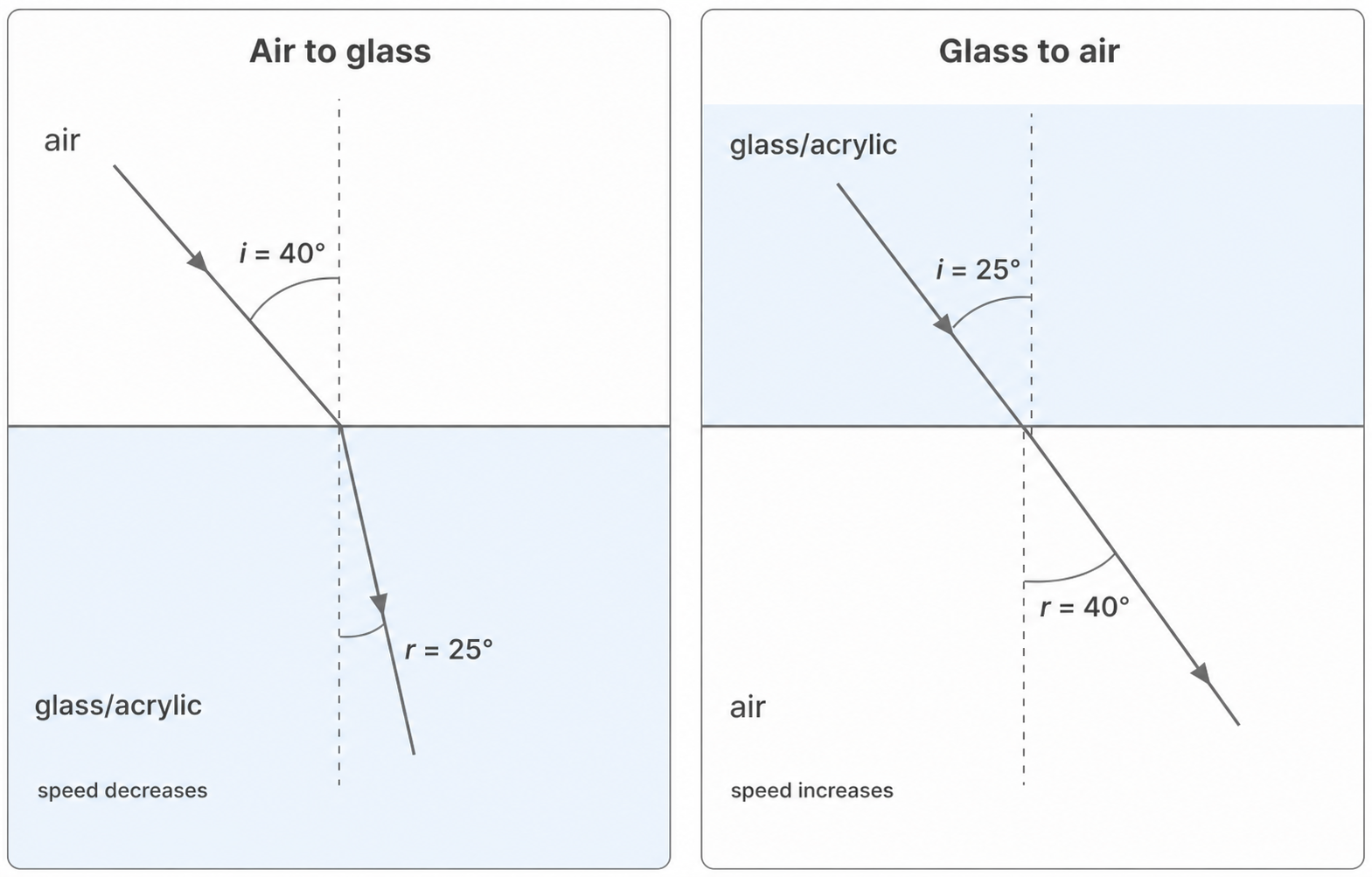
The words towards and away compare the ray with the normal. A smaller angle to the normal means the ray has bent towards the normal. A larger angle to the normal means the ray has bent away from the normal.
For refraction, first decide whether the wave speeds up or slows down in the new substance. Then decide whether the ray bends away from or towards the normal.
Constructing ray diagrams
A ray diagram is a simplified model. A ray is a straight line showing the direction in which the wave energy travels. It is not a drawing of the peaks and troughs of the wave.
To construct a refraction ray diagram:
- Draw the boundary between the two substances.
- Draw the normal at 90 degrees to the boundary where the ray hits.
- Draw the incident ray travelling towards the boundary.
- Measure the angle of incidence from the normal.
- Draw the refracted ray on the other side of the boundary.
- Make the refracted ray bend towards the normal if the wave speed decreases, or away from the normal if the wave speed increases.
- Label the incident ray, refracted ray, normal, boundary and the two media.
Continue this lesson.
You’re previewing NovaLearn without an account. Create a free account to read the rest.
Create free account