4.6.1.4 - Sound Waves
This Higher-tier, physics-only lesson is about how sound waves can make solids vibrate. That idea explains both everyday examples, such as a window buzzing near a loudspeaker, and how the ear begins the process of hearing. The important limit is frequency: human hearing only works normally from 20 Hz to 20 kHz.
Sound waves and solids
A sound wave is a mechanical disturbance that travels through a medium. In air, the disturbance is a pattern of changing pressure: compressions are higher-pressure regions and rarefactions are lower-pressure regions.
When these changing pressures reach a solid surface, they exert a changing force on that surface. The solid is pushed and pulled back and forth, so it vibrates. This is one way a wave disturbance in air can be converted into vibrations in a solid.
[DIAGRAM: asset_name: sound-wave-to-solid-vibration - diagram 1; asset_slug: 088_4_6_1_4_sound_waves_diagram1; file: diagram_assets/088_4_6_1_4_sound_waves_diagram1.png; recommended_method: image_gen; description: Assessed image-generated schematic showing a longitudinal sound wave with labelled compressions and rarefactions reaching a thin solid membrane. Arrows show alternating high and low pressure pushing and pulling the membrane so it vibrates back and forth. The visual teaches conversion between a sound-wave disturbance and vibration in a solid; labels must be readable and nearby prose explains that this is not a transverse-wave drawing.]
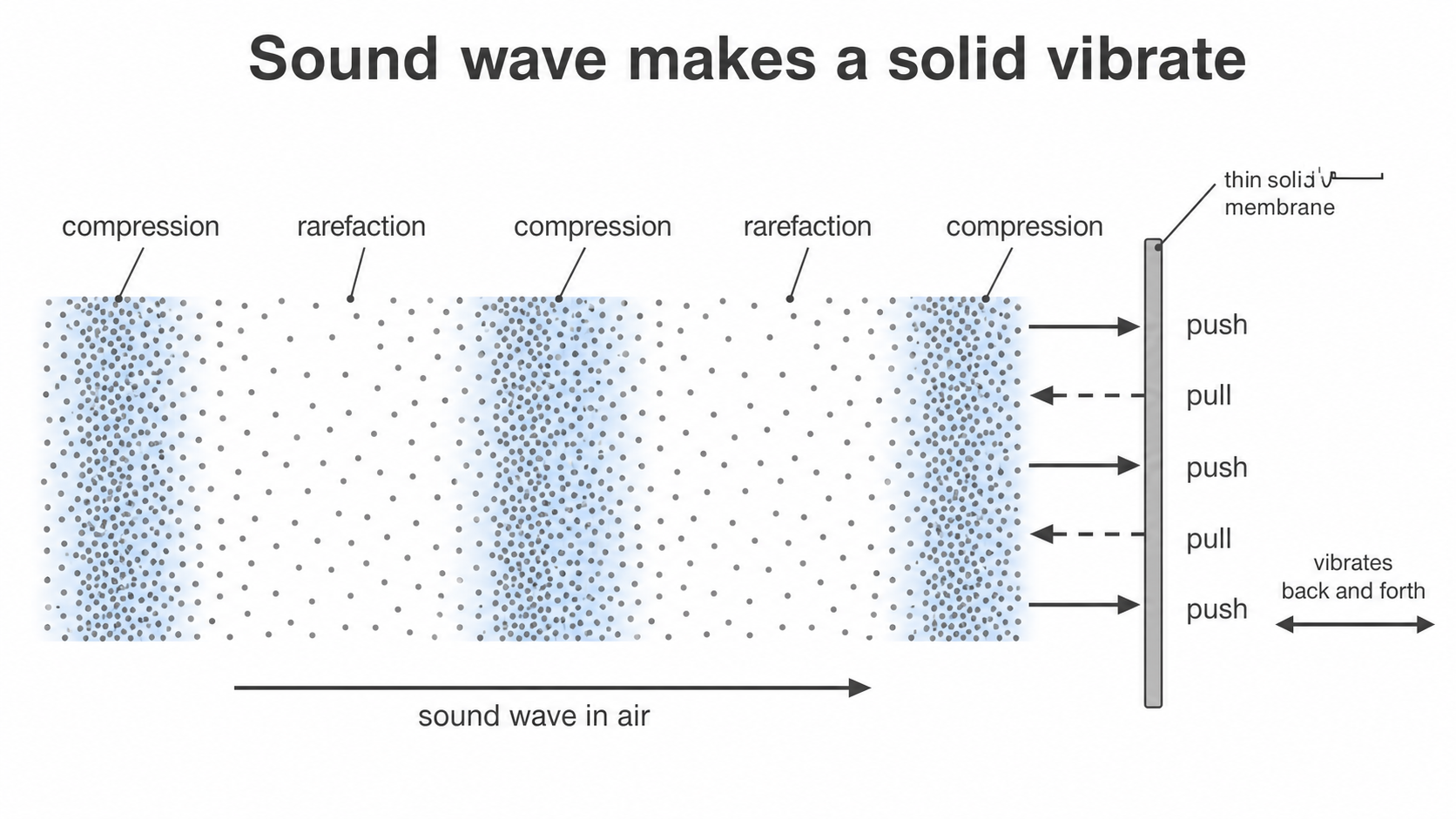
Sound waves can also travel through solids. As the sound wave passes through the solid, particles in the solid vibrate about their fixed positions and pass the disturbance on to neighbouring particles.
The conversion can also happen in the opposite direction. A vibrating solid can make a sound wave by pushing and pulling the nearby air.
Examples include:
- a loudspeaker cone vibrating to produce sound waves
- a tuning fork vibrating and producing a tone
- a loud sound making a window or thin panel vibrate
- a sound wave making the eardrum vibrate
In exam answers, be precise about the direction of conversion. A vibrating solid can produce a sound wave. A sound wave can also make a solid vibrate.
Hearing starts with vibrations
The ear is an important example of sound waves being converted into vibrations in solids. Sound waves travel along the ear canal and reach the eardrum, which is a thin membrane.
The incoming pressure changes make the eardrum vibrate. Those vibrations are passed through other solid parts of the ear, including the small bones in the middle ear. Further inside the ear, these vibrations lead to nerve signals, and the brain interprets those signals as the sensation of sound.
The key GCSE sequence is:
sound wave in air -> eardrum vibrates -> other ear parts vibrate -> sensation of sound
Do not say that the sound wave itself is the sensation of hearing. The sound wave is the physical disturbance. Hearing is the result after the ear and brain respond to that disturbance.
Eardrum
The eardrum is a thin membrane in the ear that vibrates when sound waves reach it.
The eardrum vibrates at the frequency of the incoming sound wave. A higher-frequency sound makes the eardrum vibrate more times each second than a lower-frequency sound, if that frequency is within the range the ear can respond to.
Limited frequency response
Vibration transfer does not work equally well at every frequency. A solid system has mass, stiffness and damping, so some frequencies make it vibrate much more effectively than others. This pattern is called its frequency response.
Frequency response
Frequency response describes how strongly a system vibrates or responds at different frequencies.
If a sound wave has a frequency that a solid can respond to well, the solid vibration can be large enough to matter. If the frequency is too far outside the useful range, the vibration may be too small or too poorly transferred to be useful.
For very high frequencies, the pressure changes direction extremely quickly. The solid may not have enough time to move far before the force reverses. For very low frequencies, the vibration may be too slow to be processed as normal sound by the hearing system. The exact useful range depends on the object or ear parts involved.
Continue this lesson.
You’re previewing NovaLearn without an account. Create a free account to read the rest.
Create free account