4.6.2.4 - Uses and Applications of Electromagnetic Waves
Electromagnetic waves are useful because different parts of the spectrum interact with matter in different ways. In this lesson, the key skill is to match each type of electromagnetic wave to a practical application, then, for Higher tier, give a brief reason why that wave is suitable. The reasons usually come from how well the wave is transmitted, absorbed, reflected, detected or able to transfer energy.
Matching waves to applications
The electromagnetic spectrum is ordered from long wavelength and low frequency to short wavelength and high frequency:
radio waves, microwaves, infrared, visible light, ultraviolet, X-rays, gamma rays.
Different applications use different parts of the spectrum. The official examples for this lesson are:
| Type of electromagnetic wave | Practical applications in this lesson |
|---|---|
| Radio waves | Television and radio |
| Microwaves | Satellite communications; cooking food |
| Infrared | Electrical heaters; cooking food; infrared cameras |
| Visible light | Fibre optic communications |
| Ultraviolet | Energy efficient lamps; sun tanning |
| X-rays and gamma rays | Medical imaging and treatments |
[DIAGRAM: asset_name: Uses and Applications of Electromagnetic Waves - diagram 1; asset_slug: 096_4_6_2_4_uses_and_applications_of_electromagnetic_waves_diagram1; file: diagram_assets/096_4_6_2_4_uses_and_applications_of_electromagnetic_waves_diagram1.png; recommended_method: image_gen; description: Exact ordered spectrum-to-application map. Shows the seven EM-wave groups from radio to gamma with arrows for increasing frequency and increasing photon energy, plus the official application examples under each group. Image generation is used for the current regenerated PNG.]
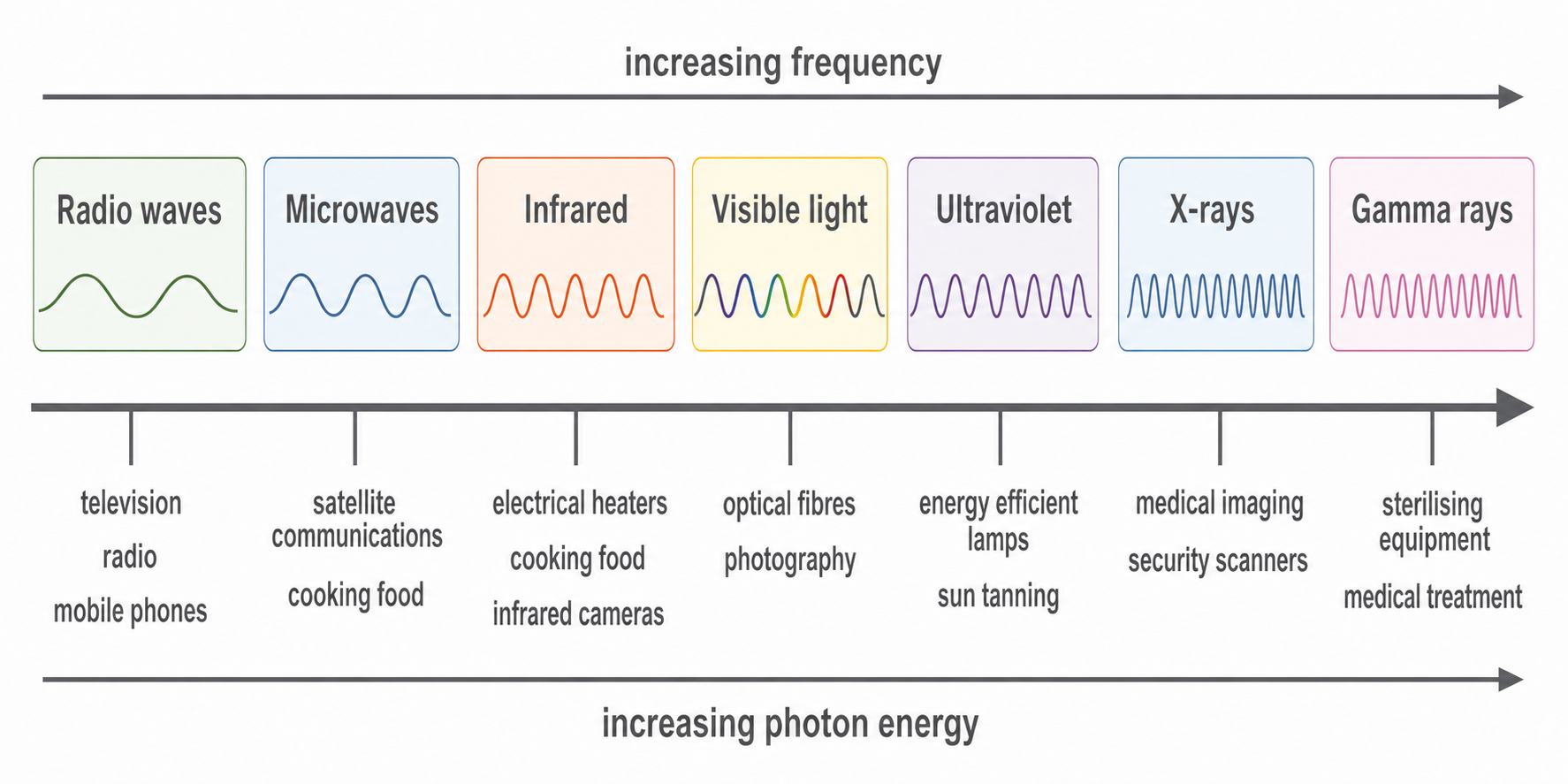
For all students, a common exam task is to state a suitable wave for an application. For example, if the application is satellite communication, the expected wave is microwaves. If the application is medical imaging of a broken bone, the expected wave is X-rays.
For Higher tier, the answer needs one more step: connect the wave to a property that makes it suitable. A suitability explanation should be brief but causal. For example, "microwaves are suitable for satellite communication because they can travel through the atmosphere to and from satellites" is stronger than "microwaves are good for satellites."
Communication applications
Communication systems use electromagnetic waves to transfer information. A transmitter sends a changing wave signal, and a receiver detects the wave and extracts the information.
Radio waves are used for television and radio broadcasts. They are suitable because they can travel through air over long distances and can carry information to an aerial or antenna. Some radio waves also diffract around obstacles, so a receiver does not always need a perfect straight-line path to the transmitter.
Microwaves are used for satellite communications. A signal can be sent from a ground station to a satellite and then back down to a different place on Earth. Microwaves are suitable because selected microwave frequencies can pass through the atmosphere and can be sent in narrow beams using dishes, which helps direct the signal towards a satellite.
Visible light is used in fibre optic communications. In a fibre optic cable, pulses of light travel along a thin glass or plastic fibre. The light is repeatedly reflected inside the fibre, so the signal can follow a curved path with little energy escaping.
The application tells you the wave, but the suitability reason explains the choice:
| Application | Wave used | Brief suitability reason |
|---|---|---|
| Television and radio broadcasts | Radio waves | Can carry information through air to an aerial |
| Satellite communications | Microwaves | Can pass through the atmosphere and be directed to/from satellites |
| Fibre optic communications | Visible light | Can travel along optical fibres by repeated internal reflection |
Heating and sensing applications
Microwaves and infrared radiation can both be used for heating, but they do it in different practical situations.
In a microwave oven, microwaves are produced inside the oven and reflected by the metal walls. They pass through many suitable containers but are absorbed by food. The absorbed microwave energy makes molecules in the food, especially water molecules, move more, so the internal energy of the food increases and the food heats up.
Infrared radiation is useful for electrical heaters and for cooking food because it is readily absorbed by many surfaces. When an object absorbs infrared radiation, energy is transferred to the object and its temperature can increase.
Infrared cameras use a different idea. Warm objects emit infrared radiation. An infrared camera detects the infrared emitted by objects and converts it into an image. Hotter regions usually emit more infrared radiation, so the camera can show temperature differences that our eyes cannot see directly.
Do not simply say "infrared is heat." Infrared is electromagnetic radiation. We often detect infrared as heating because absorbed infrared transfers energy to the absorber.
Continue this lesson.
You’re previewing NovaLearn without an account. Create a free account to read the rest.
Create free account