4.5.1.1 - Scalar and Vector Quantities
Physics uses measured quantities to describe the world. Some quantities are complete when you know their size, such as 5 kg or 20 s. Others are incomplete unless you also give a direction, such as 12 N to the right.
Scalars have magnitude only
The magnitude of a quantity means its size. For most GCSE answers, that means a number with a unit, such as 2.5 kg, 30 s or 12 J.
Scalar quantity
A scalar quantity has magnitude only.
A scalar does not need a direction to be fully described. If a student says the mass of a book is 0.8 kg, that is complete information about the mass. Adding "north" or "left" would not make sense for mass.
Common scalar quantities include:
| Scalar quantity | Example of a complete value |
|---|---|
| mass | 0.8 kg |
| time | 12 s |
| temperature | 21 °C |
| energy | 500 J |
| speed | 4 m/s |
Speed is listed here because it tells you how fast something is moving, not which way it is moving. A cyclist moving at 6 m/s could be travelling north, south, uphill or around a bend; the speed itself is just the size.
Vectors have magnitude and direction
A vector quantity needs two pieces of information: magnitude and direction. If either part is missing, the vector has not been fully described.
Vector quantity
A vector quantity has magnitude and an associated direction.
For example, 8 N tells you the magnitude of a force, but it does not tell you which way the force acts. A complete description could be 8 N to the right, 8 N upwards, or 8 N north-east.
Common vector quantities include:
| Vector quantity | Example of a complete value |
|---|---|
| force | 8 N to the right |
| velocity | 12 m/s north |
| displacement | 40 m east |
| acceleration | 2 m/s² downwards |
| weight | 6 N downwards |
The direction can be written in words, using compass directions, or using another clear direction such as upwards, downwards, towards the wall, or away from the centre. What matters is that the direction is associated with the magnitude.
Representing vectors with arrows
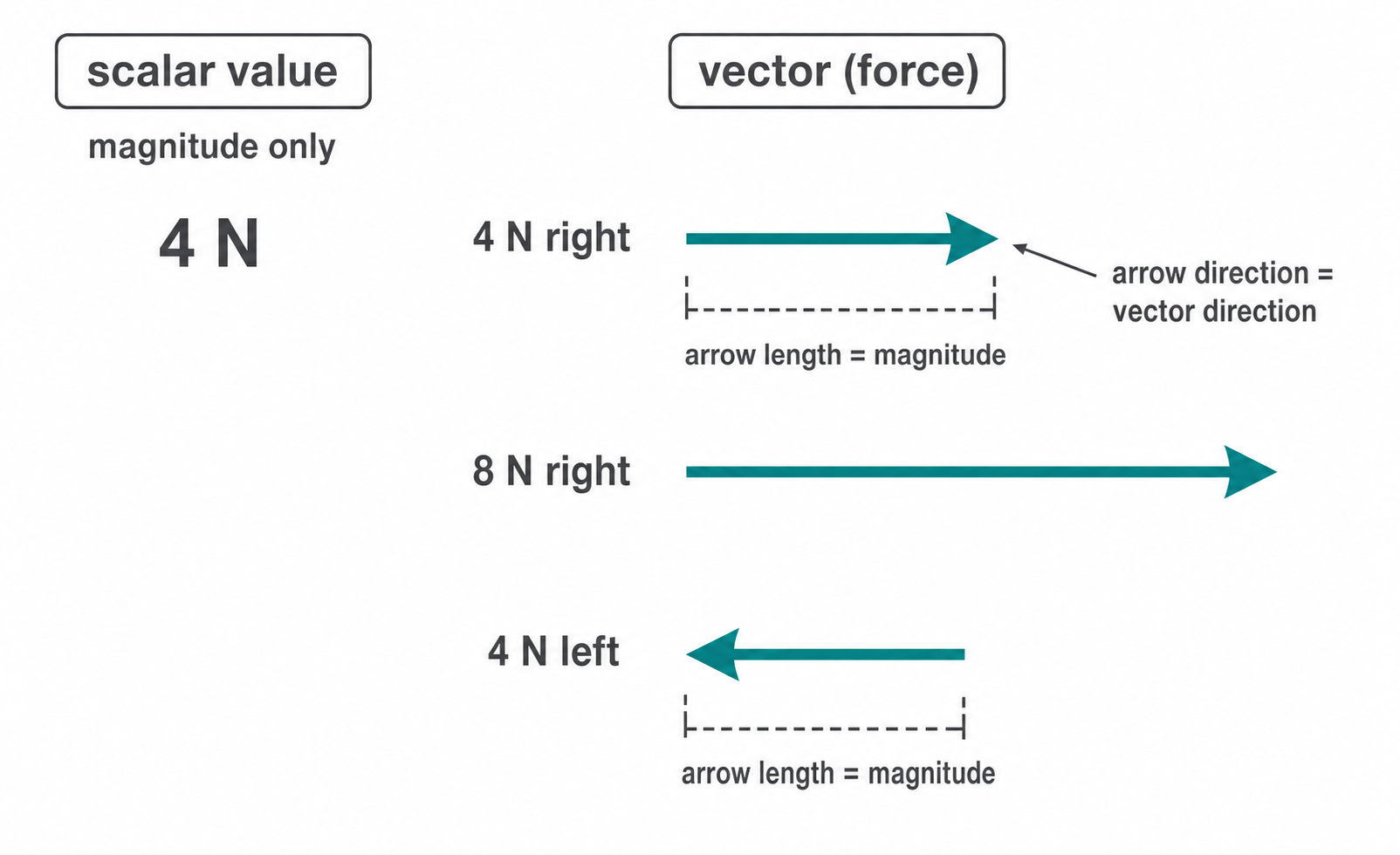
A vector quantity may be represented by an arrow. The arrow is a compact way to show both parts of the vector at once.
[DIAGRAM: asset_name: vector_arrow_representation - diagram 1; asset_slug: 053_4_5_1_1_scalar_and_vector_quantities_diagram1; file: diagram_assets/053_4_5_1_1_scalar_and_vector_quantities_diagram1.png; recommended_method: image_gen; description: Exact assessed vector-arrow visual. It shows a scalar value as magnitude only, then vector arrows labelled 4 N right, 8 N right and 4 N left. The 8 N arrow is exactly twice the 4 N arrow length, and the 4 N left arrow is the same length as the 4 N right arrow but points in the opposite direction. It labels arrow length as magnitude and arrow direction as vector direction. Image generation is used with nearby prose repeating the same information for accessibility.]
Continue this lesson.
You’re previewing NovaLearn without an account. Create a free account to read the rest.
Create free account