4.4.2.1a - Radioactive Decay, Activity and Radiation Types
Radioactive materials contain unstable nuclei. The key GCSE idea is that an unstable nucleus can give out nuclear radiation as it changes to become more stable, and this process is random. This lesson separates the actual decay rate of a source from the count-rate recorded by a detector, then identifies the four types of nuclear radiation named in the specification.
Unstable nuclei and radioactive decay
An atom has a nucleus made of protons and neutrons. Some nuclei are unstable. An unstable nucleus can change to become more stable by giving out radiation.
Radioactive decay
Radioactive decay is the random process in which an unstable nucleus gives out radiation as it changes to become more stable.
The word random has a precise meaning here. For one unstable nucleus, you cannot predict exactly when it will decay. For a sample containing many unstable nuclei, some will decay during each time interval, so the source can have a measurable decay rate.
Do not write that the detector makes the nucleus decay. The decay happens in the source; the detector only records radiation from some of those decays.
Activity and count-rate
Activity is about what the radioactive source is doing. Count-rate is about what the detector records.
Activity
Activity is the rate at which a source of unstable nuclei decays. It is measured in becquerels, Bq.
One becquerel means one radioactive decay per second:
1 Bq = 1 decay per second
A source with activity 30 Bq has, on average, 30 nuclei decaying each second. You are not predicting which particular nuclei decay; you are describing the overall rate for the source.
Count-rate
Count-rate is the number of decays recorded each second by a detector, such as a Geiger-Muller tube.
[DIAGRAM: asset_name: activity-and-count-rate-source-detector - diagram 1; asset_slug: 042_4_4_2_1a_radioactive_decay_activity_and_radiation_types_diagram1; file: diagram_assets/042_4_4_2_1a_radioactive_decay_activity_and_radiation_types_diagram1.png; recommended_method: image_gen; description: Assessed schematic showing a radioactive source with many unstable nuclei, random radiation arrows leaving in different directions, a nearby Geiger-Muller tube detecting only some emissions, and clear labels distinguishing activity as decays per second from the source and count-rate as recorded counts per second at the detector. The visual must not imply half-life, shielding, background correction or source-use evaluation.]
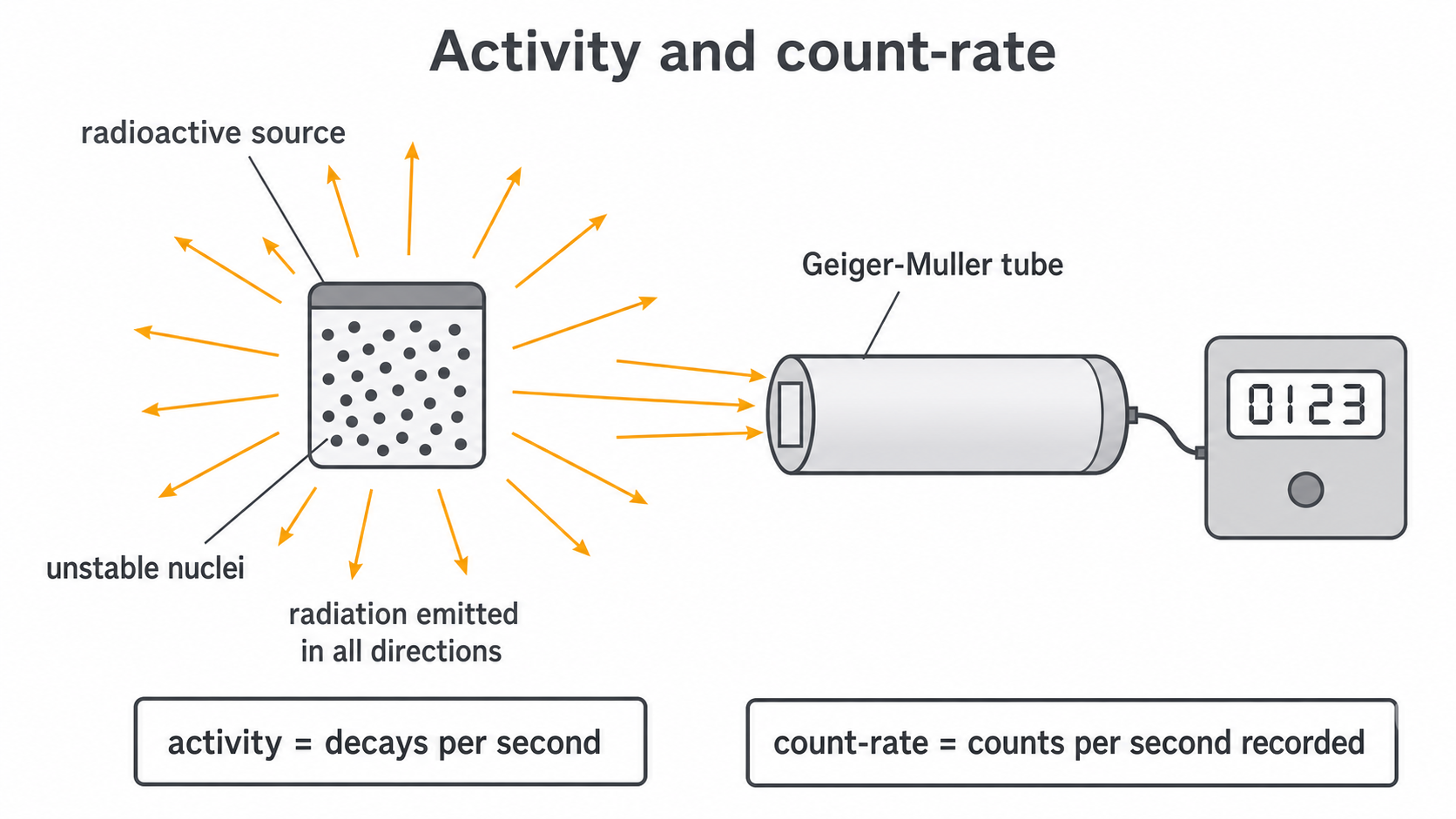
Count-rate is often written in counts/s or s^-1. If a detector records 180 counts in 60 s, then:
count-rate = 180 counts / 60 s = 3 counts/s
The count-rate may not be the same number as the activity because a detector may not record every decay from the source. For GCSE answers in this lesson, keep the distinction simple: activity belongs to the source; count-rate belongs to the detector reading.
Types of nuclear radiation
The nuclear radiation emitted during radioactive decay may be an alpha particle, a beta particle, a gamma ray or a neutron. These names describe what leaves the nucleus.
| Radiation type | What it is at GCSE |
|---|---|
alpha particle, α | two neutrons and two protons; the same as a helium nucleus |
beta particle, β | a high speed electron ejected from the nucleus as a neutron turns into a proton |
gamma ray, γ | electromagnetic radiation from the nucleus |
neutron, n | a neutron emitted from the nucleus |
The beta definition is a common trap. In beta radiation, the electron is ejected from the nucleus. It is not one of the electrons that was already arranged around the outside of the atom.
Continue this lesson.
You’re previewing NovaLearn without an account. Create a free account to read the rest.
Create free account