4.5.3b - Elastic Potential Energy and Force-Extension Data
Force-extension data lets you connect three ideas: how stiff a spring is, whether the spring is still behaving linearly, and how much energy is stored when it is stretched or compressed. The key is to read the graph or table first, then choose the relationship that matches the region of data you are using. This lesson treats the full required practical method as a separate topic, but uses the data that such an investigation produces.
Stored energy in a spring
When a force stretches or compresses a spring, the force does work on the spring. Energy is transferred to the spring's elastic potential store.
Elastic Potential Energy
Elastic potential energy is energy stored in an elastic object because its shape has been changed.
If the spring is not inelastically deformed, the work done on the spring and the elastic potential energy stored are equal. That condition matters: if the spring is permanently damaged or does not return to its original shape, not all of the work done can be treated as recoverable elastic potential energy.
Stretching and compression are handled in the same way in this part of the specification. For a stretched spring, e means extension from the unstretched length. For a compressed spring, e means the size of the compression from the natural length.
extension = stretched length - unstretched length
compression = natural length - compressed length
For example, a spring with natural length 0.30 m that is compressed to 0.24 m has a compression of 0.06 m.
Hooke's law from data
For a spring in its linear region, the force is directly proportional to the extension. This relationship is Hooke's law.
Force, Spring Constant and Extension
For AQA GCSE Physics exams in 2026 and 2027, this equation is supplied on the Physics Equations Sheet. You still need to recognise when it applies and use it accurately.
The symbols and units are:
| Symbol | Quantity | Unit |
|---|---|---|
F | force | newton, N |
k | spring constant | newton per metre, N/m |
e | extension or compression | metre, m |
The spring constant tells you how stiff the spring is. A larger spring constant means a larger force is needed for the same extension or compression.
The same equation applies to compression of an elastic object. If a spring with k = 250 N/m is compressed by 0.040 m, then:
F = k e
F = 250 x 0.040
F = 10 N
To calculate a spring constant in a linear case, rearrange:
k = F / e
Example: a spring extends by 0.030 m when a force of 6.0 N is applied.
k = F / e
k = 6.0 / 0.030
k = 200 N/m
Linear and non-linear graphs
A force-extension graph usually has extension or compression on the horizontal axis and force on the vertical axis.
[DIAGRAM: asset_name: Force-Extension Data - diagram 1; asset_slug: 060_4_5_3b_elastic_potential_energy_and_force_extension_data_diagram1; file: diagram_assets/060_4_5_3b_elastic_potential_energy_and_force_extension_data_diagram1.png; recommended_method: deterministic_drawn; description: Exact assessed graph of force in N against extension or compression in m for a spring. It shows measured data points that form a straight line through the origin up to the limit of proportionality at e = 0.050 m and F = 10 N, then curve into a non-linear region. It labels the linear region, non-linear region, limit of proportionality, a gradient calculation for spring constant k = delta F / delta e = 200 N/m, and a shaded triangular area under the linear part to show work done equals elastic potential energy. Deterministic SVG-to-PNG drawing is used because axes, values, labels, data positions, gradient and shaded area are exact assessed information.]
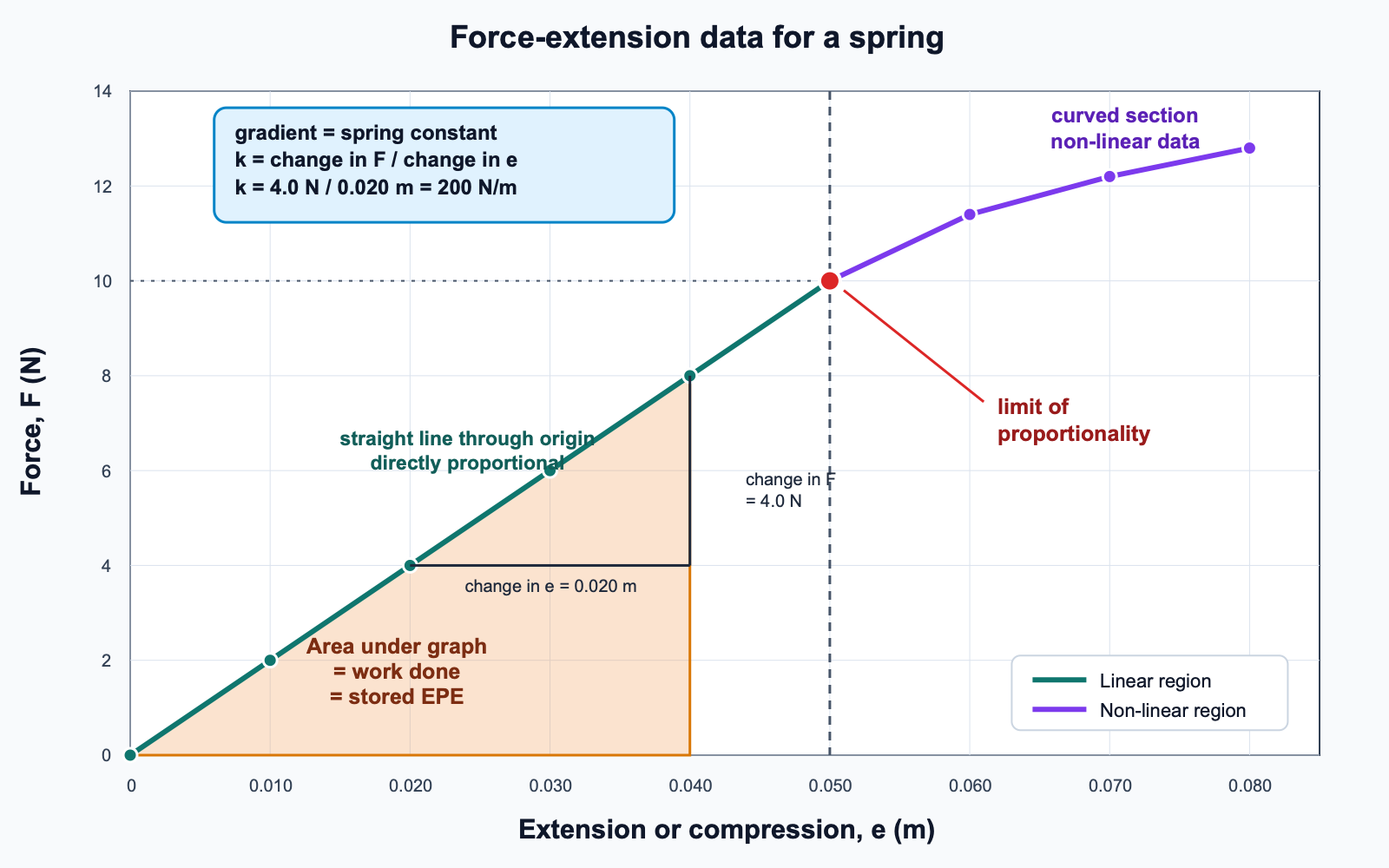
In the linear region:
- the graph is a straight line through the origin
Fis directly proportional toeF / eis constant- the gradient of a force-extension graph is the spring constant
The limit of proportionality is the point where the data first stops following a straight-line relationship. Beyond this point, the graph is non-linear. The force and extension still have a relationship, but they are no longer directly proportional, so one spring constant should not be calculated for the whole curved section.
This table matches the graph:
Force in N | Extension in m | F / e in N/m |
|---|---|---|
2.0 | 0.010 | 200 |
4.0 | 0.020 | 200 |
6.0 | 0.030 | 200 |
8.0 | 0.040 | 200 |
10.0 | 0.050 | 200 |
11.4 | 0.060 | 190 |
12.2 | 0.070 | 174 |
Continue this lesson.
You’re previewing NovaLearn without an account. Create a free account to read the rest.
Create free account