4.8.1.3 - Orbital Motion, Natural and Artificial Satellites
This physics-only lesson explains how gravity keeps planets and satellites in orbit. You will compare planets, moons and artificial satellites, then use speed and velocity carefully to describe circular motion. Higher Tier sections explain why an orbiting object can have changing velocity but unchanged speed, and why a stable orbit links orbital speed with orbital radius.
Gravity and circular orbits
An orbit is the path followed by an object as it moves around another object in space. In this lesson the orbiting object may be a planet, a moon or an artificial satellite.
For a circular orbit, gravity provides the force towards the centre of the orbit. This inward force continually changes the direction of the moving object, so the object follows a curved path instead of moving away in a straight line.
Orbit
The path followed by an object as it moves around another object in space.
If gravity did not act, the orbiting object would keep moving in a straight line. If the object had no sideways motion, gravity would pull it towards the larger body. A stable circular orbit happens when the object's sideways motion and the inward pull of gravity are matched for that radius.
[DIAGRAM: asset_name: Gravity and velocity in a circular orbit - diagram 1; asset_slug: 115_4_8_1_3_orbital_motion_and_satellites_diagram1; file: diagram_assets/115_4_8_1_3_orbital_motion_and_satellites_diagram1.png; recommended_method: image_gen; description: Assessed orbit/vector diagram showing Earth at the centre, an artificial satellite on a circular orbit, a tangential velocity arrow labelled velocity at this instant, and an inward force arrow labelled gravity towards centre of Earth. The visual should make clear that gravity changes direction of motion rather than acting forwards along the orbit.]
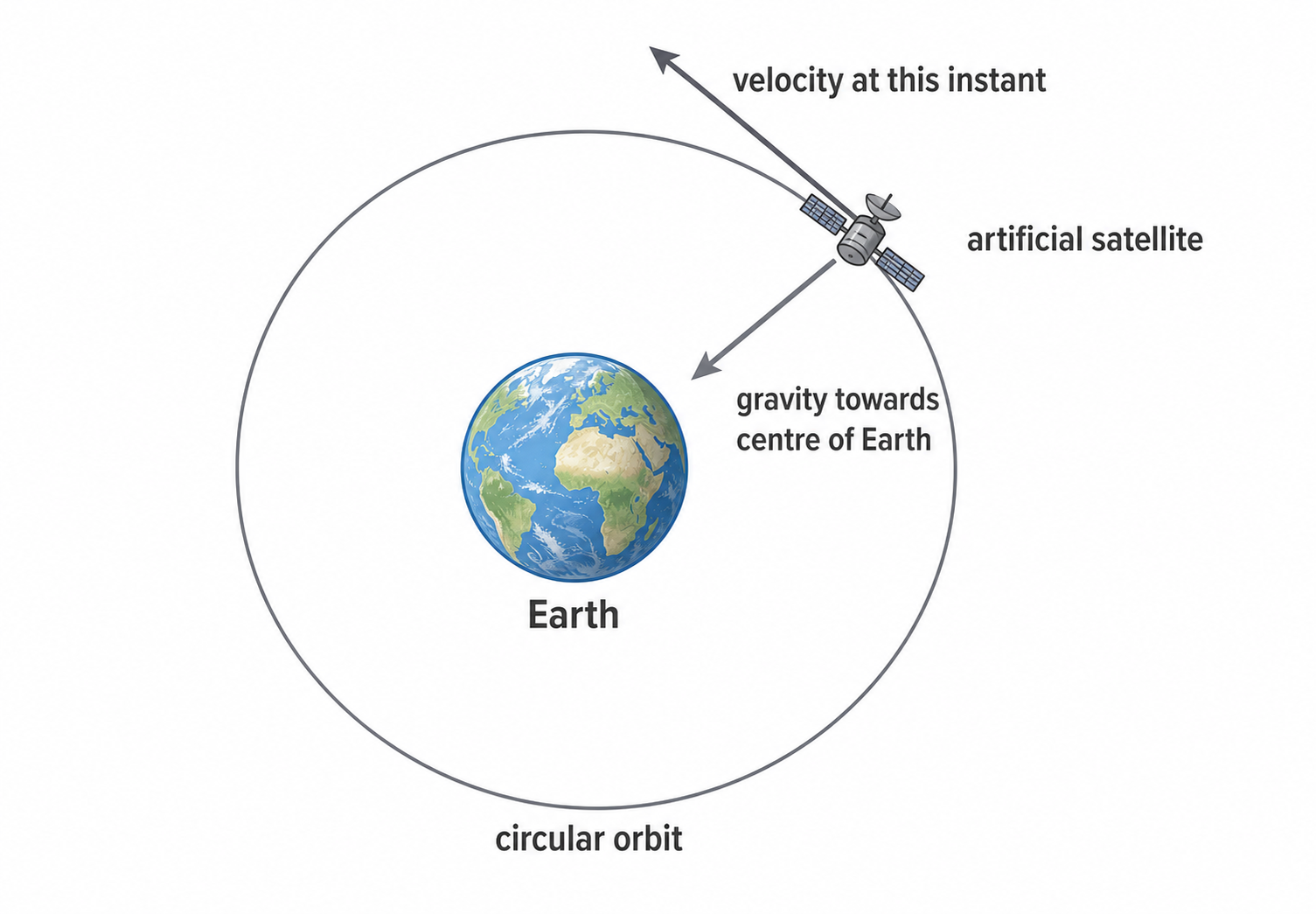
Artificial satellites do not need a continuous upward force to "hold them up" in orbit. In an ideal circular orbit, gravity is still acting; it is the inward force that keeps changing the satellite's direction. Real artificial satellites may use small thruster adjustments, but the basic orbital force is gravity.
Planets, moons and artificial satellites
Planets, moons and artificial satellites are similar because all of them are held in orbit by gravity. They are also all moving objects with an orbital period, which is the time taken to complete one orbit.
They are distinguished by what they orbit and whether they are natural or human-made.
| Object | What it orbits | Natural or artificial? | GCSE distinction |
|---|---|---|---|
| Planet | A star, such as the Sun | Natural | A large body in orbit around a star |
| Moon, or natural satellite | A planet | Natural | A naturally occurring satellite of a planet |
| Artificial satellite | Usually a planet, such as Earth | Artificial | A human-made object placed in orbit |
[DIAGRAM: asset_name: Comparing planets, moons and artificial satellites - diagram 2; asset_slug: 115_4_8_1_3_orbital_motion_and_satellites_diagram2; file: diagram_assets/115_4_8_1_3_orbital_motion_and_satellites_diagram2.png; recommended_method: image_gen; description: Assessed comparison visual with the Sun, a planet orbiting the Sun, a moon orbiting the planet, and a human-made artificial satellite orbiting the planet. Labels should identify planet, moon or natural satellite, artificial satellite, and the central object each one orbits.]
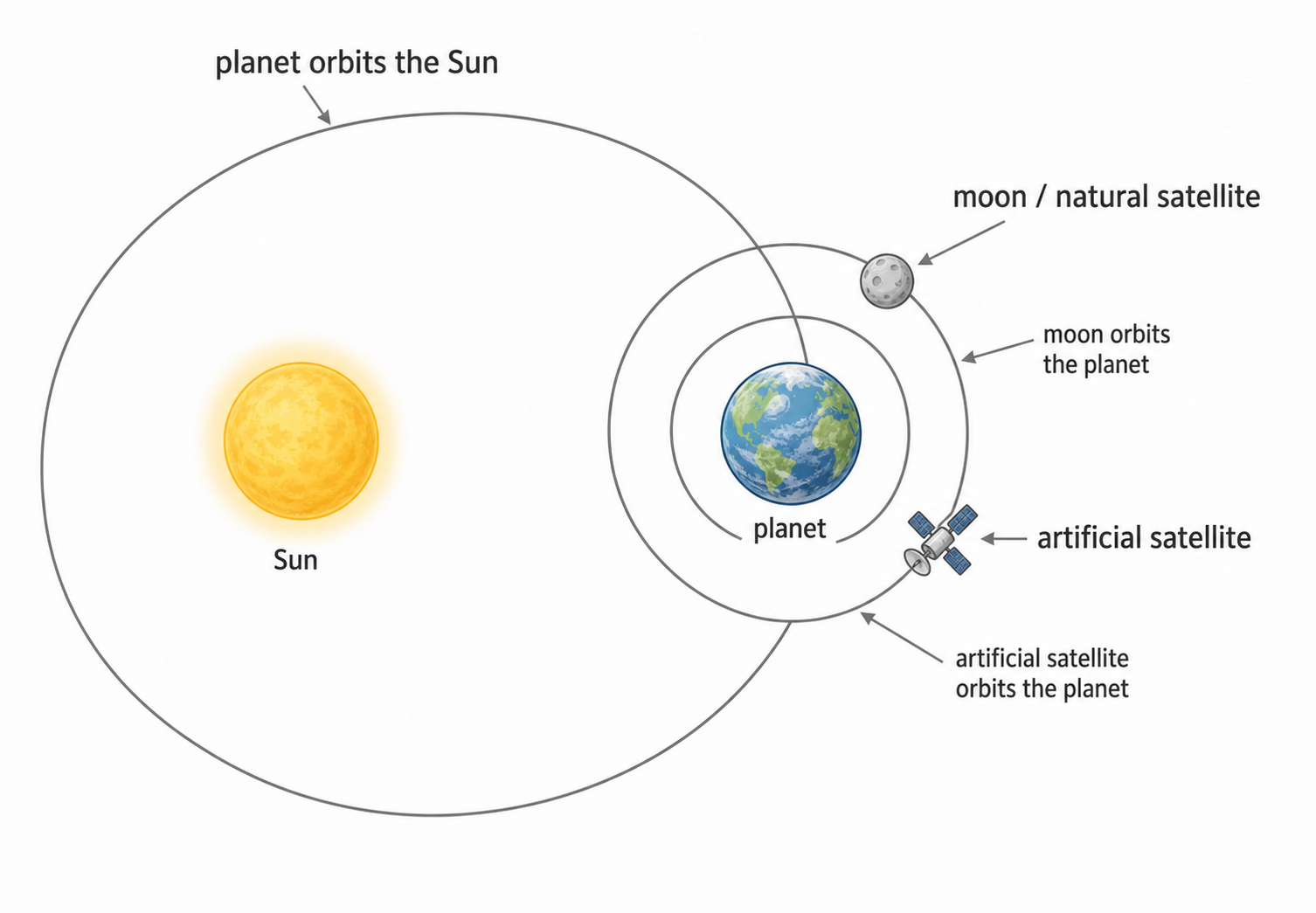
For example, Earth is a planet because it orbits the Sun. The Moon is a natural satellite because it naturally orbits Earth. A weather satellite is an artificial satellite because people built it and placed it in orbit, usually around Earth.
Common uses of artificial satellites include communication, weather monitoring, navigation and Earth observation. Those uses are examples only; the assessed physics here is that artificial satellites are human-made orbiting objects and gravity provides the force for their orbits.
Speed and velocity in orbit
This section is Higher Tier only.
Speed and velocity are not the same quantity. Speed tells you how fast an object is moving. Velocity includes both speed and direction.
Continue this lesson.
You’re previewing NovaLearn without an account. Create a free account to read the rest.
Create free account