4.5.6.3.4 - Factors Affecting Braking Distance 2
Braking is an energy transfer, not an energy disappearance. When a vehicle brakes, friction in the braking system does work that reduces the vehicle's kinetic energy and increases the temperature of the brakes. This lesson links that energy transfer to braking force, deceleration, danger, and Higher Tier force estimates.
Braking transfers energy
A moving vehicle has energy in its kinetic store. To stop the vehicle, that kinetic energy must be transferred away.
Braking force
A braking force is a force that acts against the motion of a vehicle and causes it to slow down.
In the braking system, friction acts between the brakes and the wheel or brake disc. Work is done by this friction force. The work done reduces the kinetic energy of the vehicle, and energy is transferred to thermal stores of the brakes and surroundings.
[DIAGRAM: asset_name: braking_energy_transfer - diagram 1; asset_slug: 079_4_5_6_3_4_factors_affecting_braking_distance_2_diagram1; file: diagram_assets/079_4_5_6_3_4_factors_affecting_braking_distance_2_diagram1.png; recommended_method: image_gen; description: Deterministic assessed schematic of a car moving forwards while a braking force acts backwards. Show brake friction doing work, the vehicle kinetic store decreasing, and brake thermal store increasing with a thermometer. Exact force direction and energy-transfer labels are required.]
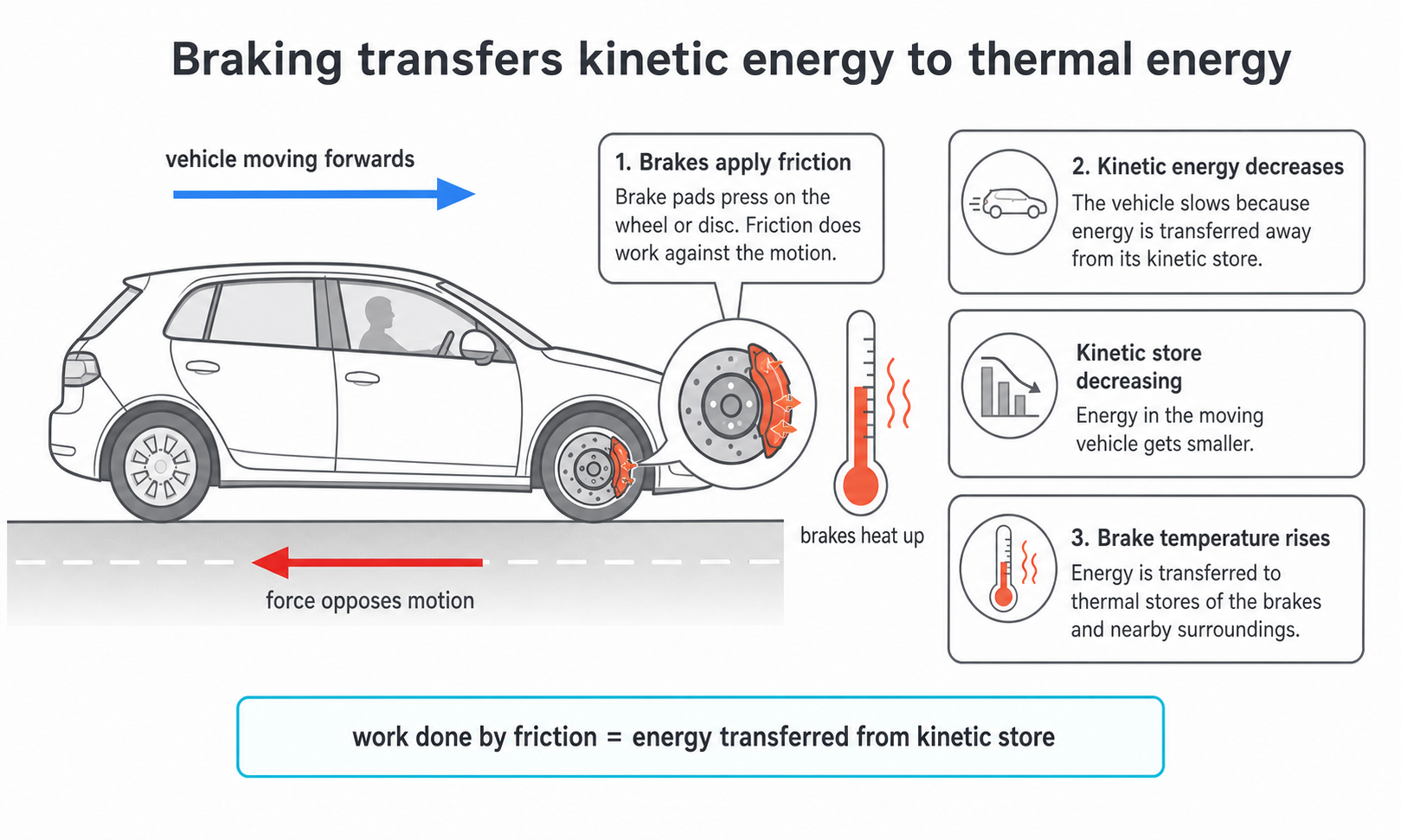
Do not write that the brakes "use up" energy. The energy is transferred: less energy is in the kinetic store, and more energy is in thermal stores. That is why brakes can become hot after hard braking.
Speed and braking force
The greater the speed of a vehicle, the greater its kinetic energy. A faster vehicle therefore has more energy that must be transferred away before it stops.
If two identical vehicles must stop in the same braking distance, the faster one needs a greater average braking force. The reason is that the work done by the braking force depends on force and distance. If the distance is fixed but more kinetic energy must be removed, the force must be greater.
For example, doubling the speed of the same vehicle gives four times as much kinetic energy, because kinetic energy depends on speed squared. To stop in the same distance, the average braking force would need to be about four times as large. If the braking force is not large enough, the vehicle needs a longer distance to stop.
For a fixed stopping distance, greater speed means more kinetic energy must be removed over the same distance, so a greater braking force is needed.
That is the reasoning an exam answer needs: energy first, then work done, then force.
Braking force and deceleration
Deceleration means acceleration in the opposite direction to motion. When a vehicle moving forwards slows down, its acceleration is backwards.
For the same vehicle mass, a greater braking force produces a greater deceleration. This follows the same idea as Newton's second law: a larger resultant force causes a larger acceleration. During braking, the resultant force is opposite the motion, so the acceleration is a deceleration.
That does not mean the safest braking is always the largest possible braking force. A very large braking force can make the vehicle decelerate very rapidly, and rapid deceleration can be dangerous.
Continue this lesson.
You’re previewing NovaLearn without an account. Create a free account to read the rest.
Create free account