4.6.1.1 - Transverse and Longitudinal Waves
A wave is a travelling disturbance. The disturbance can move through a material, such as water or air, while the material itself only moves locally. In this lesson, the key question is: how does the vibration of the medium compare with the direction the wave travels?
Wave motion and vibration
When a wave passes through a medium, the wave has a direction of travel. The particles, or small parts of the medium, also vibrate or oscillate. To classify the wave, compare these two directions:
- the direction the wave travels
- the direction the particles or surface vibrate
Medium
A medium is the material through which a mechanical wave travels, such as water for ripples or air for sound.
The medium is not carried along with the wave overall. Instead, nearby parts of the medium disturb each other, so the disturbance is passed on.
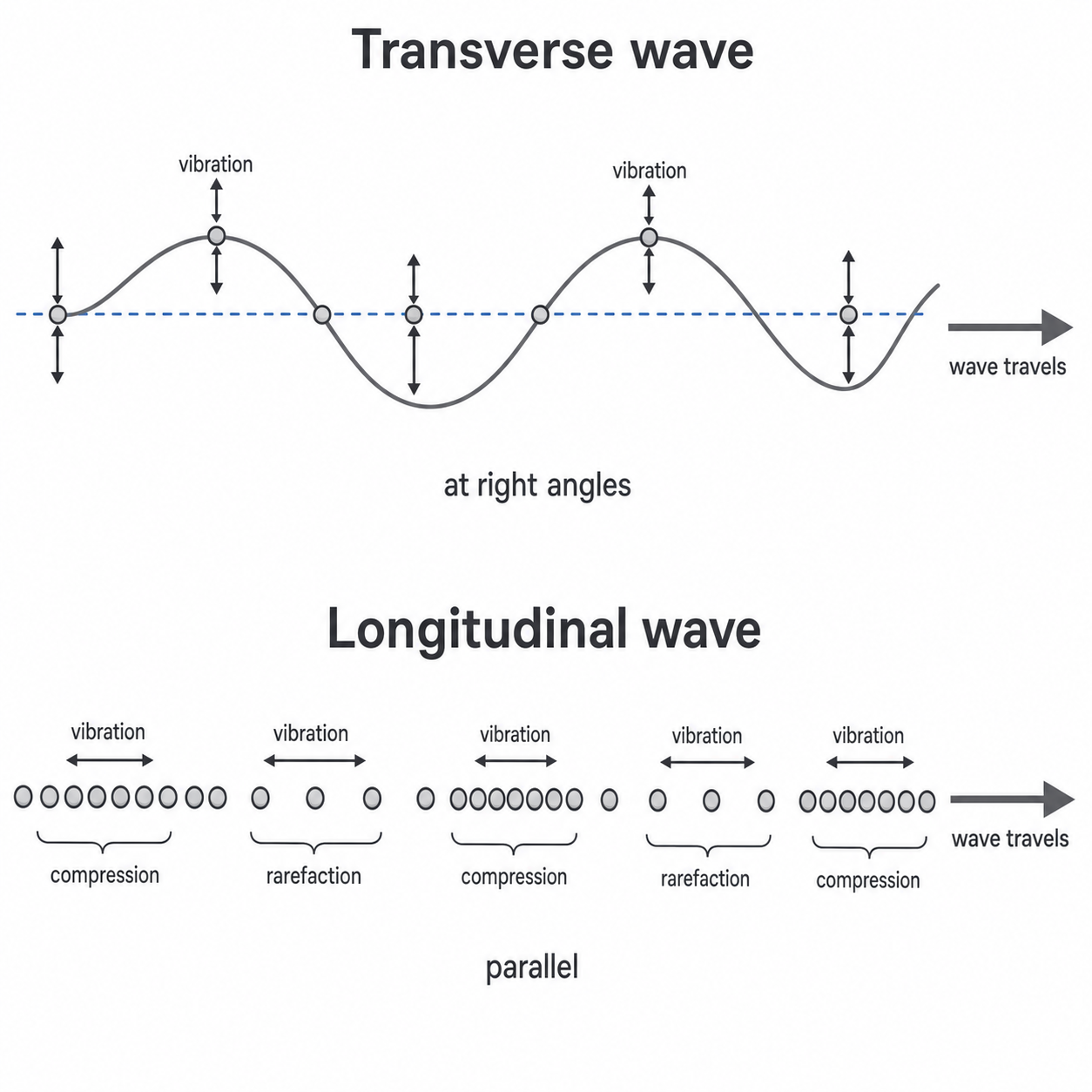
[DIAGRAM: asset_name: transverse and longitudinal wave motion comparison - diagram 1; asset_slug: 083_4_6_1_1_transverse_and_longitudinal_waves_diagram1; file: diagram_assets/083_4_6_1_1_transverse_and_longitudinal_waves_diagram1.png; recommended_method: image_gen; description: Exact qualitative comparison of particle motion with wave travel. Top panel shows a transverse water-surface style wave travelling right while particles vibrate up and down at right angles. Bottom panel shows a longitudinal wave travelling right with compressions and rarefactions, and particles vibrating left and right parallel to the wave direction. Assessed labels should be readable: wave travels, vibration, compression, rarefaction, at right angles, parallel.]
Transverse waves
In a transverse wave, the vibration is at right angles to the direction the wave travels. "At right angles" means perpendicular: if the wave travels horizontally, the vibration is vertical.
Transverse wave
A transverse wave is a wave in which the vibration is at right angles to the direction the wave travels.
Ripples on a water surface are transverse waves. The ripple pattern can travel across the surface, but a small floating object mostly moves up and down as the ripple passes. The vertical movement of the water surface is at right angles to the horizontal travel of the ripple.
A common mistake is to think a transverse wave must be drawn as a sideways wavy line. The drawing is only a model. What matters is the real direction of vibration compared with the real direction of wave travel.
Longitudinal waves
In a longitudinal wave, the vibration is parallel to the direction the wave travels. The particles vibrate backwards and forwards along the same line as the wave travels.
Longitudinal wave
A longitudinal wave is a wave in which the vibration is parallel to the direction the wave travels.
Longitudinal waves have regions called compressions and rarefactions. In a compression, particles are closer together than normal. In a rarefaction, particles are further apart than normal.
Sound waves travelling through air are longitudinal. When a sound wave passes, air particles vibrate backwards and forwards. A pattern of compressions and rarefactions moves through the air, carrying the sound.
Continue this lesson.
You’re previewing NovaLearn without an account. Create a free account to read the rest.
Create free account