4.7.3.1 - Induced Potential and the Generator Effect
When a conductor experiences a changing magnetic field, a potential difference can be induced across it. If the conductor is part of a complete circuit, that induced potential difference can drive an induced current. This Higher-tier physics-only lesson is about the generator effect: what causes it, what changes its size and direction, and how to apply the idea in unfamiliar contexts.
The Generator Effect
A conductor can be made to produce a potential difference without being connected to a cell. The key condition is change: either the conductor moves relative to a magnetic field, or the magnetic field around the conductor changes.
Generator Effect
The generator effect is the induction of a potential difference across a conductor when it moves relative to a magnetic field, or when the magnetic field around it changes.
The word "relative" matters. A wire can move through a fixed magnetic field, or a magnet can move past a fixed wire. In both cases, the conductor experiences a changing magnetic field, so an induced potential difference is produced.
[DIAGRAM: asset_name: conductor_cutting_field - diagram 1; asset_slug: 108_4_7_3_1_induced_potential_diagram1; file: diagram_assets/108_4_7_3_1_induced_potential_diagram1.png; recommended_method: image_gen; description: Assessed generator-effect diagram showing a straight conductor moving down through a uniform magnetic field from N to S pole pieces. It labels relative motion, magnetic field direction, induced potential difference across the conductor, and the condition that no complete circuit means no sustained current.]
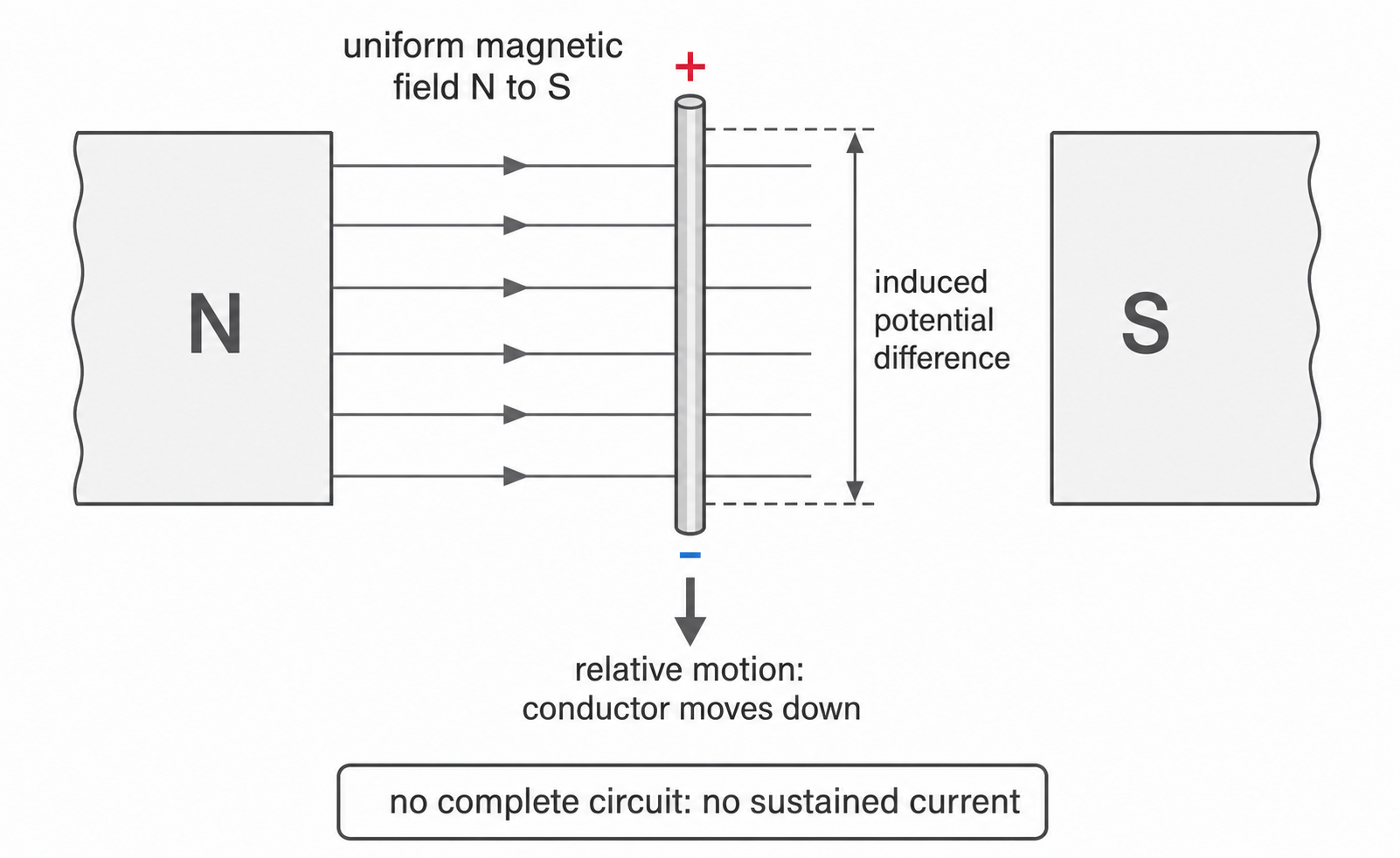
An induced potential difference is produced across the ends of the conductor. If the conductor is not part of a complete circuit, charge cannot flow continuously around a loop, so there is no induced current. If the conductor is part of a complete circuit, the induced potential difference drives an induced current.
No change means no generator effect. A stationary conductor in a steady magnetic field does not have an induced potential difference. A conductor moving parallel to a uniform field without cutting across the field lines gives little or no induced potential difference in this GCSE model.
Magnet, Coil and Meter
A common demonstration uses a coil connected to a sensitive centre-zero meter. The coil is a conductor arranged in many turns. The meter detects the direction and size of the induced current when the circuit is complete.
[DIAGRAM: asset_name: magnet_coil_meter_induction - diagram 2; asset_slug: 108_4_7_3_1_induced_potential_diagram2; file: diagram_assets/108_4_7_3_1_induced_potential_diagram2.png; recommended_method: image_gen; description: Assessed magnet-coil-meter diagram showing a bar magnet moving into a coil connected to a centre-zero meter. It labels induced current while the magnet moves, zero deflection when the magnet is stationary, and opposite meter deflections for pushing in and pulling out.]
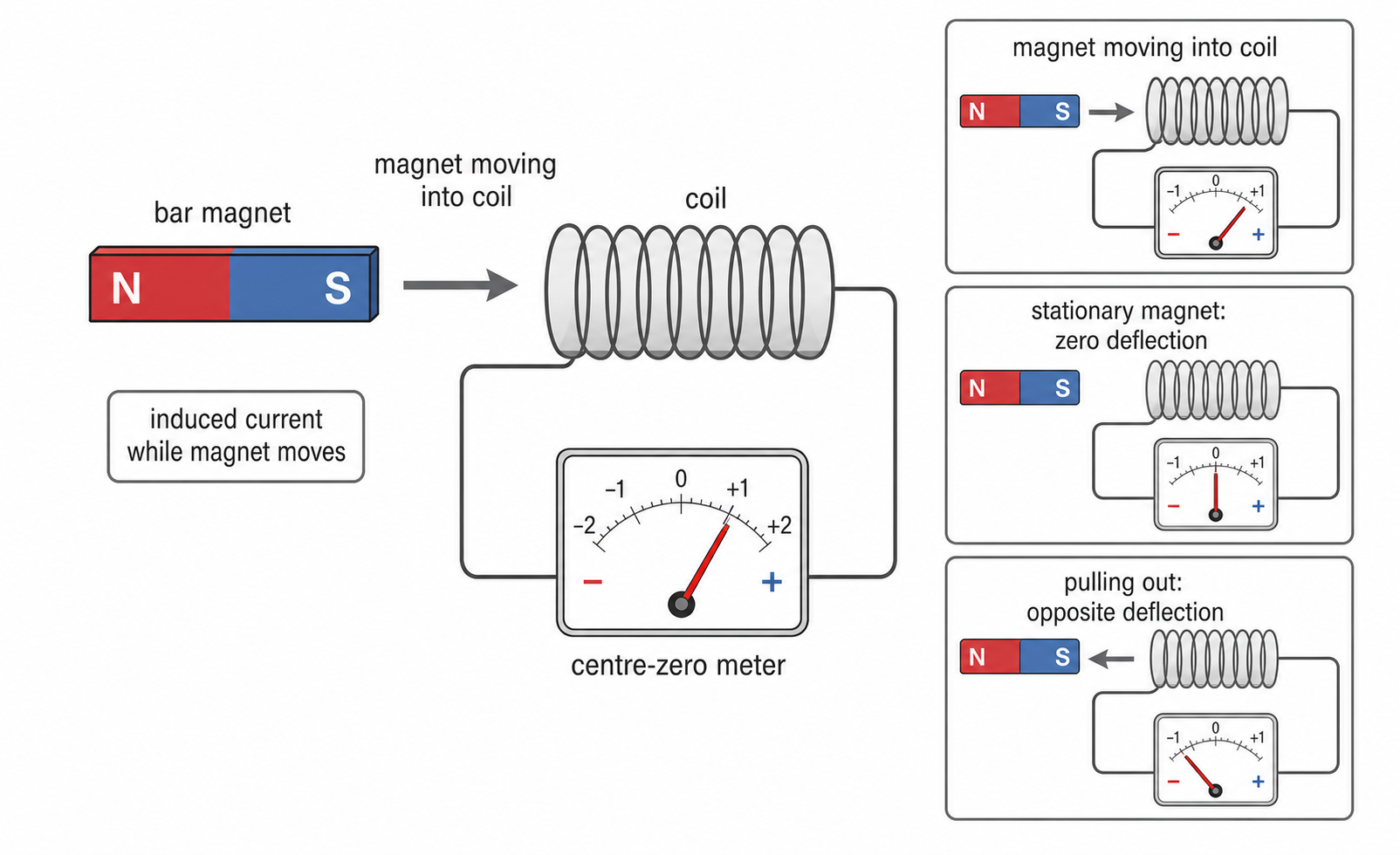
When the magnet is pushed into the coil, the magnetic field through the coil changes, so an induced potential difference is produced. Because the coil and meter form a complete circuit, an induced current flows and the meter deflects.
When the magnet is held still inside or near the coil, the magnetic field through the coil is no longer changing. The meter returns to zero. When the magnet is pulled back out, the change is in the opposite direction, so the meter deflects the other way.
This is why the generator effect is not caused by "having a magnet nearby" by itself. It is caused by relative motion or a changing magnetic field.
An induced current is produced only while the magnetic field around the conductor is changing.
The induced current also creates its own magnetic field. AQA expects you to know the direction of this field opposes the original change. If a north pole is pushed towards a coil, the induced current makes the near side of the coil behave like a north pole, opposing the push. If the north pole is pulled away, the induced current changes direction so the coil's magnetic field opposes the magnet leaving.
That explanation is most useful when you can turn it into a prediction for each stage of the movement.
Changing the Size
The size of the induced potential difference depends on how quickly and how strongly the conductor experiences a changing magnetic field. For a complete circuit, a larger induced potential difference usually produces a larger induced current.
Ways to increase the induced potential difference include:
Continue this lesson.
You’re previewing NovaLearn without an account. Create a free account to read the rest.
Create free account