4.5.2 - Calculating Work Done and Energy Transfer
Work done is a way of measuring energy transfer by a force. In this lesson, the force must cause an object to move, and the distance used in the equation must be along the line of action of the force. You will practise the equation, the joule/newton-metre link, and the energy transfer that happens when friction is involved.
When work is done
In everyday speech, "work" can mean any effort. In physics, work done has a more precise meaning: a force does work on an object when the force causes a displacement of that object.
Work done
Work done is the energy transferred when a force causes an object to move through a distance.
Two conditions are needed:
- a force acts on the object
- the object is displaced because of that force
If a person pushes a box and the box moves, the person does work on the box. If a person pushes a solid wall and the wall does not move, no work is done on the wall by that pushing force in this GCSE sense, even though the person may feel tired.
The direction matters. The official equation uses the distance moved along the line of action of the force. For this lesson, that means the useful distance is in the same straight-line direction as the force being considered.
[DIAGRAM: asset_name: force_displacement_line_of_action - diagram 1; asset_slug: 058_4_5_2_work_done_and_energy_transfer_diagram1; file: diagram_assets/058_4_5_2_work_done_and_energy_transfer_diagram1.png; recommended_method: image_gen; description: Assessed schematic generated with built-in Codex Image Gen showing a crate pulled horizontally with a 30 N force and displaced 4.0 m along the same horizontal line of action. Include the line of action, displacement arrow, formula W = F s, substitution W = 30 N x 4.0 m = 120 J, and a small unit note 1 J = 1 N m. Students should learn that the distance must be measured along the force direction.]
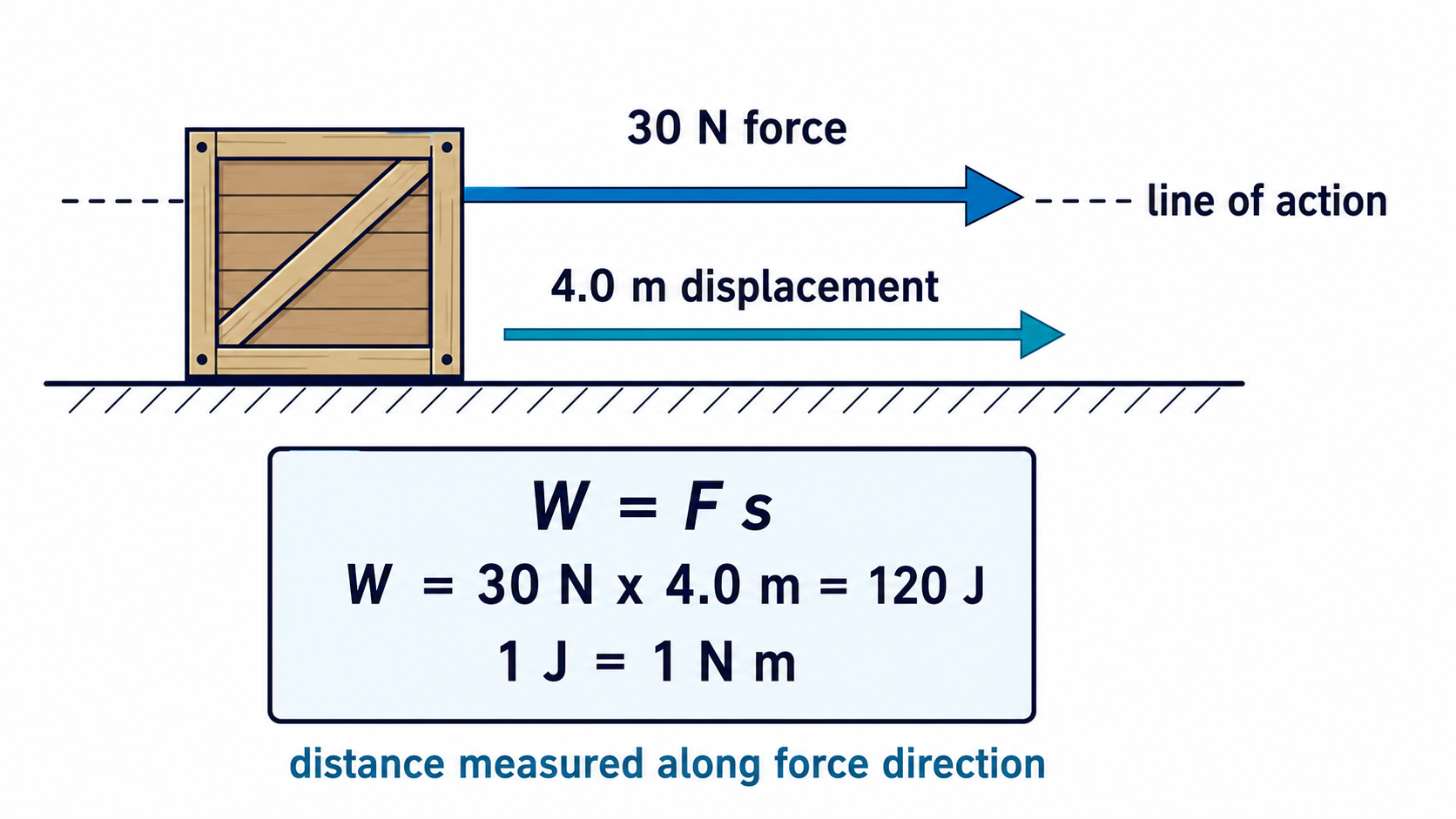
In the diagram, the force and displacement are both horizontal. The force has caused the crate to move 4.0 m along the force's line of action, so work is done on the crate.
Equation and units
The work done by a force on an object is calculated using:
Work done by a force
The quantities and units are:
| Quantity | Symbol | Unit |
|---|---|---|
| work done | joule, J | |
| force | newton, N | |
| distance moved along the line of action of the force | metre, m |
The AQA specification treats this as a recall-and-apply equation. For exams in 2026 and 2027, AQA provides it on the Physics Equations Sheet, so the important exam skill is to recognise when it applies and use it correctly.
Be careful with the symbol . In , means work done. The capital W used as a unit in power questions means watts. The context tells you which meaning is intended.
One joule of work is done when a force of one newton causes a displacement of one metre:
This is a unit equivalence. A value of is the same amount of work as .
Use with force in newtons and distance in metres; the answer can be written in joules, and is equal to .
Calculating work done
For a calculation, write the equation first, substitute the values, then give the answer with a unit.
Worked example: a student pulls a sledge with a horizontal force of . The sledge moves along the line of action of the force. Calculate the work done on the sledge.
The same answer could be written as , but joules are usually the clearest unit for work done.
You may also need to rearrange the equation. If , then:
Example: of work is done moving a box . The force is:
Energy transfer when work is done
Work done is not a new energy store. It is a measure of energy transferred by a force.
When a motor lifts a load, the motor exerts an upward force and the load moves upwards. Work is done on the load, so energy is transferred mechanically to the gravitational potential store of the load.
Continue this lesson.
You’re previewing NovaLearn without an account. Create a free account to read the rest.
Create free account