4.3.3.2 - Pressure in Gases
Gas pressure is a physics-only part of the particle model topic. You will explain pressure using particles colliding with surfaces, then use the relationship between pressure and volume for a fixed mass of gas at constant temperature. The equation is given on the Physics equation sheet, but you need to know when it applies and how to use it.
Gas pressure from particles
The particles in a gas move in constant random motion. When a gas particle hits the wall of its container, the particle changes direction. During the collision, the particle exerts a force on the wall.
Gas pressure
Gas pressure is caused by gas particles colliding with the walls of a container or with any surface in contact with the gas.
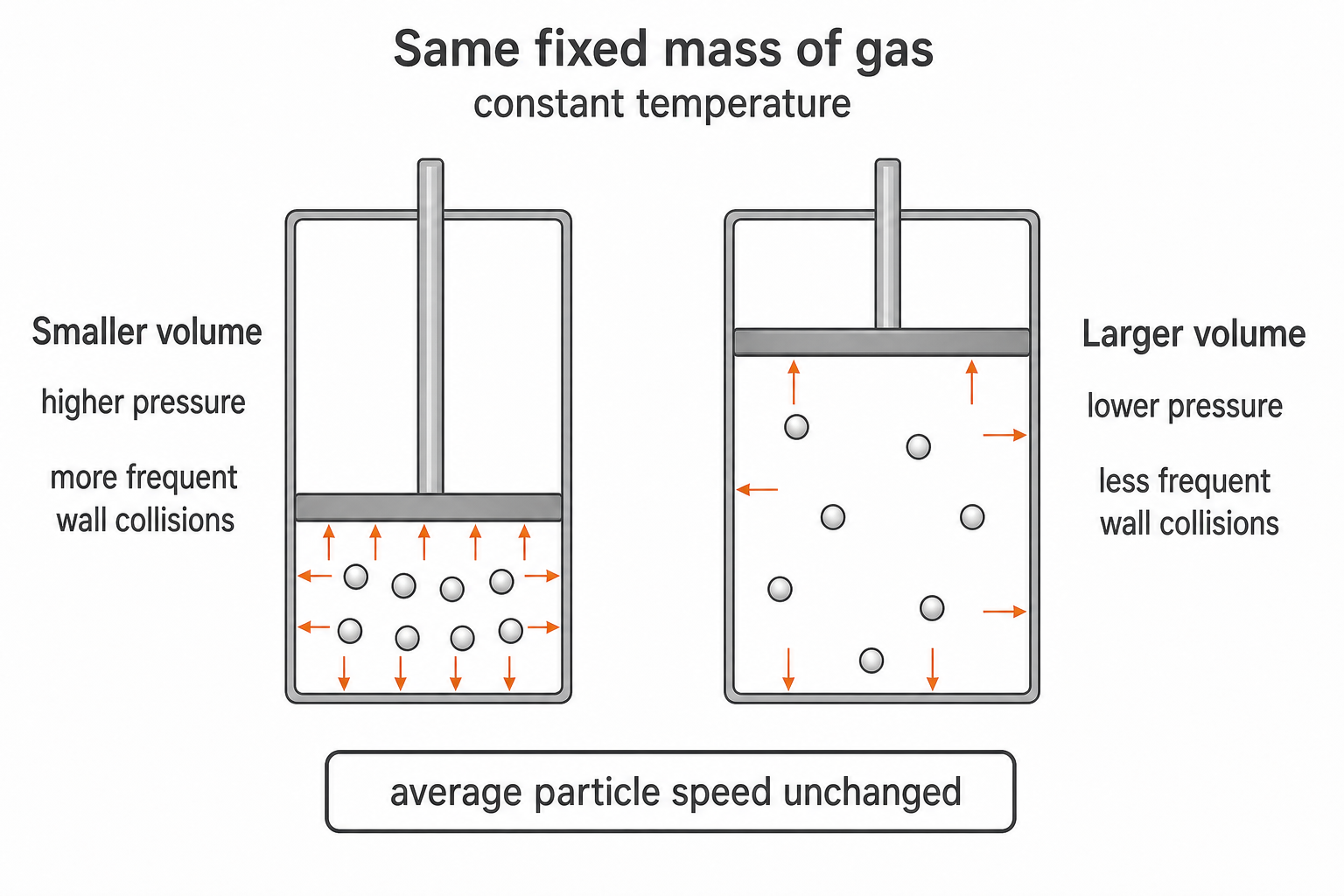
The force from each collision acts at right angles to the wall or surface. Lots of tiny collisions happen every second, so the total effect is a pressure on the wall. A greater rate of collisions with a given area of wall means a greater pressure.
A sealed container, a syringe, a tyre and a gas cylinder all rely on this same idea. The particles are too small to see, but their collisions with the inside surfaces produce measurable pressure.
[DIAGRAM: asset_name: gas-particles-and-pressure - diagram 1; asset_slug: 037_4_3_3_2_pressure_in_gases_diagram1; file: diagram_assets/037_4_3_3_2_pressure_in_gases_diagram1.png; recommended_method: image_gen; description: Two piston containers with the same fixed mass of gas at the same temperature. The smaller volume is labelled higher pressure and more frequent wall collisions; the larger volume is labelled lower pressure and less frequent wall collisions. Collision arrows hit the wall at right angles, and a note says the average particle speed is unchanged at constant temperature. Nearby prose gives the exact assessed particle-model relationship.]
Volume and pressure
A gas can be compressed when pressure changes push it into a smaller volume. A gas can expand if it is allowed to occupy a larger volume. In this lesson the important condition is that the temperature stays constant.
At constant temperature, the average kinetic energy of the particles stays the same. That means the particles have the same average speed before and after the volume change. The explanation is therefore about how often particles collide with the walls, not about particles becoming faster.
If the volume is increased for the same mass of gas:
- the same number of particles is spread through a larger space
- the mean distance between particles increases
- particles travel further, on average, between wall collisions
- collisions with a given area of wall happen less often
- the pressure decreases
If the volume is decreased, the reverse happens. Particles have less distance to travel between wall collisions, so collisions with the walls are more frequent and the pressure increases.
A strong explanation should mention both assumptions: the mass of gas is fixed and the temperature is constant. Without those assumptions, the pressure-volume relationship in this lesson may not apply.
Using pV equals constant
For a fixed mass of gas held at constant temperature, pressure and volume are inversely related. When one increases, the other decreases by the matching factor.
Pressure-volume relationship for a gas
This equation is given on the Physics equation sheet. You do not need to treat it as a recall equation, but you do need to recognise the conditions: fixed mass of gas and constant temperature.
The official units are:
Continue this lesson.
You’re previewing NovaLearn without an account. Create a free account to read the rest.
Create free account