4.7.2.4 - Loudspeakers
Loudspeakers and headphones turn an electrical signal into a sound wave. In AQA Physics this is a Physics-only, Higher Tier only example of the motor effect. The key idea is that variations in current cause variations in force, so a cone or diaphragm vibrates and makes pressure variations in the air.
What a Loudspeaker Converts
A loudspeaker is an output device. It takes variations in current in an electrical circuit and produces pressure variations in a sound wave.
Moving-coil loudspeaker
A moving-coil loudspeaker is a device in which a coil carrying a varying current moves in a magnetic field and makes a cone or diaphragm vibrate.
The phrase "pressure variations" means that nearby air is alternately compressed and spread out as the cone moves in and out. These compressions and rarefactions travel away from the loudspeaker as a sound wave.
This lesson does not introduce a new equation. It uses the motor effect from the previous magnetism section: when a current-carrying conductor is placed in a magnetic field, the conductor experiences a force.
Parts of a Moving-coil Loudspeaker
A GCSE moving-coil loudspeaker can be understood using four main parts:
- a permanent magnet, which provides a magnetic field
- a coil of wire, often called the moving coil or voice coil
- a cone or diaphragm attached to the coil
- an electrical signal that provides a varying current in the coil
[DIAGRAM: asset_name: moving_coil_loudspeaker_cross_section - diagram 1; asset_slug: 107_4_7_2_4_loudspeakers_diagram1; file: diagram_assets/107_4_7_2_4_loudspeakers_diagram1.png; recommended_method: image_gen; description: Exact assessed cross-section of a moving-coil loudspeaker showing a permanent magnet, magnetic gap, coil in the gap, cone/diaphragm attached to the coil, signal-current leads, magnetic field across the gap and force/motion arrows in and out. Deterministic drawing is required because the coil, magnet, force direction, cone attachment and labels carry assessed meaning.]
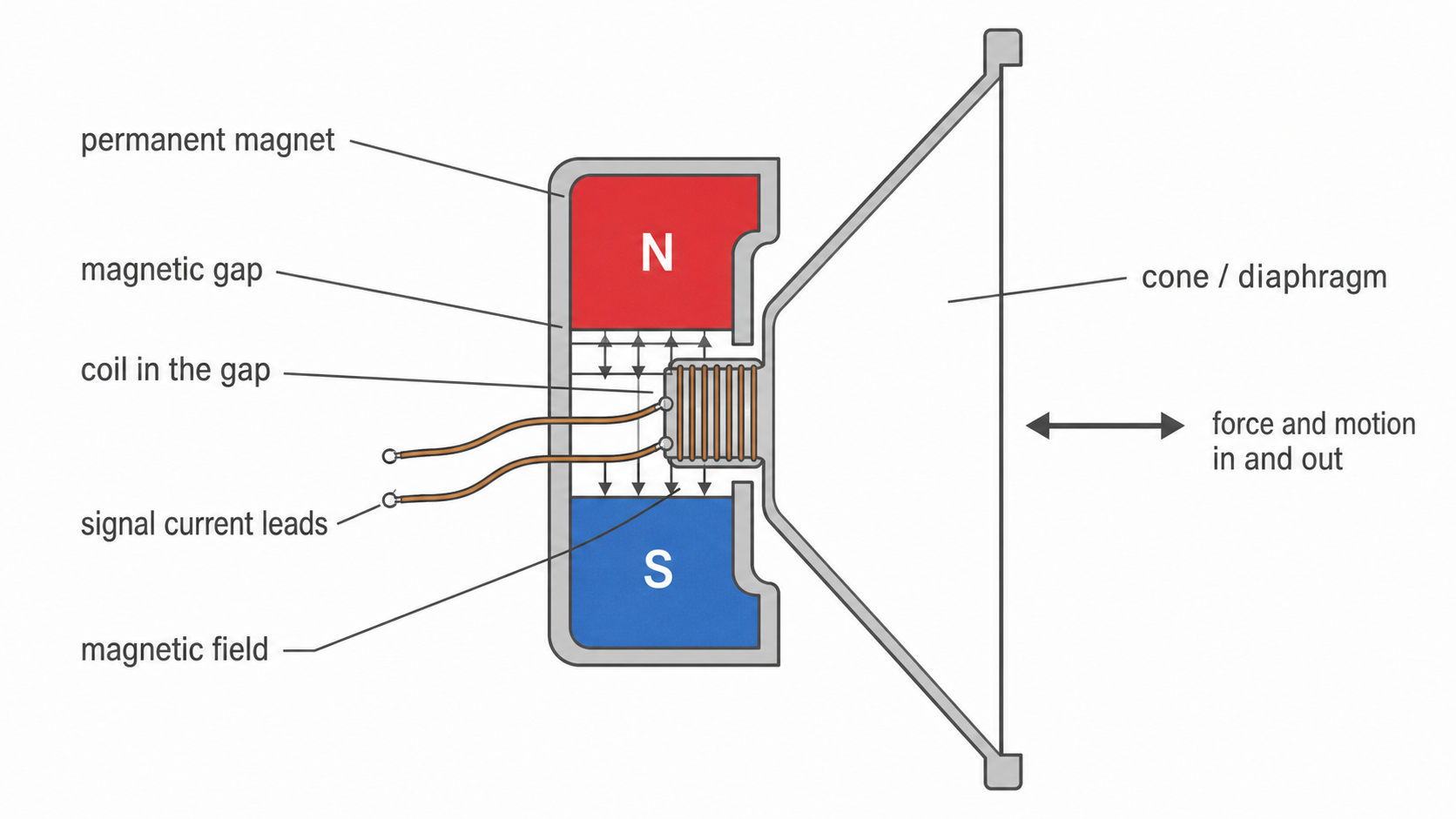
The coil is placed in the magnetic field of the permanent magnet. The cone is attached to the coil, so if the coil moves, the cone moves with it. The cone has a larger area than the coil, so it can push and pull enough air to produce a sound wave.
The exact engineering shape of a real speaker can vary, but AQA questions usually care about the same chain of physics: coil, magnet, force, movement, vibration, pressure variations.
The Motor-effect Sequence
When current flows in the coil, it creates a magnetic field around the coil. This magnetic field interacts with the field from the permanent magnet. The interaction produces a resultant force on the coil.
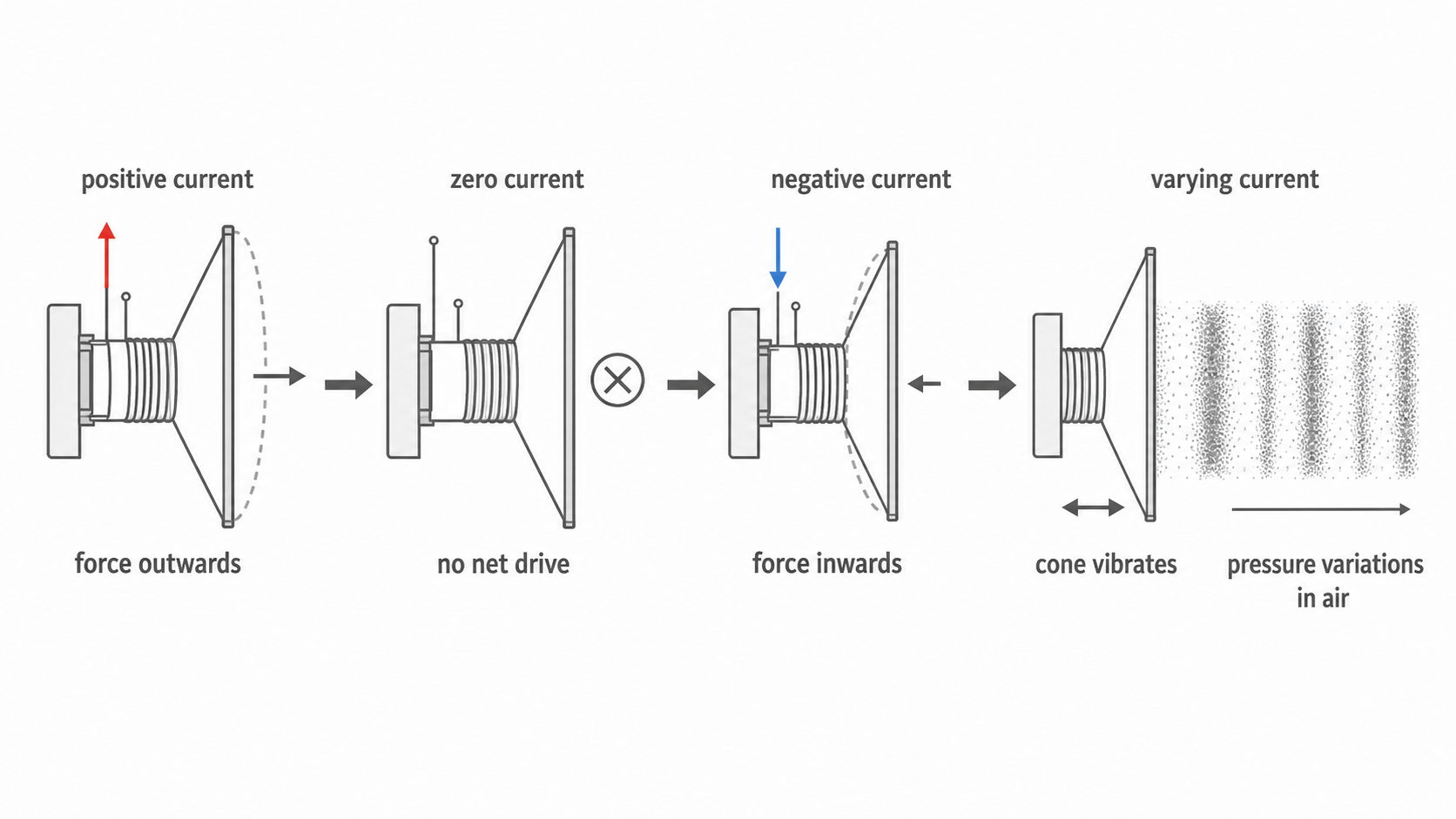
Because the cone is attached to the coil, the force moves the coil and cone together. If the current gets larger, the magnetic effect of the coil is stronger, so the force is larger. If the current reverses direction, the magnetic field around the coil reverses, so the force on the coil reverses.
In a sound signal, the current is varying all the time. The force on the coil therefore varies all the time. This makes the coil and cone move backwards and forwards: they vibrate.
[DIAGRAM: asset_name: current_force_vibration_chain - diagram 2; asset_slug: 107_4_7_2_4_loudspeakers_diagram2; file: diagram_assets/107_4_7_2_4_loudspeakers_diagram2.png; recommended_method: image_gen; description: Exact assessed sequence diagram linking positive current to force outwards, zero current to no net drive, negative current to force inwards, and repeated current variation to cone vibration and pressure variations in air. Deterministic drawing is required because the reversal of current, reversal of force and resulting vibration are the central assessed mechanism.]
Continue this lesson.
You’re previewing NovaLearn without an account. Create a free account to read the rest.
Create free account