4.4.3.2 - Half-Lives and Isotope Hazards
Radioactive isotopes do not all stay radioactive for similar lengths of time. Some have half-lives measured in seconds or hours, while others have half-lives measured in years, millions of years, or billions of years. In this physics-only lesson, you will use half-life data, often written in standard form, to explain why different radioactive materials can create different hazards.
Half-life as a hazard clue
Half-life tells you how quickly the nuclei in a radioactive isotope decay. As a reminder, one half-life is the time taken for the number of undecayed nuclei, or the count rate/activity from a sample, to fall to half its initial value.
For this lesson, the key question is not just "what is the half-life?" It is "what does that half-life imply about the hazard from the radioactive material?"
Half-life affects hazard because decay is when ionising radiation is emitted. If many decays happen each second, the activity is high and the material can give a larger radiation dose in a short time. If the material remains radioactive for a very long time, it may continue to be a hazard long after it was first made, used or released.
Half-life is only one factor. The hazard also depends on the amount of material, the type of radiation emitted, whether the material is inside or outside the body, distance, shielding and exposure time. In this lesson, focus on explaining the half-life part of the hazard clearly.
A wide range of half-life values
Radioactive isotopes have a very wide range of half-life values. Standard form is useful because it lets you write very large or very small numbers compactly.
Standard Form
A number in standard form is written as a x 10^n, where a is at least 1 and less than 10, and n is an integer.
For example:
24 000 s = 2.4 x 10^4 s
950 000 000 s = 9.5 x 10^8 s
140 000 000 000 000 000 s = 1.4 x 10^17 s
The power of ten is the quickest way to compare the scale of two half-lives. A half-life of 1.0 x 10^8 s is about 10 000 times longer than a half-life of 1.0 x 10^4 s, because 10^8 / 10^4 = 10^4.
[DIAGRAM: asset_name: Half-Life Range in Standard Form - diagram 1; asset_slug: 049_4_4_3_2_half_lives_and_isotope_hazards_diagram1; file: diagram_assets/049_4_4_3_2_half_lives_and_isotope_hazards_diagram1.png; recommended_method: deterministic_drawn; description: Exact log-scale point chart showing example isotope half-lives in seconds: technetium-99m at about 2.2 x 10^4 s, iodine-131 at about 7.0 x 10^5 s, cobalt-60 at about 1.7 x 10^8 s, caesium-137 at about 9.5 x 10^8 s, americium-241 at about 1.4 x 10^10 s, and uranium-238 at about 1.4 x 10^17 s. It teaches that half-lives span many powers of ten and supports standard-form comparison. The isotope examples are not recall facts; deterministic drawing is used because exact values, labels and log-scale positions matter.]
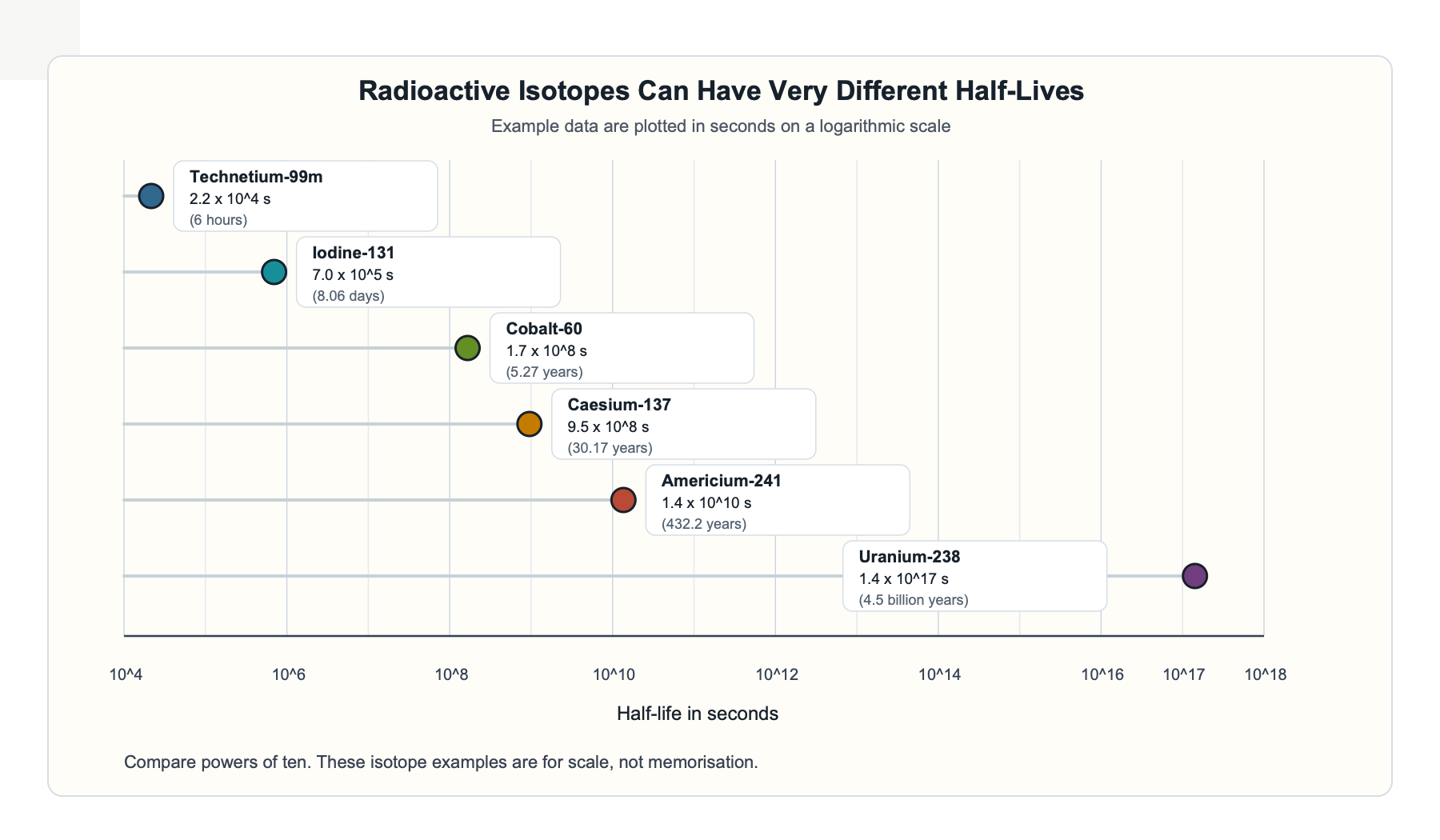
You do not need to memorise isotope names or exact half-life values. In an exam question, the data would be given. Your job is to use the data to compare hazards and timescales.
Short half-life hazards
For two samples with the same number of undecayed nuclei and the same type of radiation, the sample with the shorter half-life has the higher initial activity. This is because the same fraction of nuclei decays in a shorter time, so more decays happen each second.
That can make a short-half-life material hazardous while it is active. It may produce a large dose rate at first, so the time spent near it should be kept as short as possible and handling may need remote tools, shielding, or distance.
The other side of a short half-life is that the activity falls quickly. After enough time has passed, much less radioactive material remains. This is why some short-lived radioactive waste can be stored temporarily until its activity has fallen close to background level before it is handled or disposed of.
A very short half-life therefore tends to mean:
Continue this lesson.
You’re previewing NovaLearn without an account. Create a free account to read the rest.
Create free account