4.4.4.1 - Nuclear Fission
Nuclear fission is a physics-only part of AQA GCSE Physics. It explains how a large unstable nucleus can split, why this releases energy, and how the released neutrons can lead to a chain reaction. The key exam skill is to describe or interpret the sequence in a fission diagram without adding reactor details that are not needed.
What fission is
Nuclear fission is the splitting of a large and unstable nucleus. The specification gives uranium and plutonium as examples of large unstable nuclei that can undergo fission.
Nuclear fission
Nuclear fission is the splitting of a large and unstable nucleus into smaller nuclei.
This is a change in the nucleus, not a chemical reaction between atoms. A chemical reaction rearranges electrons and bonds; nuclear fission changes the nucleus itself.
Spontaneous fission is rare. Usually, for fission to occur, the unstable nucleus must first absorb a neutron. That incoming neutron makes the already unstable nucleus even less stable, so it splits.
large unstable nucleus + absorbed neutron -> fission
A single fission event
In neutron-induced fission, the nucleus first absorbs a neutron. The nucleus then splits into two smaller nuclei that are roughly equal in size. It also emits two or three neutrons and gamma rays.
[DIAGRAM: asset_name: neutron-induced-fission-event - diagram 1; asset_slug: 051_4_4_4_1_nuclear_fission_diagram1; file: diagram_assets/051_4_4_4_1_nuclear_fission_diagram1.png; recommended_method: image_gen; description: Assessed sequence diagram of neutron-induced fission. It shows an incoming neutron being absorbed by a large unstable uranium/plutonium nucleus, the nucleus splitting into two smaller nuclei roughly equal in size, and two or three neutrons plus gamma rays being emitted. Arrows show the fission products moving apart with kinetic energy, and a label states that energy is released. Built-in Codex Image Gen raster diagram selected for a clean GCSE classroom visual.]
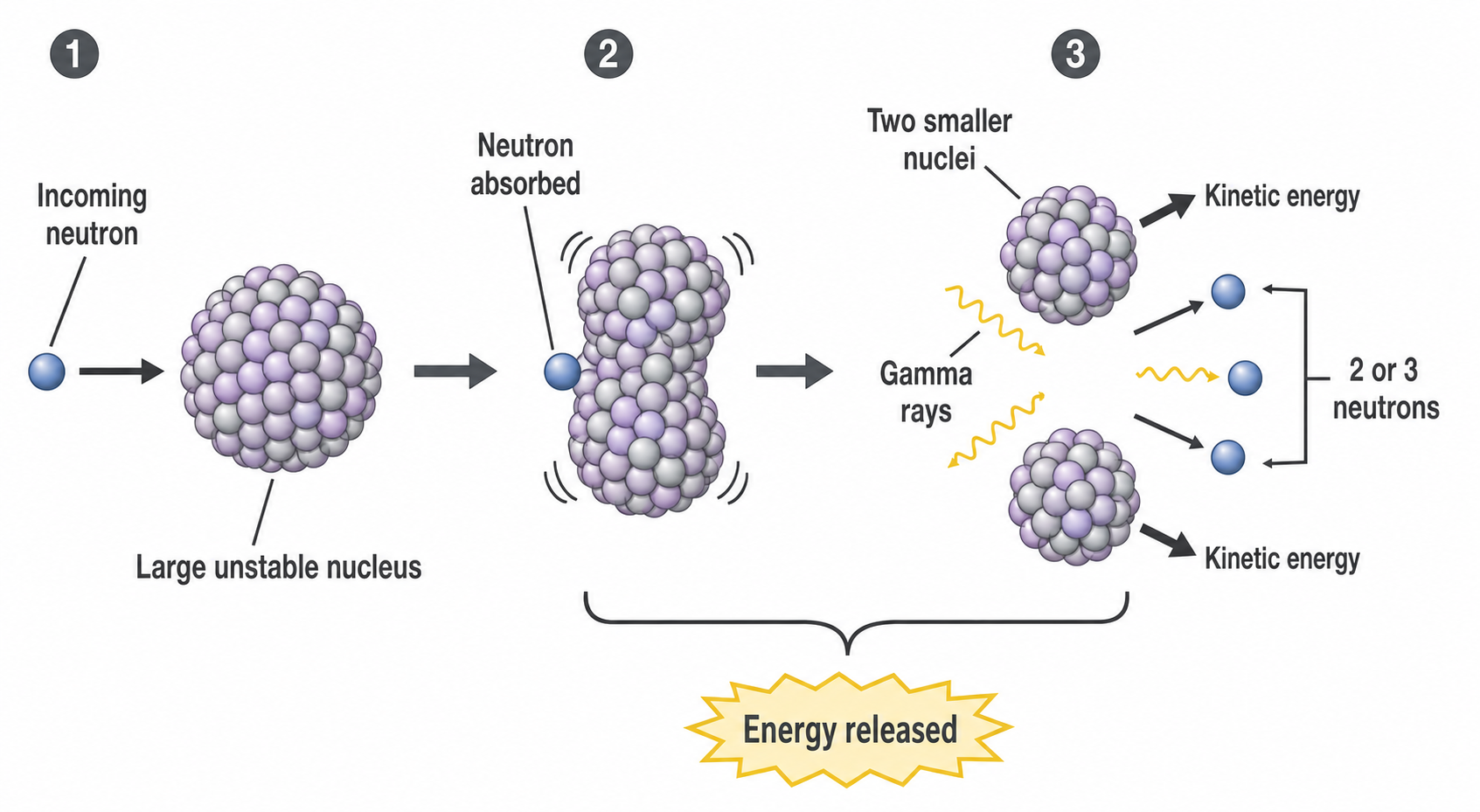
The products of fission move away at high speed, so the products have kinetic energy. Energy is also carried away by the gamma rays. In a reactor fuel, the kinetic energy of moving fission products is transferred to the surroundings as thermal energy when the products collide with nearby particles.
Do not describe fission as the nucleus "burning" or "exploding" at this stage. The precise GCSE description is that the nucleus splits and releases energy.
Chain reactions
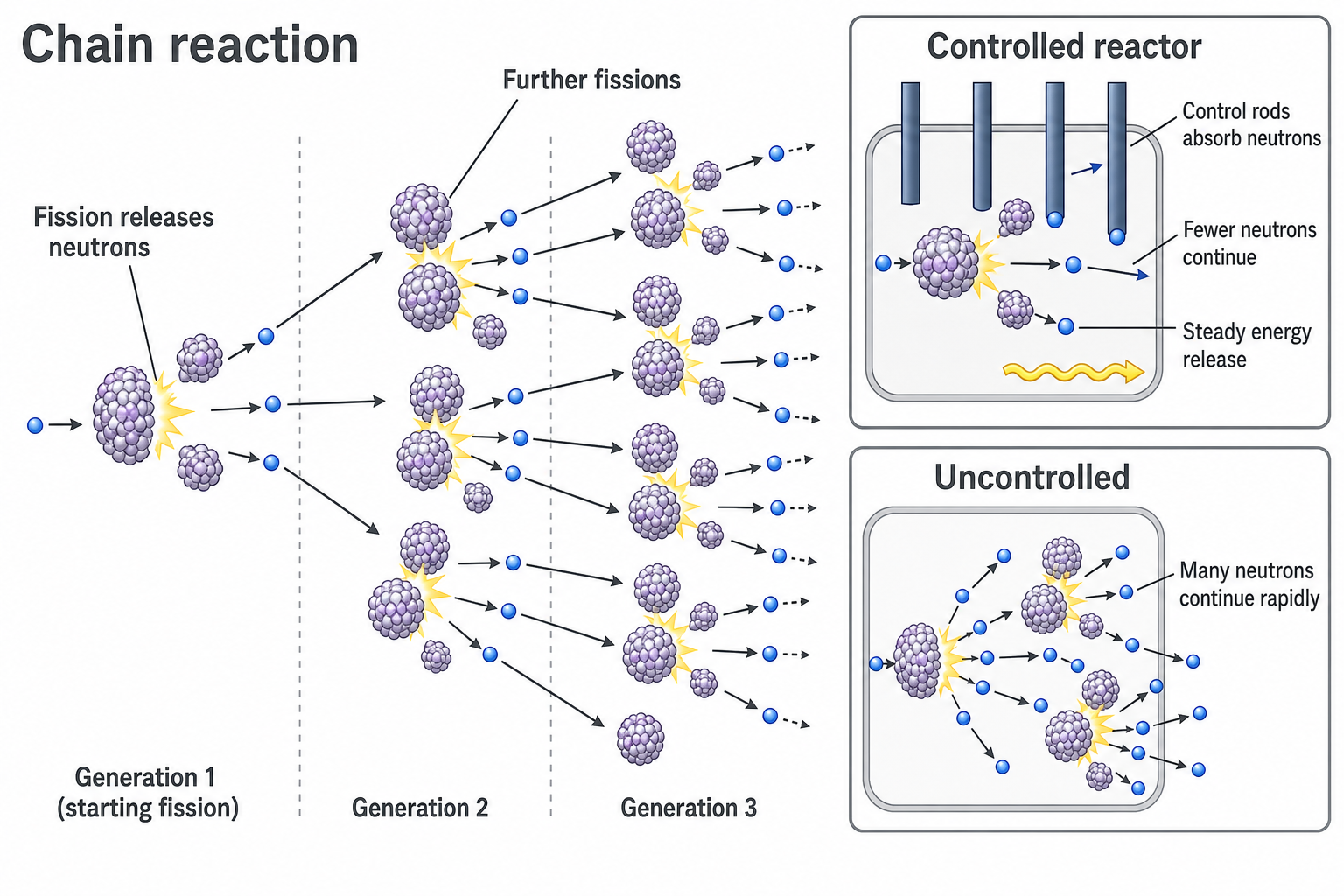
The neutrons emitted by one fission event may go on to start more fission events. If an emitted neutron is absorbed by another large unstable nucleus, that nucleus may also split and release more neutrons. Those neutrons may then cause further fissions.
This repeated process is called a chain reaction. The word "chain" is useful because each fission can lead to the next fission.
[DIAGRAM: asset_name: fission-chain-reaction-and-control - diagram 2; asset_slug: 051_4_4_4_1_nuclear_fission_diagram2; file: diagram_assets/051_4_4_4_1_nuclear_fission_diagram2.png; recommended_method: image_gen; description: Assessed schematic of a fission chain reaction and reactor control. The main panel shows one fission releasing neutrons that may cause further fissions over several generations. A controlled-reactor inset shows control rods absorbing some neutrons so fewer continue the chain reaction and the energy release is steady. An uncontrolled inset shows many neutrons continuing the chain reaction rapidly. Built-in Codex Image Gen raster diagram selected for a clean GCSE classroom visual.]
Continue this lesson.
You’re previewing NovaLearn without an account. Create a free account to read the rest.
Create free account